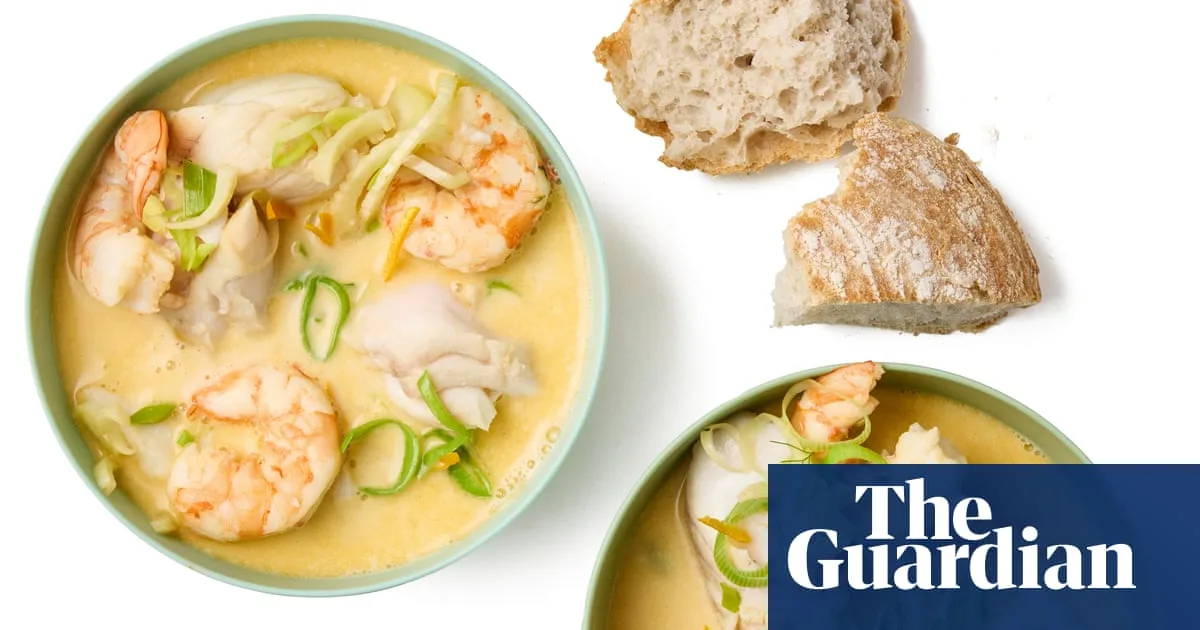
Fish stew in the south of France doesn’t have to mean a complicated bouillabaisse: bourride is a simpler and equally perfect match for a summer’s evening. Much as I love bouillabaisse, I’ve never come across rascasse, the spiny Mediterranean rockfish that’s the backbone of Marseille’s signature dish, outside its homeland. Bourride, another southern French fish stew, is a simpler affair that’s much easier to recreate here. Enriched with garlicky aïoli, it’s a lovely thing for a summer’s evening, and can be prepared ahead up to the end of step 7.
For the aïoli, you will need: 1 garlic clove, 1 pinch coarse salt, 1 egg yolk, 75ml light olive oil or neutral oil, 30ml extra-virgin olive oil, 1 tsp lemon juice, and salt and white pepper to taste. For the stew: 6 sustainably sourced raw shell-on prawns (optional), 2 small leeks, 1 fennel bulb, 2 tbsp oil, 3 garlic cloves peeled and sliced, 1 long strip orange peel cut into slivers, ½ tsp fennel seeds, 1 pinch saffron threads, salt and pepper, 75ml dry white wine, 500ml fish stock (or use fish and shellfish carcasses to make your own), 400g sustainably sourced firm-fleshed white fish (e.g., hake, gurnard, monkfish, pollock) cut into bite-size pieces, and bread, croutons, or boiled new potatoes to serve.
Bourride can be made with any fish firm enough to keep its shape. A combination of hake and gurnard works well, but cod, mullet, haddock, monkfish, or bream are also suitable. Ask to keep the carcasses if your fishmonger is filleting the fish. Though some purists claim shellfish is never used, some recipes include squid, prawns, or mussels. Shell-on prawns are easier to come by and can enrich a ready-made stock; feel free to leave them out if preferred.
Shell the prawns if using, keeping the shells. Roughly chop one leek and half the fennel, then soften them in oil in a large saucepan. Stir in the garlic, most of the orange peel, fennel seeds, and saffron, season generously, and fry for two minutes. Stir in the prawn shells if using, turn up the heat, and sauté until vivid pink. Add the wine and, once almost evaporated, pour in the stock (or add fish carcasses and cover with cold water). Bring to a simmer, then leave to bubble gently for 20 minutes (30 minutes if making stock from scratch). Strain into a large jug – you should have about 400ml broth – and top up with water if needed. Discard the carcasses and aromatics.
To make the aïoli, crush the garlic with the salt. Beat this mixture into the egg yolk, then very gradually whisk in the oils a little at a time until thick and emulsified. Add lemon juice and season to taste. Alternatively, use a hand blender: put the crushed garlic, salt, egg yolk, lemon juice, and a tablespoon of cold water in a cylindrical container. Pour 75ml oil on top, let settle, then whizz on high speed until a thick emulsion forms. Slowly tilt the container to incorporate the rest of the oil. Whisk in the extra-virgin olive oil by hand and season.
Return the strained broth to the pan and bring to a simmer. Cook each variety of fish and seafood separately by dropping it into the hot broth, then cover the pan, turn down the heat, and leave until just cooked. Transfer to a plate and repeat with the rest. Once all fish is cooked, divide it between warmed serving bowls. Finely slice the remaining leek and fennel, poach them in the broth, then add to the bowls. Take the broth off the heat. Put three tablespoons of aïoli in a heatproof bowl, gradually whisk in a ladleful of warm broth to loosen, then slowly whisk this mixture back into the remaining broth. Pour the broth over the fish and serve with bread, croutons, or boiled new potatoes.