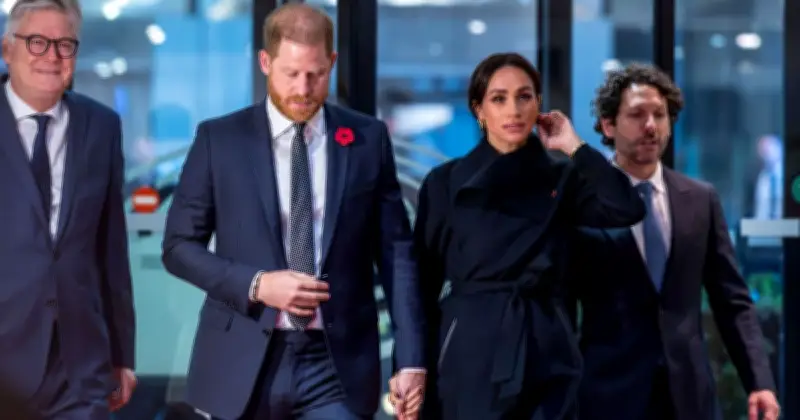
Meghan Markle has made her first public appearance since her father, Thomas Markle Snr., was charged with possession of purported child sex abuse material. The Duchess of Sussex joined Prince Harry in Brussels on Tuesday, where he delivered a speech calling for greater protection for children online.
Harry took to the stage at the European Parliament to deliver a solo keynote address after Meghan pulled out of speaking alongside him because she was not “strong enough emotionally”. It was the first time Meghan had been seen in public since allegations surrounding Thomas Markle Sr surfaced last month. He appeared in court on Friday charged with possession of reputed child sexual abuse material.
Body Language Signals Analysed
The couple's appearance marked the opening of the Lost Screen Memorial, which has moved to Europe after being launched in New York City last year. A body language expert has analysed the moment the Sussexes arrived at the opening at the European Parliament on Tuesday.
Judi James said the Duchess appeared less confident and more withdrawn than she has during previous public engagements. She said: "Meghan's body language signals here appear set to project a message of some fragility and vulnerability. There are two key 'tells' to this messaging here: firstly as she walks into the area when, instead of greeting the press and her hosts with the usual arrival smile of delight, energy and confidence while quietly taking the lead, there is a trait of smile suppression from the way her lips part slightly but with a tightening of her top lip and then that non-verbal cue of a sense of wariness as she raises her hand to touch her hair in a partial barrier ritual."
She added: "The second tell comes from the same left hand, which she then stuffs into her pocket. When Meghan frequently places one hand into a pocket it is usually a gesture that is performed to show off her outfit at its fullest or to signal relaxed confidence but here there is an intrinsic difference. Her whole hand is stuffed into that pocket, where normally the thumb would remain outside. This lets us know it is a gesture linked more to a desire to protect or hide than a desire to fashion-flaunt."
Harry Leading and Protecting
James also noted: "Her eye expression suggests some sadness here. Her eyes normally sparkle when she's in public, but that amused and excited look has vanished here and some of the photos suggest a more reflective state." She added: "Her sombre outfit also suggests no desire to showboat confidently. The black coat is pulled in hard at the waist with a tight double knot and her collar is turned up and folded over in what would appear to form another barrier ritual."
James said: "Harry is leading and protecting his wife here, walking with chest puffed and his left arm in front of hers so that her right arm is virtually hidden behind him. Her fingers curl up in the clasp while his appear to bend at the upper joint so that his fingertips are pressed into her hand. As Meghan looks fragile his signals suggest wariness. He looks down as they arrive and at one point he lifts his right hand to stroke his beard in what is often a self-soothe gesture."
Support for Parents
The Duchess held Harry’s hand tightly during her arrival at the Paul-Henri Spaak building, and ignored shouts from the media. She sat in the front row, listened intently during her husband’s speech, and afterwards placed her hand on Harry’s arm. Meghan also hugged and comforted Sandra Spitaels, a Belgian mother whose 15-year-old son Glenn died by suicide in 2017 after a nude image of him was posted online. Ms Spitaels broke down in tears while delivering a speech about Glenn’s experience.
Harry told those in attendance that he was there as a “father” and Meghan “as a mother” to support parents who had lost children to online harm. He said: "I’m not here as an expert or a politician. I’m here as a father. My wife, as a mother." He added: "All children should be able to go online and discover something wonderful. A friend. An interest that becomes a passion. A place where they feel understood. They deserve to feel safe wherever they are. In a classroom. On a playground. At any time, no matter where they are."
He urged social media companies to do more to help protect children. “Don’t put anything in front of our children that you wouldn’t put in front of your own children," Harry said. He also said: "For many parents, even though their child killed themselves, they’ve had to wait years – in some instances, eight years – to get access to their child’s phone […] Because of the company’s privacy policies, the parents were blocked from finding out how their child died. That cannot be right."