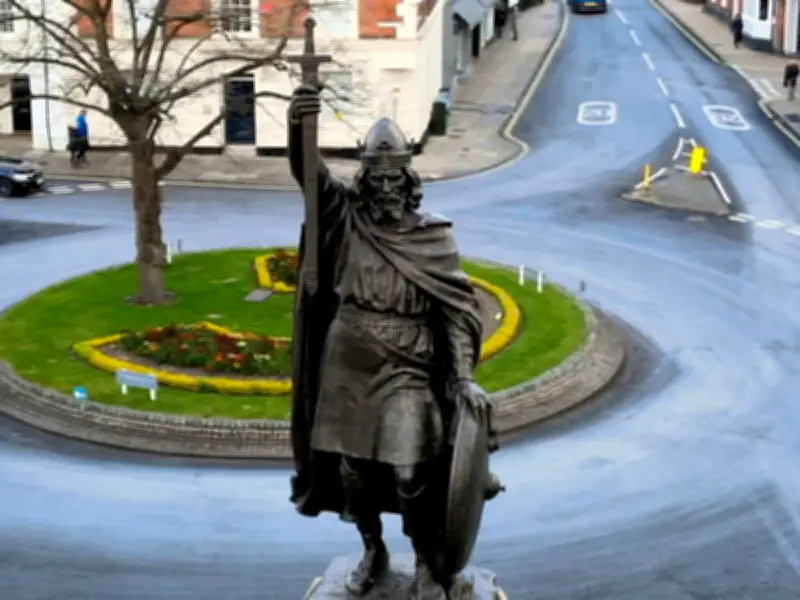
King Alfred the Great, the only English monarch to bear the moniker, may have been found buried under a car park, according to author and historical researcher Graham Phillips. The discovery, which Phillips claims follows a 13-year investigation, is set to be revealed in a new episode of the British TV series Weird Britain on Blaze TV this Wednesday, July 8 at 9pm.
Location of the Remains
Phillips asserts that the remains lie 20 yards from a slab marking Alfred's original burial site. He remarked, "Bizarrely, like Richard III, the bones are under a car park." The researcher's claims echo the 2012 discovery of Richard III's skeleton under a Leicester car park.
Historical Background of Alfred's Burial
Alfred the Great, who united Anglo-Saxons against Viking invasions and is considered a founder of England, died in 899. His remains were moved multiple times: initially buried in Winchester Cathedral, then in 1110 transferred to Winchester's Hyde Abbey, where they were interred before the high altar alongside his wife and son. The abbey was demolished after the dissolution of the monasteries in 1539, leaving the site in ruins.
In 1866, during workhouse construction, antiquarian John Mellor excavated and believed he found Alfred's bones, reburying them at St. Bartholomew's Church. However, carbon dating in 2013 revealed those bones dated from over 200 years after Alfred's death, prompting Phillips's search.
Phillips's Investigation
Phillips said, "Whoever's bones they were, they weren't Alfred's. So, I decided to discover what happened to them. The quest has taken me 13 years." He believed the bones perished during the 1860s workhouse construction, but Winchester City Council had turned the Hyde Abbey site into a garden with stone slabs marking the graves. Phillips found evidence the bones were moved decades earlier.
He explained, "I discovered that in 1788 a prison was built next to the area, and the site where graves were was turned into a garden for the warden's house. I'm convinced the original bones were moved at that time." In the late 1700s, historian Henry Howard visited warden Richard Page to obtain plans of the ruins. Phillips, searching for a copy at Cambridge University archives, found Howard's 1800 article in Archaeologia referencing prisoners unearthing bones during landscaping, including a map of reburial locations.
Impact and Next Steps
The claim has sparked interest, though no official archaeological verification has been announced. Phillips's findings will be detailed in the upcoming TV episode, potentially reigniting the search for Alfred's final resting place.