Frank Sinatra, palming a can of Sprite in one hand and the fist of his beautiful red-headed wife in the other, sat in a dark corner across from Jeff Bezos, who looked like he was waiting for him to say something. But Sinatra said nothing. He'd been mostly quiet all evening, and now in this cabaret he seemed even more distant, staring out past fog and strobe and Bezos's strong bald head and into the large room where at least half a dozen men had basically shattered a bistro table trying to get a better look at Marilyn Monroe. Sinatra's wife knew, as did Roy Orbison and Austin Powers, who stood nearby, that it was only minutes before he was supposed to go onstage, and that forcing any sort of conversation on him in this mood of focus would be extremely stupid.
The fact was, Sinatra had already been waiting for more than an hour for his moment at the mic, and at this point would have been more than fine with just heading back to his cabin. He was tired of the constant low-grade pitch in gravity under his feet. He was still annoyed that he'd nearly lost his luggage on the first day here, a fact his wife was not letting him forget; was humiliated that he never really got his onboard wifi – wifi he paid for – to work all week; had been viciously massaging his kidneys throughout the past four songs; and now, at this strangulating moment, had to sit through the noises being made by the group of military veterans Monroe had just asked to join her in a conga. Sinatra, wincing, was the victim of a condition so common around here that most people accepted it as a given. But when it got to him, shot through his personal plumbing, we were looking at a man in crisis. The fact was – and he's going to kill me for saying this – Frank Sinatra was seasick.
Boarding the MSC Seashore
Three nights and about eight hours earlier, select members of the Sunburst Convention of Celebrity Impersonators boarded a 169,000-tonne cruise ship in civilian disguise. They crossed the gangplank by sandalled foot and standard wheelchair, in panama hats and Bermuda shorts, naked of the costumes, pancake makeup and in some cases false breasts required to faithfully look like their lookalikes. Alongside an estimated 4,000 other, non-impersonating passengers slated to set sail with them, these 20 professional plagiarists, under cover of normie human camouflage, slipped silently into the crush.
“LORD I HAVE NEVER SEEN THIS MUCH COCONUT RUM IN MY LIFE,” yelled a man on his phone, jabbing his free hand into his free ear. “MAN IT IS COMPLETELY SUNNY – I SAID SUNNY – YOU KNOW WHAT, I'M GETTING A CALL FROM DONNA – DONNA – YEAH LOOK I'M NOT TRYING TO HAVE HER TRY AND TEAR MY ASS IN HALF AGAIN SO I'M GONNA HAVE HER CALL YOU.”
Welcome to the open-air bar on the 18th floor of the MSC Seashore, a luxury mega ship with the fuel economy of an oil tanker and the handling of a Marriott. That was the man seated to my left, silenced by the drink handed to him by a bartender. To my right was a woman in a shirt that read: “I DON'T GIVE A SHIP”, and behind us, beyond the bar – which led out on to the pool deck, the pool deck's smoking section and two Jacuzzis – was the Atlantic Ocean, foamy and real under the sun above Port Canaveral, Florida.
I was seated smack in the centre of the ship's “embarkation party”, the Seashore's farewell-to-land fiesta. In these last few hours of boarding, standard cruisegoers (reuniting families, couples, singles, swingers) were already loudly settling in for the top-hole amenities, pampering and bacchanalia that the Seashore's four-day boomerang voyage to the Bahamas had promised. They more or less knew what they were in for. What they didn't know was that the impersonators of Sunburst walked among them, incognito, settling in for the same.
The Sunburst Convention
The occasion of Sunburst's presence on the cruise was this: time had been having its remorseless way with our lookalikes. For four days a year for the past two decades, the Sunburst Convention of Celebrity Impersonators, a three-to-five-dozen-strong troupe of doppelgangers, tribute artists and hobbyist dead ringers, had assembled in hotels and conference centres across greater Orlando. In its heyday, Sunburst's annual congress served as the tribute industry's largest American sanctuary. But the average age for a Sunburster now hovered around 55. The typical status of the celebrities they impersonated was “deceased”.
The digital era had swallowed demand for in-person homages to golden-age Hollywood and AI was a wallop to its people en masse. Folks were retiring from the trade, ageing out of plausible fidelity to their chosen doubles, or, from entirely natural causes, disappearing for good. (One of Sunburst's most redoubtable talent agents had in fact died just a few weeks before the cruise.) This made the cruise purely leisurely, a hopefully happy sunset for Sunburst's long reign.
So here I was. Shipping out. Desperately seeking someone from Sunburst. In the long mirror above the bar, every woman in the pool, drifting in and out of frame on her inflatables, now had the air of a once-fabulous mid-century minx. Elvises of every era groped for their towels. Here walked a plausible Oprah. In came an ayatollah. And there, lanky in her tankini: a Cher.
A man was flailing his arms by the bathrooms 15 yards away. This was Greg, Sunburst's founder and figurehead. The phrase: “ENTERTAINMENT JUST LIKE YOU REMEMBER” blazed on his T-shirt. Also he was shouting my name. “We're here in the back!” he yelled. “Where?” the guy on my left shouted. “The BACK BACK!” Greg yelled again.
Gathering of the Doppelgangers
The back back turned out to be a lounge space 10 floors down. Rodney Dangerfield, walking in with a rum and Coke, was the first to slap Greg on the shoulder. “Damn. Wow. Smells like someone's grilling a raccoon in here,” Dangerfield said, looking around. “You guys just get in?”
An aerial view of the piano hall in the aft of Deck 8 – aft being the rear half of the ship, and Deck 8 being the eighth of 20 floors – would have revealed concentric circles of men and women sucked into orbit around an arrangement of microsuede sofas. In the centre was now Greg, struggling with a pair of armpitted clipboards. On the far outer ring was the adjacent cantina, sizzling with orders of the Fajita'n'Rita Feast ($20.95). But the energy in the room emanated from the fusion of Hollywood lovelies, B- and C-listers, dead musicians and a few completely imaginary characters.
In came the tiny and fabulous Sharon Osbourne, fresh off a flight from London. Near the exit, with his blue eyes and sensible sandals, was Boy George, who swanned over to double-cheek kiss Sharon, then peck the forehead of Martha Stewart and – skipping over Jeff Bezos – the tip of Fran Drescher's nose. Sinatra (A), by the banquette, had just politely pumped the hand of Sinatra (B), when both were intercepted by Dangerfield, who seemed interested in explaining the dimensions of his cabin's toilet. The Dude from The Big Lebowski was tearing a tortilla into pieces; over by the baby grand was Jerry Garcia; Bezos left to go to the bathroom; and Greg, who was beaming richly over his dominion, looked like he might cry with pleasure when someone's wife started talking about closing on a new condo in Mexico.
Every impersonator made for a convincing person. But as the gathering of celebrity doubles milled about the room, it was growing obvious just how broad the spectrum of fidelity within impersonation could get. Some were just blessed with a genuinely miraculous assembly of genetic glitches. Dangerfield, for instance, with big red eyes hot enough to boil water, and now miming his golf swing for Greg, was an amazing, near-perfect dupe, clearly put on this planet as proof of a lazy and hilarious God. (Ditto Boy George, with his stubble, his exemplary androgynous smoulder – and same for Walter White of Breaking Bad, who kept pulling out a small bag of laundry beads from his shirt pocket as his prop ounce of crystal meth.)
But the lion's share of them weren't so finely biologically determined. The majority looked more like second or third cousins to their doubles. Staring at them yielded a whole other feeling, stranger than the vague awe you might harbour for folks obviously cashing in on their Darwinian dues. The faces of the not-quite-theres held a secret, focused serenity – kin to the quality inborn in the showman, dramatised by the spy, not far from the one on your casual adulterer. It was the flickering, only occasionally visible pact between at least two selves.
A yell came from the hallway. Then a crash, a cackling, the sound of a man asking directions to the lounge. Sharon rose from her seat like a woman possessed. As someone boomed an approximation of the opening power chords of Crazy Train, in came Ozzy. With both arms outstretched, and followed closely by his wife, the late Osbourne made his entrance with the dignity of a large and holy animal. He wore boat shoes, cargo shorts down to the shin. But as we saw him now in the modest lounge – his grey mane rippling, his mumblings blubbery, his prescription readers dazzling a joist of sunlight – it felt unthinkable that the Prince of Darkness could, or in fact did, actually just die. “My London Sharon,” he whispered in his low, smacked-out cant. “My lovely London Sharon.”
The Art of Impersonation
The ways celebrity impersonators define themselves can be pretty slippery. Sinatra (B) insistently calls himself a “tribute artist” rather than “lookalike” or “impersonator”. His performances as “Sinatra” (scare quotes his) are strictly “reinterpretations” of “the better bits” of the discography, as opposed to a straightforward reincarnation of the man and his oeuvre. Boy George – and this is despite his uncanny resemblance to and actual friendship with the legitimate Boy George – keeps a similar distance from the word “impersonator”. “He isn't the real Boy George, and he wants his audience to know that,” Sinatra (B) said, slipping the bartender a twenty. “That's why his act's called the Boy George Experience.”
In a separate category are your perfect impersonators. A “lookalike” (often used interchangeably with “impersonator”) is a soup-to-nuts facsimile who performs freely and openly as their character. Onstage at a trade show, Martha Stewart is Martha Stewart. Over by the limbo line, Ozzy was busily nuzzling his wife's earlobe. He caught me staring, tipped his hat brim.
Ozzy's Ozzy is a unique case. As he tells it, after visiting Cabo San Lucas, Mexico, without a haircut, he'd been swarmed by Black Sabbath fans, chased down a country road. As soon as he returned Stateside, his wife sat him down to watch all four seasons of The Osbournes. She bought him a wardrobe full of black clothing, a box of eyeliner and Master of Reality on iTunes. He'd spent years working as a corrections officer and told me he'd lost more than one son to addiction; now life had thrown him an extra curvy curveball too good to pass up. His version of Ozzy is a drug-free preacher man, a costumed minister in the spirit of the cartoon bloodhound McGruff the Crime Dog. “You know what happens when I talk to kids as Ozzy? They finally listen,” he said, raising what looked and smelled like a goblet of melon juice. “Everyone listens when I bring them the chalice of Ozzy.”
Suddenly there was a heaving lurch, a flutter in the pit of the gut. Ozzy set down his glass and squeezed his wife closer. Now, with all our backs to Florida and in a sort of wild calm, the sea, the sky and the horizon, marked by idle ships and the fat buoys between them, started crawling closer, tighter into frame.
Karaoke Night
“Ladies and gentlemen, that's SHARON OSBOURNE! Over there's FRANK SINATRA! If you see JERRY GARCIA walking through, you're NOT DRUNK! YOU MIGHT BE! BUT HE'S HERE!” Greg, suited up as Austin Powers in blue velour and a ruffled collar, was using the bridge of Chuck Berry's Johnny B Goode as an opportunity for a little crowd work. Inaugurating our first evening of karaoke, Powers was all finger guns and shagadelic horniness, now jerking spastically through an ecstatic mashed potato onstage.
Greg had tried and failed to get the Seashore's management to set up a dedicated zone for performances by registered Sunbursters. As a compromise, the group would gather, nightly and unofficially, at the ship's red-velveted cabaret. This was a deal that served both as sustenance for the impersonators and as a charming subplot for anyone else on the ship. Austin Powers had been mobbed by a squall of teens on the way up, and bartenders all night had been fist-bumping our Dude and doling him white russians, gratis. Dangerfield was a hit with the over-60 crowd, while Bezos courted a remarkable fanbase almost exclusively made up of South Asian cruise waitstaff and children under 16. Karaoke privileges the performative, the actually talented and the wasted, which made the night's revue an inherently egalitarian affair. All evening, civilians and impersonators alike waited for their turn to inhabit a pop star.
“Can we get a MARILYN to the stage? Looking for MARILYN,” boomed the DJ. Approaching the platform in a slither of pink silks and sequins, ladies and gentlemen, here was Marilyn Monroe. Followed by a thousand eyes, she posed in a showgirl's stance – hips, arms and one eyebrow all cocked – and held herself still as a photograph. In came the gasps of recognition, the hootings of lust. In came the opening horns of I Wanna Be Loved By You. “You didn't expect to see me here, did you, boys and girls?” She wiggled.
Had anyone ever expected to see Marilyn Monroe? The fantasist born Norma Jeane Mortenson – born with a drive to make the switch from human to icon, to cross the magic portal we sometimes call “celebrity” – invented a character she called Marilyn. Immortality of a kind ensued. Could a Monroe impersonator spirit that sleight of hand back to us? Beam us even a particle of her star's shine? I wanna be kissed by you, just you … There was already havoc in the room by her first sung line. Five-seven in heels, built like a bottle of Coke, somehow getting the entire front row to groan in unison at a whippy waggle of her pinky (a copy of the waggle seen exactly 70 minutes and six seconds into Some Like It Hot) – the kid was pure showbiz knowhow. In her stupefying show of come-hithering coquetry, melty glances, perky pin-up poise plus the useful fact that she was, as it happens, Greg's daughter – Nobody else but you … – she was a reminder that impersonating was not just an act of inhabitation, but something more on the order of consecration. Right there, floating somewhere over the Gulf Stream, Sunburst's scion merged our memories of Monroe with her rush of impressions – Monroe as funny bunny, Medusa, siren, naif, bimbette, angel – recasting her song into a hymn, the performance into a ceremonial resurrection. By the time she sang the delicious pre-chorus – I couldn't aspire / to anything higher – then turned to a corner of the crowd – “Say! Do I see a birthday boy over there? (shielding her eyes) And you're turning – what's that? (cupping her right ear) 47?” – and, satisfyingly, snapping back into place – Then to feel the desire / To make you my own … / Paah-dum paah-dum pa-doodly-dum – poooo! – an ancient longing surged anew. Men and women rose for bloodthirsty ovations, shrieks of piety; some were clearly buffaloed to the point of paralysis. And as Marilyn bowed, bidding goodbye with a final crescendo of slow-motion kisses, it seemed almost ridiculous that there was no heap of flung roses, no smoking crater, no burst of cleansing fire left smouldering in her wake.
Advice from the Dude
“Never put on your suit without knowing there's gonna be a cheque on the other end of it,” said the Dude to Jeff Bezos. “Make sure people have a way to find you if they want to book you for something.” The Dude and Jeff Bezos, already medium-rare under the broiling morning sun, sat cramped together on the only lounge chair in our cabana. Bezos – the greenest of the Sunbursters – was sweating out last night's juices and nodding at the counsel the Dude was dealing. He only occasionally broke eye contact to crunch the ice in his cup.
Our first cruisely drop-off point was the island of Ocean Cay, a 95-acre wodge of sand dredged up from the Atlantic floor by a shipping company in the late 60s. Today, the landmass is completely owned by MSC Cruises and tricked out with miles of plumbing. It convincingly mimics paradise. With so many of the traditional hallmarks of a tropical island (water on all sides, abundant biodiversity, the interminable sound of someone pinging a steel drum in the distance, etc), plus all the niceties of your standard-issue luxury cruise (two separate all-you-can-eat buffets, 16 bars, 132 units of apartment-style shelter for MSC-contracted employees), Ocean Cay feels more like a tribute to an island than it does an island proper.
“And just know it takes a while to get really comfortable,” the Dude went on. “I had a few months where I suffered from such crazy self-doubt that I wasn't able to pick up so much as a fork without thinking: 'I'm not going to do this right.'”
The work was hard, and the gigs petered out. After realising he could cover his nightly bar tab if he had a dollar for every time someone came up to him and said: “You know who you look like?” he took the idea of doing impersonations to heart. “You ever get tired of being someone else?” Bezos asked. The Dude shrugged, distracted by a man wearing a shirt that read: “SOMEBODY” arm-in-arm with a woman in a shirt that read: “SOMEBODY'S PROBLEM”. “I used to get pissed off at how pigeonholed I got,” he said, still staring. “But, if you think about it, no artist exists without getting inspired by some other artist before them. Everyone starts by imitating someone else. It's sort of like we're just people that do that part for ever.”
Dinner and Reflections
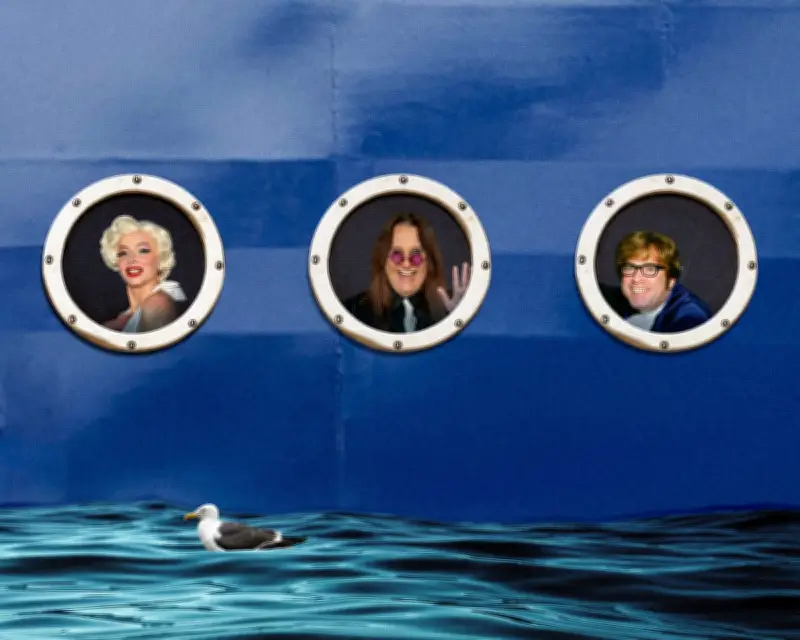
Martha Stewart, Walter White and Rodney Dangerfield walk into a bar. The bartender looks at Dangerfield, asks what he's having. “Vodka soda,” he replies. The bartender starts shovelling ice. “Double?” he checks. “Course I am,” says Dangerfield. “Dangerfield's dead.” It was Kenny Rogers's 80th birthday, and dinner that night in the resplendently portholed Central Park restaurant was an all-out, costumes-not-optional affair. Kenny Rogers was looking as radiant and moisturised as if there were a portrait of him decomposing in an attic somewhere.
A laugh rang out from the corner of the room, cool and reedy as a clarinet. This was Roseanne, clad in a clingy sweat suit and presently being wheeled into place by the Dude. You may be familiar with the standup comic Roseanne Barr, at one point America's plump and pushy everymom. Roseanne, which ran from 1988 until 1997, centered on a brash tell-it-like-it-is mother and the concerns of her working-class family. Between her sitcom's plotlines (refreshingly unpretentious) and her whole anomalous look (especially amid the body-fascist 90s prime-time landscape), Roseanne became a household name. Things looked good for her as recently as 2018, when she was tapped for a reboot of the show – until May of that year, when she made a racist remark and some otherwise confounding comments on Twitter. She was dropped from all television networks, later attributing her tirade to being under the influence of the sedative Ambien. “I loved being her,” said the Roseanne to my right. “Though one time – and this was before everything happened – she came to my standup set. She was like: 'Great set!' then asked me to stop doing her jokes unless I wanted to get hit with a lawsuit.”
Our Roseanne went on to make a killing doing her own Roseanne-flavoured routine, and by the looks of the decade-old talent reel she was showing me, she'd been a body-and-soul Xerox of the sitcom star for most of her adult life. But the Twitter incident marked a turning point for the both of them. Our Roseanne retired her Roseanne. Shortly thereafter, she decided it was time to get serious about portion control and transformed her body entirely. Now the woman sitting next to me – waving her sequined cap around, calling for more horseradish – bore no resemblance to the zaftig blue-collar goddess she'd impersonated for 25 years.
The Final Night
The sea seltzered nastily against the side of the ship late that final night. Deep inside, Austin Powers was being attacked by a group of women. “Like the suit? Chicks dig the blue velour, baby! Oh behave! Jesus – hang on.” Greg's phone was beeping a jingle. “Hold it. Hold it.” All trip, Greg had been hounded by calls for his Santa impersonation business (an enterprise distinct from Sunburst), which was about to ratchet up to peak season. Office parties, brand activations, Christmas villages in the middles of malls: Greg managed a tranche of Santas deployable like a rebel militia. “Family business,” he told me later. He pointed to his wife and his daughter, both snug in the cabaret's corner banquette. “That's Mrs Claus and Cindy Lou Who.”
In the blue suit and prosthetic teeth, Greg was hard not to adore. Buoyed up by the unwavering support of his wife, the near-disturbing talent of his daughter and the memory of his brother – an aerobics champion, Disney World dancer and cruise-ship entertainer who had died nearly 32 years earlier of complications from Aids – Greg treated the art of tribute showbiz less like a baroque vocation and more like an instinct as complex as the project of fatherhood. To him, the Sunburst impersonators were a life force – a feedback loop of energy that was endlessly nurturable, and that nurtured in return. “I'm buying Roy Orbison a light beer!” screamed a woman over our section. “Want anything?”
Sinatra (A), meanwhile, gripped the edge of our table as if it were a tiller. It was nearly time for his number. Marilyn, onstage, was banging out Diamonds Are a Girl's Best Friend in a low-cut leopard-print dress, causing one group of liveried veterans to explode in a boyish holler that seemed to announce that whatever war they'd fought in was maybe worth fighting after all. “You know, I think I feel him here,” Sinatra (A) nodded, finally speaking just as the applause thundered for the bowing blonde. “I can feel Sinatra,” he repeated, this time with more confidence. “I can sense him enter my body and exit my lungs. And I think I can … ” Just then the DJ sounded an air horn, and either a squirt of bile or a choke of relief surged in Sinatra (A)'s throat when his name was not called to the stage. Instead, as he swallowed, a handsomely bangled woman approached the floor to deliver Wind Beneath My Wings, barefoot and with vibrato.
Conclusion
The Texas hold'em table was mostly in high spirits near 2am. I'd already made $120. The woman to my right was up $200, though the guy across from me, Dave, was down $1,300. He dabbed at the corners of his eyes. Eyeballs watered everywhere on the beeping expanse of Deck 7, where the carpeting felt like marshmallow and cigarette smoke billowed. An announcement blared on the loudspeaker: “LADIES AND GENTLEMEN, WE FORESEE A SLIGHT DELAY TO OUR ARRIVAL DEPENDING ON HOW FAST THE MEDICAL EVACUATION WILL PROCEED DURING THE NIGHT.” “Medical evacuation?” asked the man to Dave's right. “Did someone die?” “Are we gonna die?” Dave said. “People die all the time on cruises,” said the woman. “Tons of old people, loads of booze – they put morgues on cruise ships for a reason. Get over it.”
I already had. If the whole idea is to go out of the world as late and as happy as possible, you could do worse than die on a mega liner. You would've plausibly just seen a few nice sucrose beaches. Hopefully, you would've pampered yourself in a Jacuzzi, felt the full clothy weight of a subtropical sky and gotten, maybe for some stretch of time, the narcoleptic comfort of a lounge chair in the sun too. But if you were me, you would have left knowing how a crowd surrenders when a man stands before them as Frank Sinatra. You would have understood that Marilyn Monroe can and will not truly die, that legacy is a real, transmittable idea and would have seen men and women, with no exaggeration, get moved to tears at the sight of a former corrections officer dressed as a titan of heavy metal.
If you ever find yourself meditating on the spectre of death on a cruise ship, you could do worse than think of the people of Sunburst. Their work was made to soothe the living by bringing them the dead and the distant. If no art can forestall death or undo what's been lost, these reincarnation artists believe that, by living through another – if but for the span of a song or a photo op at a time – they can intervene in reality, perform miracles. For most of us, the single body we've been dealt holds only a short series of vaguely mutable selves. There are elaborate ways to escape your own oneness – make a getaway from your circumscribed self – but the impersonator suggests a compelling path out. Their logic works like this: accept that there are few complete originals. Make do with your earthly gifts. Understand that to be close enough to greatness is, very often, more than enough. Act accordingly.