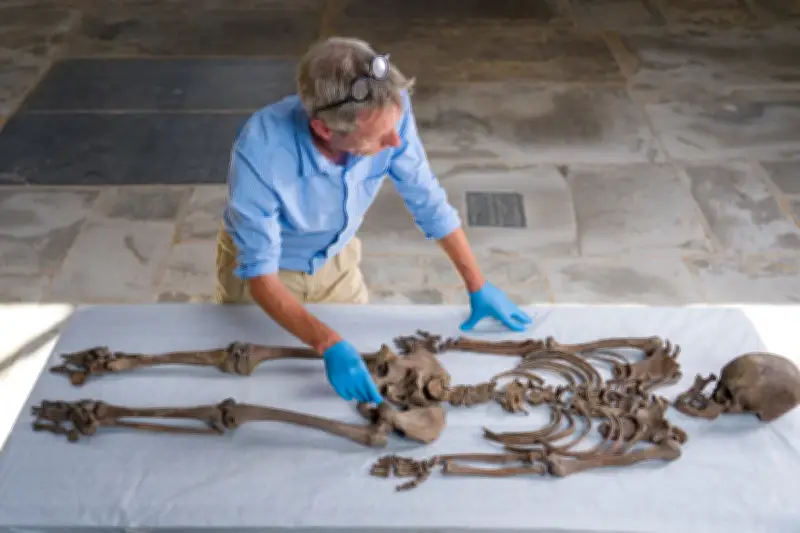
Researchers have revealed what a man who lived through the Norman Conquest may have looked like, uncovering new details about his life more than 1,000 years ago. Known as Conquest Man, his remains were analysed by researchers from English Heritage and Historic England using osteological analysis, ancient DNA and isotope testing, alongside a digital face reconstruction.
The results from his DNA suggest he had substantial ancestry from continental Europe. He was described as “stocky and muscular”, more than five feet tall and around 50 to 60 years old with evidence of multiple healed fractures.
Privileged burial in a Norman church
He was given a privileged burial in a Norman church then owned by one of William the Conqueror’s knights, St Peter’s in Barton-upon-Humber, and laid to rest in a coffin made from an oak tree felled around 1079. His arms were folded with his head supported on a grass pillow and kept from falling sideways by two lumps of local chalk. Three apple wood staffs – which were seen as sacred in Scandinavian tradition – were by his side.

Ahead of the Bayeux Tapestry exhibition opening and Battle of Hastings re-enactment, English Heritage partnered with researchers from Historic England, the Crick Institute, the British Geological Survey, the University of Southampton, muVIS and FaceLab to examine Conquest Man.
Curator’s fascination with Conquest Man
Kevin Booth, English Heritage head curator of collections, who co-ordinated the study, said: “I’ve been fascinated by this individual – this man of the Conquest – for 20 years. Who was he, what did he experience, could he have been at the Battle of Hastings, what sort of person might he have been?
“With this new analysis, it feels like we can really get close to him. To be able to now look at his face is to feel we can almost speak to him.
“He’s a fascinating survivor of a cataclysmic period in history, born in the reign of Viking King Cnut, he survived the Norman Conquest to be buried with honour next to a pre-Conquest church, part of the new Norman world.
“It seems to me his legacy is of survival, resilience and adaptation and I hope that by sharing his story in this way, when people go to our Battle of Hastings re-enactment or visit the Bayeux Tapestry – of course they can cheer on who they like – but maybe he can help us not to pigeonhole those who fought and died there, but to understand them as human above all.”
Conquest Man can be seen at St Peter’s Church, Barton-upon-Humber in Lincolnshire on September 20 from 12pm to 4pm.