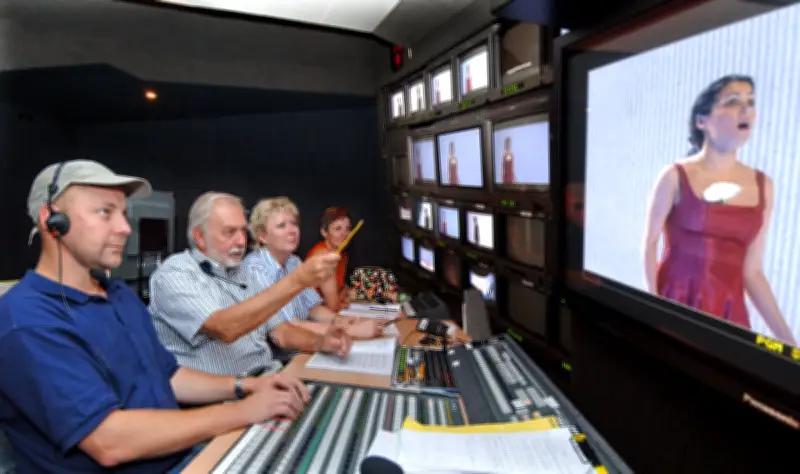
Brian Large, the visionary television director who brought opera to a global audience and masterminded the legendary Three Tenors concert at the 1990 football World Cup, has died at the age of 89. His career spanned more than half a century, encompassing over 800 live broadcasts and films for the BBC and other major broadcasters worldwide.
Early career at BBC2
Large joined BBC2 in 1965 as a music and opera director, just a year after the network launched. The controller at the time, David Attenborough, recalled that there were no experienced opera production staff because the field was so new. Large's first live broadcast was of Igor Stravinsky conducting The Firebird with the New Philharmonia Orchestra in September 1965, an event he later admitted left him "scared stiff."
He quickly made his mark, directing Double Concerto (1966) with Vladimir Ashkenazy and Daniel Barenboim. Working with producer John Culshaw, he directed studio performances of Benjamin Britten's The Burning Fiery and Peter Grimes, as well as Mozart's Idomeneo. These productions used two studios over several days, with chorus and orchestra in one and soloists and sets in the other.
Pioneering television opera
In 1971, the BBC commissioned Britten to write an opera specifically for television: Owen Wingrave, based on a pacifist ghost story by Henry James. Large co-directed the production with Colin Graham at the Maltings in Snape, Suffolk. He loved working with composers to blend music with new visual techniques, such as colour separation overlay (CSO), which created backgrounds and illusions impossible on stage at the time, notably in Hansel and Gretel and The Flying Dutchman.
Recordings from Covent Garden included Grace Bumbry as Amneris in Aida with the Royal Opera (1968) and performances by Margot Fonteyn and Rudolf Nureyev with the Royal Ballet. Live telecasts from the BBC Proms at the Royal Albert Hall also featured prominently.
Bayreuth and the Ring cycle
In 1974, Wolfgang Wagner invited Large to Bayreuth, the opera house built by Richard Wagner. Over a decade, he recorded Die Meistersinger von Nürnberg, Tannhäuser, Parsifal, Der Fliegender Holländer and Lohengrin for Bavarian Television. For the centenary of Der Ring des Nibelungen in 1976, Bayreuth mounted a production by Patrice Chéreau with an Industrial Revolution setting, conducted by Pierre Boulez. Large filmed it in 1980 in an empty opera house, with seats removed to allow cameras greater freedom and closeness to the singers. The result was a milestone in classical music television, and in 1982 the BBC broadcast the entire Ring in 10 parts simultaneously on radio and television.
Freelance career and global reach
Large left the BBC in 1980 to go freelance, directing telecasts for the Royal Opera and at Glyndebourne, including Janáček's The Makropulos Case (1995) and Rossini's Le Comte Ory (1997). He directed the Vienna Philharmonic's New Year's Day concert 18 times (1989-93 and 1997-2009). In the US, he directed more than 100 works for the Metropolitan Opera in New York and other companies, captured on DVD and broadcast on public television and in cinemas.
The Three Tenors and other iconic broadcasts
His most famous project was the Three Tenors concert in Rome during the 1990 football World Cup, featuring Luciano Pavarotti, Plácido Domingo and José Carreras. Large recalled: "We created on that day a monster which could not be tamed." The concert reached a worldwide audience. Also from Rome, he directed Tosca (1993), set live in the historical locations and times of day of the story, seen on 106 television networks.
In 1986, he directed the CBS telecast Horowitz in Moscow, capturing the Ukrainian-born pianist Vladimir Horowitz's return to the Soviet Union. As Horowitz played Schumann's Traumerei as an encore, the camera caught an elderly man with tears streaming down his cheek. Large said: "I saw it, and it was a gift from heaven, and I punched it in. It is something I never regretted."
Early life and legacy
Born in Lambeth, south London, on 16 February 1937, Large was the son of Ruby (née Willis), a pianist, and John Large, a violinist. He studied piano at the Royal Academy of Music with Myra Hess and earned a bachelor's degree (1960) and PhD (1964) from the University of London. His doctoral research involved collecting folksongs in Moravia and Slovakia. He later published biographies of Smetana (1970) and Martinů (1975).
He began his career as head of music at Strand School in south London before joining BBC2. He wrote At Large: Behind the Camera With Brian Large (2015) with Jane Scovell. In its foreword, Renée Fleming highlighted how he used his cameras "in the service of the story and the music."
Large is survived by his partner of four decades, Jack Mastroianni, whom he married in 2016. He died on 23 May 2026. His many awards included TV director of the year from the Royal Television Society for both the Ring cycle and the Three Tenors.