To mark Benedict Cumberbatch’s recent 50th birthday, we rank his finest screen roles – from hyper-British patricians and seething serpents, to ghastly Yanks, tragic codebreakers and sci-fi scoundrels.
20. The Roses (2025)
Benedict Cumberbatch does his considerable best opposite the equally prestigious Olivia Colman in this souped-up marital-breakdown dramedy, essentially remade from the 1989 movie with Michael Douglas and Kathleen Turner. This time, though, it’s all about the Britons – indicating the supposed classiness of the affair. But the film is overwrought and unconvincing; it never convinces us that the couple were once passionately in love and now passionately in hate. The below-par script has the effect of bringing out an unrewarding kind of coldness in Cumberbatch, technically assured though he always is.
19. The Thing With Feathers (2025)
Here is an example of Cumberbatch’s presence signalling a film’s purposeful seriousness – and he does indeed give an honest, intelligent and well-intentioned performance in an otherwise self-conscious and contrived study of grief and emotional breakdown. He is the writer and illustrator whose wife has died, and who is visited by a gigantic hallucinatory crow (raspingly voiced by David Thewlis) symbolising the agony of loss. Cumberbatch’s performance, however, looks a little refined and dry for the material.
18. August: Osage County (2013)
An interesting, subdued appearance from Cumberbatch in this film version of Tracy Letts’s award-winning play about an explosive family reunion. It is an example of how his theatrical accomplishment, technique and distinctive appearance, when married up to material that doesn’t overstate things, can work well. In fact, it is the rest of the cast, headed up by Meryl Streep, who bring the fireworks; Cumberbatch, playing the shy, depressed cousin Little Charles, delivers a less-is-more premium.
17. The Hobbit trilogy (2012-2014)
Popcorn movies like this, as opposed to upmarket Masterpiece Theatre-type productions, allow Cumberbatch to have some fun – and here he is, playing in motion-capture as the terrifying dragon Smaug and the equally daunting Necromancer, in Peter Jackson’s LOTR prequel-triple. Within the confines of motion-capture, his Smaug – a little like Ian McKellen’s Gandalf – delivers authentic British vocal richness and theatrical hamminess, evil and yet lonely.
16. The Other Boleyn Girl (2008)
Nowadays, a Tudorbethan romp with Cumberbatch would have to cast him as Henry VIII or Thomas Cromwell at the very least. In Justin Chadwick’s enjoyably gossipy and saucy what-if period drama about Henry’s illicit relationship with Anne Boleyn’s sister Mary (played by Scarlett Johansson), Cumberbatch has to content himself with the more self-effacing role of Henry’s courtier and Mary’s husband, William Carey, who is a step away from the real action. But Cumberbatch’s theatrical credentials are important to the film’s integrity.
15. The Courier (2020)
Cumberbatch gives some serious moustache action in this espionage drama-thriller, based on a true story. It’s not as good as his appearance in Tinker Tailor Soldier Spy, but Cumberbatch is very good at conveying something that for most actors is just the pretext for comedy – a certain kind of simmeringly significant British uptightness. He plays Greville Wynne, a mousy 1960s businessman, always going to Moscow on boring business and who is asked by MI6 to make contact with a possible Soviet defector. And so, with his fusty homburg and moustache, he makes his appointment with destiny.
14. Atonement (2007)
One of Cumberbatch’s distinctive supporting roles is in this bold and starrily cast version of the Ian McEwan bestseller about a tragic lie that changes lives. Cumberbatch is Paul Marshall, a well-spoken young man who visits an aristocratic country house before the second world war, and whose sexual assault of a girl there forms part of a calamitous misunderstanding and untruth. Cumberbatch does sterling work, but this is one of the lesser roles that he tended to get before TV’s Sherlock catapulted him into the big league.
13. Four Lions (2010)
Cumberbatch can play comedy, although he rarely gets the chance. He displays those skills in this small but perfectly deadpan role, as the special branch negotiator who has to talk to the potential suicide bombers in Chris Morris’s acidic black comedy about jihadist extremism. The character’s stolid professionalism coexists with a certain kind of cluelessness almost comparable to that of the bumbling terrorists themselves.
12. Black Mass (2015)
No self-respecting English actor shrinks from the challenge of an accent – and in Scott Cooper’s Black Mass, Cumberbatch does an entertainingly studied version of south Bostonian: posh, but with a hint of the mean streets. In this true-story mob drama, he is Massachusetts senator Billy Bulger, at home in the cigar-smoky gentleman’s clubs and bars exchanging worldly badinage with the great and the good. But his brother is gangster Whitey Bulger, played by Johnny Depp, and Billy finds himself under pressure to persuade Whitey to become an informant. Cumberbatch is very good at showing how infatuated Billy is with his own prestige.
11. War Horse (2011)
As befits the title, this movie demonstrated Cumberbatch’s horse-riding chops and the elegant figure he cuts in the saddle. As the blusteringly patriotic Maj Jamie Stewart, he is every inch a clenched member of the officer class, giving a fierce speech to his men before a deeply misjudged cavalry charge in which the British are cut down by German machine guns. Cumberbatch looks and sounds the part, and you can fully imagine that gimlet-eyed fanaticism on the faces of actual officers of the time. But it’s a slightly cartoony character in a slightly cartoony film.
10. Starter for 10 (2006)
A very early movie role for Cumberbatch, in which – perhaps before the industry quite realised what a thoroughbred they were dealing with – he was cast in an almost slapstick role as the pop-eyed, geeky butt-of-the-joke. In this version of David Nicholls’ novel about students competing in the TV quizshow University Challenge, James McAvoy is the fresher at Bristol Uni, mad keen to be on the team. But he is unbearably patronised by Cumberbatch’s team captain – a pompous postgrad – and their confrontation ends in chaotic violence. It’s a very tasty, broad comic role for Cumberbatch – and it’s a shame he hasn’t developed that side of his career.
9. 1917 (2019)
Cumberbatch’s second performance as a ramrod-straight commanding officer in the first world war. His contribution here is smaller than in Steven Spielberg’s War Horse, but it is a very powerful cameo and in some ways more realistic. He is Col Mackenzie, to whom two desperate young lance corporals have to deliver a vital message to call off an attack the cunning Germans are attempting to lure the British into making. His Mackenzie is a fierce martinet, careworn by slaughter and by the burden of command, and with a poignant hint of despair.
8. Tinker Tailor Soldier Spy (2011)
Cumberbatch had one of the trickiest, knottiest roles of his career in this John le Carré thriller, playing Peter Guillam – an intelligence officer low enough on the food chain to have escaped suspicion of double-dealing, but nonetheless little liked by his superiors. He has, however, a close relationship with Gary Oldman’s spy chief George Smiley and, by virtue of the semi-protected status this gives him, has a somewhat cool and insolent manner. Cumberbatch amusingly carries off a cuff-shooting style with a rather absurd mop of a haircut, and a dandruffy three-piece suit.
7. Star Trek Into Darkness (2013)
Cumberbatch deserves a massive supervillain role and perhaps the sheer obviousness of this possibility means that he hasn’t really had one. (He could be a Bond villain – but, then again, he may be more interesting as Bond himself.) At all events, he was a watchable turn as the blankly named John Harrison, AKA Khan Noonien Singh – the enigmatically cool foe of Kirk and Spock in JJ Abrams’ 2013 follow-up to his great reboot of the sci-fi pop classic. His role here is a little light on dialogue, and Abrams’ intention was probably more to let us simply luxuriate in that mysterious face: unbearably sexy in its rodenty way.
6. Wreckers (2011)
Writer-director Dictynna Hood’s little-known indie drama gives us one of Cumberbatch’s most interesting and fully realised performances, notable because there is less of the slant, quirk or mannerism that many other directors and writers would contrive for him. He plays David, a schoolteacher and decent guy married to Claire Foy’s Dawn, living in a quiet English village. Their home life is upended when his troubled brother Nick (Shaun Evans) returns from the army and reveals some uncomfortable family secrets. Cumberbatch’s David shows that he himself is not the cool customer we thought. A finely detailed and well-judged performance.
5. Doctor Strange (2016)
Cumberbatch was genius casting as Doctor Strange, arriving at what now, perhaps, looks like the end of the Marvel superhero golden age. Strange is a brilliant but arrogant neurosurgeon who achieves his superpowers – in time-honoured fashion – through an accident, but has to be schooled in a distinctively Zen kind of mastery by an enigmatic mentor (played by Tilda Swinton). With this, and 2022 follow-up Doctor Strange in the Multiverse of Madness, Marvel gave Cumberbatch a massive global cineplex audience for his unique charisma, theatricality and unconventional handsomeness.
4. The Wonderful Story of Henry Sugar (2023)
Perhaps it is odd that Cumberbatch has only been in two Wes Anderson films: this Oscar-winning short for Netflix, and The Phoenician Scheme two years later. The elegance and British idiosyncrasy of Cumberbatch would make him an obvious candidate. Henry Sugar gives Cumberbatch another side to his underappreciated comedy style: the deadpan pose, which is here an almost Keatonian stoneface. His Sugar is a wealthy, greedy man with an inscrutable manner, who discovers in himself magic powers (which are, however, not quite superpowers in the Marvel sense) that he is able to exploit for gain in casinos all over the world.
3. 12 Years a Slave (2013)
Cumberbatch played the most insidiously culpable role in Steve McQueen’s Oscar-winning slavery drama – the true story of Solomon Northup (Chiwetel Ejiofor), a black man abducted in 1841 from freedom in the US north into slavery in the south. Northup has two masters: the apparently thoughtful and liberal William Ford, played by Cumberbatch, who then sells him to the sadistic and odious Edwin Epps, played by Michael Fassbender. Ford is supposedly the good guy, and yet he is all the more despicable for being so blandly complicit in the situation, and for his weakness in selling Solomon to a man he knows is evil just to clear his personal debt. His chief emotion is a kind of sorrowing and worldly self-pity.
2. The Imitation Game (2014)
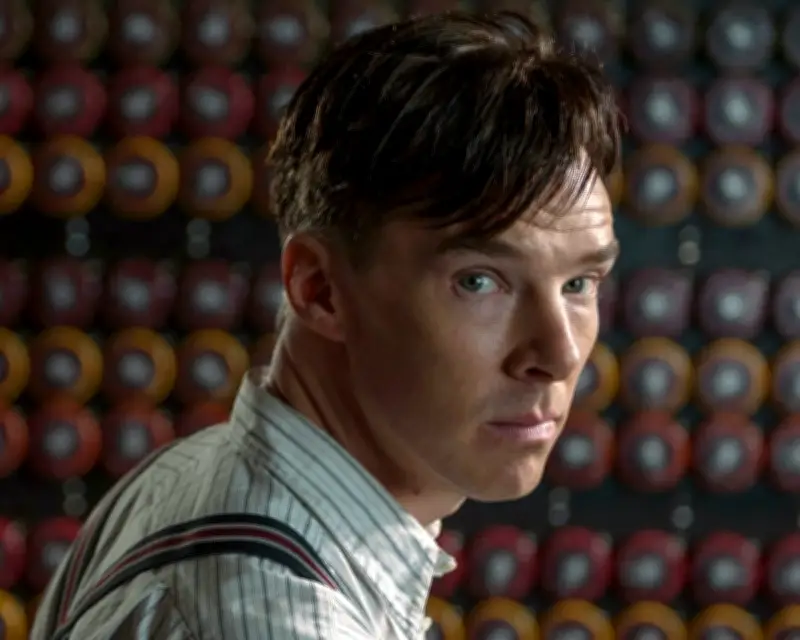
Here is the one movie that really gave Cumberbatch a chance to develop the Sherlockian persona that had made him an international star. He plays Alan Turing, the genius mathematician and wartime codebreaker who was later persecuted as a gay man in the 1950s, in the middle of a seedy moral panic led by Churchill’s home secretary, David Maxwell Fyfe. Cumberbatch is excellent at showing the young Turing’s brilliance, his abruptness and tactlessness (which may now be attributed to autism spectrum disorder), and also his sensitivity and loneliness. There is a rich, romantic melancholy in the fake heterosexual relationship that Turing confects with his fellow codebreaker and friend Joan Clarke, played with energy and charm by Keira Knightley. Sherlock was fictional, but the equally exceptional Turing was real, and achieved more than Sherlock ever could.
1. The Power of the Dog (2021)
Ironically, Cumberbatch’s greatest film to date is a western – and this most English of actors plays the nastiest US roughneck imaginable. He is the boorish and charmless Phil Burbank, who runs a ranch in remote Montana with his brother George (Jesse Plemons). Phil is more than just ornery; he is a sociopath and a bully, obsessed with mocking his brother’s pretensions to culture and refinement, but profoundly dependent on him emotionally. And so, when George marries sensitive widow and single mother Rose Gordon (Kirsten Dunst), Phil starts harassing and abusing her – there is a bizarre scene where he strums derisively along on a five-string banjo while she is trying to play the piano. In his dysfunctional, childlike way, he is clearly unable to stop thinking about the fact that his brother and this woman are enjoying sexual relations. Phil himself would appear to be a virgin. Or is he? He also begins to take an oppressively strange interest in Rose’s teenage son, offering to teach him to ride and take him out into the remote hills to school him in the rancher ways of manly self-reliance. It is a huge role for Cumberbatch, and his wild-eyed magnetic and sinister aura floods the screen.