Antonio Rattín, the Argentine footballer whose refusal to leave the pitch after being sent off during the 1966 World Cup quarter-final against England led to the introduction of yellow and red cards, has died at the age of 89. His death was announced on 11 July 2026 in Buenos Aires.
The 1966 World Cup Incident
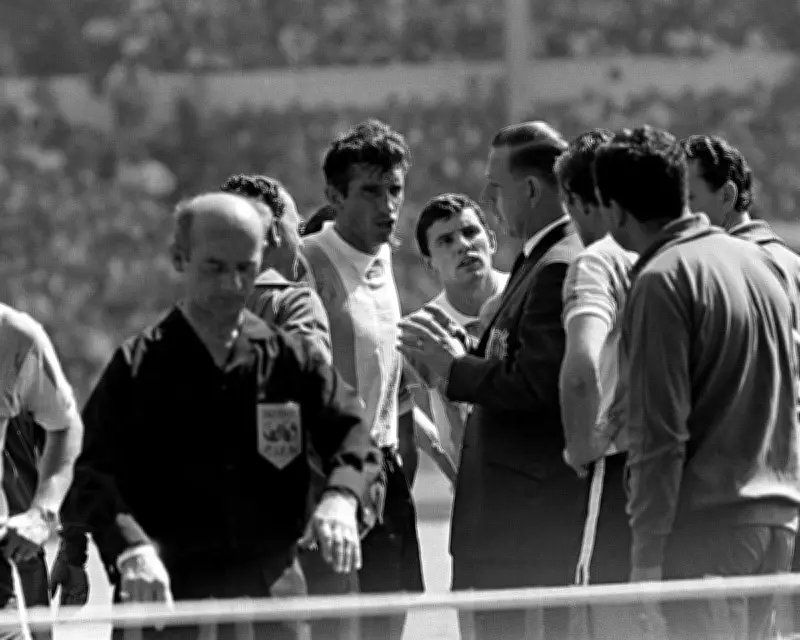
On 23 July 1966, at Wembley Stadium, Rattín was sent off by West German referee Rudolf Kreitlein after just 30 minutes. The official reason was 'violence of the tongue,' despite neither man speaking the other's language. Kreitlein later said, 'Rattín said nothing I could understand, but I could see in his face what he was saying.' It took eight minutes to remove Rattín, who initially refused to leave, claiming he was asking for an interpreter. He eventually walked off accompanied by two policemen, pausing to tweak a corner flag bearing the Union Jack—an act he later regretted.
England won 1-0 with a goal by Geoff Hurst, advancing to the semi-finals. After the match, England manager Alf Ramsey prevented George Cohen from swapping shirts, calling Argentina's players 'animals,' despite England committing 33 fouls to Argentina's 19. The incident deepened tensions between the two nations, exacerbated by later events such as Diego Maradona's 'Hand of God' goal in 1986 and David Beckham's red card in 1998.
Legacy: Introduction of Yellow and Red Cards
The chaotic scenes surrounding Rattín's dismissal prompted Ken Aston, the referees' supervisor at the tournament, to devise a system of yellow and red cards to avoid language misunderstandings. The system was introduced at the 1970 World Cup and remains in use worldwide.
Career and Life
Born on 16 May 1937 in Tigre, Argentina, Rattín was the son of an Italian immigrant. He worked as a delivery boy and trained as an electrician before joining Boca Juniors. On his debut against River Plate, he played with a heavily bandaged arm after falling from a ladder and successfully marked Ángel Labruna, helping Boca win 2-1. Over 15 years with Boca, he won five national championships and the Copa Argentina, making 382 appearances. He earned 34 caps for Argentina between 1959 and 1969, winning the 1964 Nations Cup in Brazil.
After retiring at 33, Rattín managed Gimnasia y Esgrima La Plata, Tigre, and briefly Boca Juniors in 1980. He later entered politics, serving as a national deputy for the Federalist Union party from 2001 to 2005 and as a Peronist councillor until 2009.
Final Days
Rattín died on the same day Argentina beat Switzerland in the 2026 World Cup quarter-finals, setting up a semi-final against England. Argentina's players wore black armbands in his honour. A statue of Rattín was unveiled at La Bombonera in 2005, but his greatest legacy is the yellow and red card system that transformed football discipline worldwide.