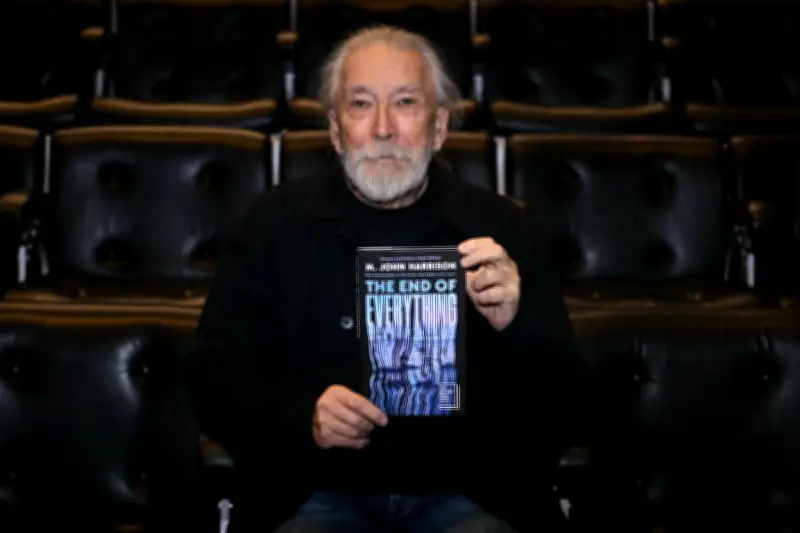
The Booker Prize 2026 has been awarded to British author M. John Harrison for his novel The End of Everything. At 81, Harrison is the oldest writer to receive the honour, marking the pinnacle of a six-decade career known for genre-bending fiction.
A Landmark Win for a Genre-Defying Author
The End of Everything is Harrison's 13th novel, a dystopian satire set in a coastal English town after societal collapse. He beat past winners Marlon James and Douglas Stuart to the top literary honour.
Chair of the judges, Mary Beard, described the book as a "book that turns you upside down, raises a wry smile – and surprisingly, given the subject matter, leaves you with a twinge of optimism."
The Prize and Its Legacy
Established in 1969, the Booker Prize is the world's most significant award for a single work of fiction, with winning authors receiving £50,000. The book must be a work of long-form fiction originally written in English, by an author of any nationality, and published in the UK or Ireland between 1 October 2025 and 30 September 2026.
Past winners include Hilary Mantel for Wolf Hall, Salman Rushdie for Midnight's Children, and Arundhati Roy for The God of Small Things. At the ceremony in Old Billingsgate, Harrison's trophy was presented by David Szalay, who won last year's prize for his novel Flesh.
Judges' Unanimous Decision
The winning novel was selected by a judging panel that included poet Raymond Antrobus, musician Jarvis Cocker, journalist Rebecca Loi, and Booker-shortlisted novelist Patricia Lockwood. The shortlist featured works ranging from dystopian fiction and contemporary realism to campus drama and historical fiction.
Beard said: "The Booker judges spent a whole day debating the six remarkable novels on this year's shortlist, before agreeing unanimously to award the 2026 prize to The End of Everything by M. John Harrison." She described the book as "the politics of now seen through the lens of the future."
About the Winning Novel
Beard elaborated on the plot: "Central to the story are Phillip Tennent and his elderly aunt Marnie, living on the south coast of England, a few decades into the future, some years after a mysterious catastrophe: an invasion of 'iGhetti' (the 'i' hinting at something digital, but you can't be sure). Social norms have been eroded, law and order have fallen into the hands of vigilantes, and you may well have a crashed plane lodged in your garden. People try to muddle through nonetheless, even making a show of business as usual (children's parties and a morning coffee at a seaside café)."
She added: "Some try desperately to make sense of what has happened. But one main point of the book is that if, or when, such an apocalypse comes it will be incomprehensible. And the old rules won't matter either. Phillip is landed with an 'item' he found on the beach, a blob of jelly which quickly grows, develops speech and starts to tell his human minders what to do."