Lee Friedlander, the renowned American photographer, has been capturing the essence of the American social landscape since the 1950s. His work, characterized by storefronts, signage, reflections, contradictions, and a stubborn sense of comedy, is now compiled in a new book titled Life Still. Published by Aperture, the collection brings together more than 130 images, the majority of which have never been published before. The sequence is guided by Friedlander's knack for uncanny association, offering a fresh perspective on his decades-long career.
A Glimpse into Friedlander's World
Friedlander's journey began in the streets of New York City, where he prowled with insatiable curiosity. The city rewarded his attention with scenes that evoke our best ideas and better selves. One image from 1959 captures this early period, showcasing his ability to find the extraordinary in the ordinary.
As Peter Galassi, curator of Friedlander's monumental 2005 career survey at the Museum of Modern Art in New York, astutely remarked, the artist was 'adept at turning any scrap of junk into a lavish puzzle.' This sentiment is evident in images like those from Nashville in 1963, where everyday objects become part of a larger visual riddle.

The Evolution of His Style
In the mid-1990s, Friedlander began making more still lifes, inspired by the vases of freshly cut flowers his wife Maria would place around their home. This shift was also influenced by the reality of aching knees, which limited his mobility. Surgery helped restore his movement, but images like one from Nyack, New York, made a decade later, bear traces of the careful, quiet aptitude honed during that period.
Friedlander also made a significant shift in the early 1990s, beginning to shoot with a Hasselblad Superwide in addition to his trusty Leica. The square format collapses space to emphasize inherent contrasts. In a 1997 image from Las Vegas, a drainage ditch clogged with debris contrasts with the rising Luxor casino, while a stucco sphinx peers over the parking lot wall. Each element is equally weighted and equally strange.
Themes and Motifs
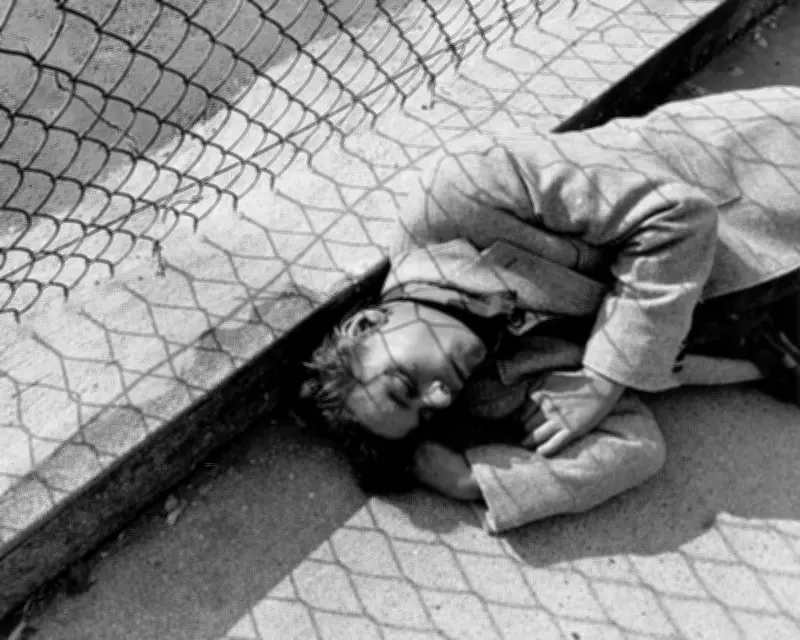
Chain link fences are a leitmotif in Friedlander's career. They form screens and cast shadows, dividing space while remaining permeable. An image from Chicago in 1986 reminds us that we are looking at a two-dimensional description of a three-dimensional world. Friedlander's deadpan style is always revealing, making the specific feel universal through careful framing and an astute eye for offbeat stylistic sensibilities.
Friedlander is the first to acknowledge that encountering a sign for 'Hope auto repair' in a remote corner of Montana is a gift that keeps on giving, long after the film is exposed. Along with us, he chortles every time he sees it. His photographs are not editorialized; he points and trusts we are all in on the joke.
Influences and Collaborations
While still a teenager, Friedlander moved from Los Angeles to New York to work as a freelance magazine photographer. There, he met Walker Evans and Robert Frank, two luminaries who helped him realize the creative potential of the medium. A postcard on a window sash from Evans's American Photographs, made in Boston in 1930, serves as a quiet nod to his mentor and friend.
Friedlander is a prolific bookmaker. For his first book, Self Portrait (1970), he and his wife Maria managed every detail of the sequencing, design, and production. Ever since, he has played a central role in the conception and creation of his books. For Life Still, Friedlander, Stephanie Prussin, and Peter Kayafas pulled together work made across seven decades to create a sequence that both guides and surprises readers.
The Book's Presentation
On the back cover of the book, an image from Tucson in 1985 captures Friedlander's signature wit and the quiet confidence with which he allows photographs to speak for themselves. The book is a testament to his ability to turn any scrap of junk into a lavish puzzle, as Galassi noted.
All images courtesy of Lee Friedlander; Fraenkel Gallery, San Francisco; and Luhring Augustine, New York. Captions from Sarah Meister, executive director of Aperture Foundation.