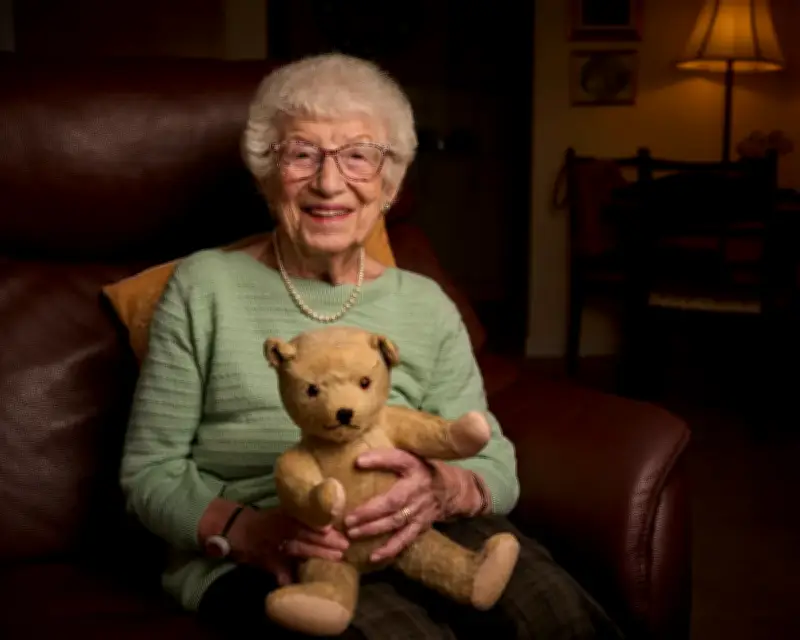
Gabriele Keenaghan, a 99-year-old retired head teacher from North Shields, is preparing to return to Vienna's Westbahnhof station this week, the place where she parted from her grandmother in April 1939 before boarding a Kindertransport to Britain. She admits she may feel emotional.
“I haven’t thought about how I’ll feel – I probably will feel emotional,” she said.
A terrifying farewell
Keenaghan was 12 when she left Nazi Austria. She remembers the shock of saying goodbye at the station, where tears were strictly forbidden. “I was apprehensive and I was worried because Nazis in black uniforms were on the platform,” she said. “I was only 12 years old so I think they were frightening … terrifying.”

“People had been told that there were to be no emotional scenes, they didn’t want any emotion shown by anyone. I tried not to cry. It was very difficult. My grandmother … she smiled.”
The trip, planned for her centenary, was nearly cancelled after Lufthansa scrapped routes from Newcastle. A private jet was offered by a good samaritan, and the family say they have been bowled over by the generosity.
Discovering her Jewish identity
Keenaghan, an only child, said she did not know she was Jewish until after the Nazis invaded Austria. Her mother, Hildegard, was a Catholic and died suddenly in 1935. Her father, Josef, was Jewish and made heating stoves.
She was a boarder at a Catholic convent school when the Nazis arrived and told pupils they would all be moving. “The authorities came into the convent to tell us which schools we had to go to. We were all standing in the hall and names were called for this school, that school. At the end, I was the only one left standing. And I thought: ‘What’s happening to me?’”
She was sent to a Jewish school and a yellow star of David was sewn on to her coat. “I hadn’t realised that my father was a Jew. I didn’t know. I don’t think I even knew what being a Jew meant.” People treated her horribly, she said. “They called me a ‘dirty little Jew’ and I was a sensitive girl. It was upsetting.”
A new life in Britain
Keenaghan never saw her father again. He was deported to Łódź in Poland and was almost certainly murdered in an extermination camp. Her grandmother, also called Gabriele, arranged for her to leave on a Kindertransport, the scheme that brought about 10,000 Jewish children to Britain as refugees.
She left with 150 other children, travelling by train to the Netherlands and then by boat to Harwich. One of her first jobs was as a nanny to a family in Woldingham, Surrey.
She has vivid memories of VE Day, when all the village’s nannies were given the day off and went to London. “It was really euphoric,” she said. “I’ve never experienced such excitement and joy. People were dancing in the street. They were climbing trees.”
“We were in front of Buckingham Palace and out came the king and queen and the two princesses, Elizabeth and Margaret. Princess Elizabeth was the same age as me … she would also be 100 this year had she lived.”
Returning to the station
Keenaghan trained as a teacher in the north-east and met her husband, Ken, raising a family in Wallsend. She became a middle-school head teacher. She has returned to Austria annually to see relatives, especially her grandmother, who died in 1974. The one place she and her family have not visited is the station.
Her official birthday is in November, when Vienna would be too cold. “I’m going to be like Queen Elizabeth. I’m going to have two birthdays,” she said. Family members on the plane will include her two daughters, Pat and Christine. Christine recalled calling her great-grandmother “Noddy Grandmother” because she did not realise she could not speak English.
Keenaghan has spoken many times to children about her experiences. “I hope they have learned something from it,” she said. “But do we ever learn? Look at the world, look at the state it is in now.”