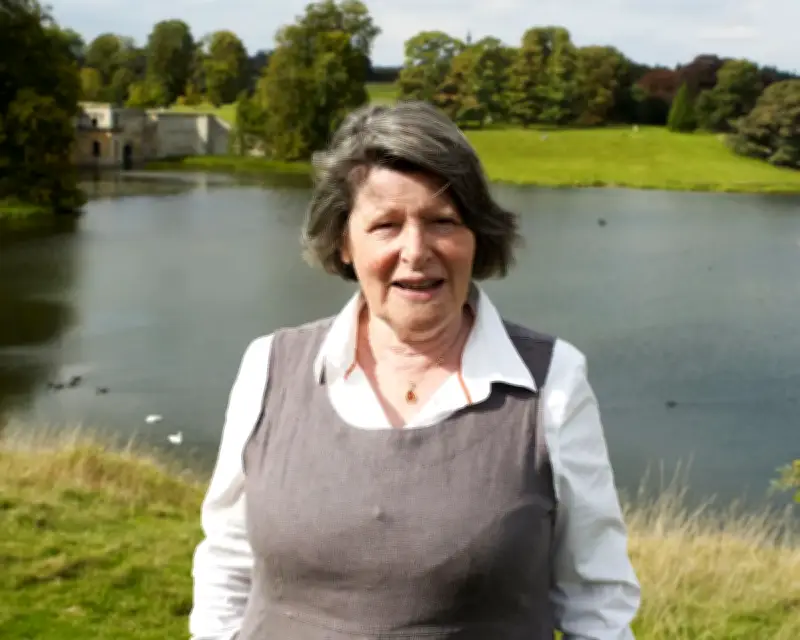
Jane Brown, the garden historian whose books on figures such as Gertrude Jekyll and Edwin Lutyens helped revive interest in the subject, has died aged 87. Brown led a resurgence of interest from the 1980s onwards in figures such as Sir Edwin Lutyens, Gertrude Jekyll and the American landscape architect Lanning Roper from the earlier part of the century, and she deserves at least some of the credit for the growing enthusiasm for garden history during the past 50 years, both as an academic discipline and as an area of interest to garden designers and casual garden visitors alike.
A Pioneering Approach to Garden History
What was groundbreaking about her approach, however, was the determination to avoid what she called the “overly aristocratic” approach to garden history, which she felt made it seem “as if only the great and the good had gardens”. In the foreword to her book The Pursuit of Paradise (1999), she declared it was an attempt “to redress the balance, to outline a history of gardens that is also popular and nostalgic”.
This egalitarian approach assumed that cottage gardeners who grew Fat Hen and Good Henry among wild roses and flowers for bees, or the provincial florists’ societies that bred flowers such as carnations, polyanthus and tulips, could be just as interesting as princes and parterres.
Brown pointed out that Roper’s book Successful Town Gardening (1957) and John Brookes’s Room Outside (1969) were talking to a new generation of gardeners who did not possess ancestral acres; neither did they want to be reminded of wartime gloom and digging for victory. They preferred to create a small, preferably lawned oasis where they could sit and relax with family and friends.
Personal Tributes and Writing Style
Those who knew her well describe Brown as friendly but unassuming; someone who did not want to talk about herself. Dr Catherine Horwood got to know her in 1999, while writing her own book, Gardening Women, and recalled her as “enormously helpful. There was never a hint of competitiveness. She was always so generous with her huge knowledge. I thought she might have been rather terrifying but she was the most modest, gentle person.”
Christopher Woodward, director of the Garden Museum, considered her “the most eloquent garden historian of her generation. She applied the approach of a top literary biographer – a Hermione Lee, say, or a Victoria Glendinning, whom she reminded me of in manner – to her subjects.”
Brown’s readable yet authoritative style occasionally ventures into the acerbic. A chapter ironically entitled Science Lends a Hand takes aim at the pesticide and fertiliser industry and their wartime advocates Sir Frederick Keeble and Professor Geoffrey Blackman. These two embodied what Brown calls “the scientist’s well-intentioned but disastrous role as friendly gardener-uncle” and between them introduced a generation of gardeners to the idea that chemistry was their ally. (Blackman later came to regret the fact that his work had resulted in the disappearance of poppies from cornfields.)
Early Life and Inspirations
Brown was born shortly before the outbreak of the second world war, at the tea rooms run by her aunts at Picket Post, near Ringwood, in the New Forest. An advertisement placed in an RAC brochure from around the same time describes the Kettle Tea House as having two acres of “lovely old gardens” and names the proprietors as the Misses Taylor – these were Jane’s mother’s sisters.
One of her earliest memories, which later inspired her book about rhododendrons, Tales of the Rose Tree (2004), was of “the green ghosts that guarded a miniature cottage in a New Forest garden, where my favourite aunt once sat sewing petticoats out of parachute silk, guarded by a giant yellow teddy bear, all fascinating to an under-five”. In 1963, Jane married Peter Brown, an airline pilot, and in 1970 they moved to Abinger in Surrey, “in the greensand hills with rhododendrons in every garden”. However, it was what Brown called “the strong Lutyens inspiration of the house” that inspired her initial interest in the architect, and his partnership with Jekyll, which lasted until her death in 1932.
At the time, despite having two young sons, Brown was studying landscape architecture at Thames Polytechnic (now the University of Greenwich). Her father had disapproved of the idea of university when she left Winchester county high school for girls, and she had taken a secretarial course, followed by a job at the Royal Institute of British Architects in London.
Later Career and Legacy
The book led to an exhibition at the Hayward Gallery in London in 1981 and the setting up in 1984 of the Lutyens Trust, for which Brown served as a trustee until 2008. She also became a patron of the Hestercombe Gardens Trust established in 1986 to oversee the restoration of the Somerset gardens laid out by Lutyens and Jekyll. Other books followed; 23 in total, including The Omnipotent Magician (2011), a biography of Lancelot “Capability” Brown.
Brown’s last book was Angel Dorothy (2017), a biography of Dorothy Elmhirst, founder of the trust that runs the Dartington Hall estate in Devon, where Farrand created the gardens. She had difficulty finding a publisher for it, which seems extraordinary for a writer with such a body of work behind her, but somehow the book got published, a tribute to Brown’s determination, as ever, to tell a story that had seized her by the arm and compelled her to put it down on paper. Jane Caryl Brown, garden historian and author, born 6 December 1938; died 26 June 2026.