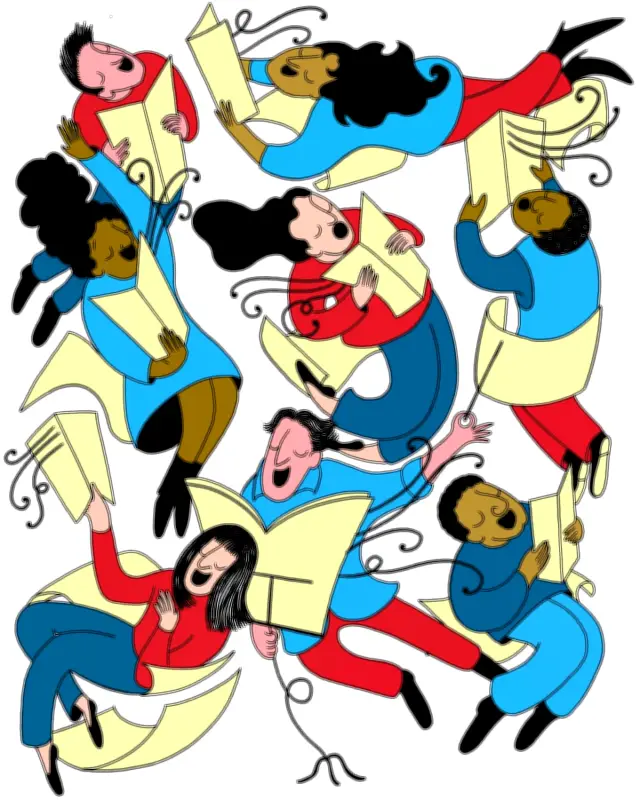
In a former synagogue near downtown Los Angeles, over 100 strangers gathered for a three-hour one-day choir hosted by the Gaia Music Collective. Their goal: learn and perform a choral arrangement of Miley Cyrus's 'The Climb' from the Hannah Montana movie, singing it three times with themselves as the only audience.
A growing movement for connection
One-day choirs are popping up worldwide as people seek connection. Gaia, launched in a Brooklyn apartment during the pandemic, has brought thousands together in New York and beyond. Similar groups have emerged in Toronto, Brisbane, and across Europe and Asia.
'People are hungry for opportunities to make music, but they're also hungry for opportunities to connect with other people,' said Asher Blank, a Gaia organizer and conductor. Gaia has hosted Broadway stars like Leslie Odom Jr and Jessica Vosk, and its TikTok clips have gone viral, including a Brooklyn performance of Natasha Bedingfield's 'Unwritten' with nearly 10 million views.

Filling a void in an 'anti-social century'
The gatherings come amid what the US surgeon general identified in 2023 as a loneliness epidemic. Time spent socializing has declined across all age brackets over the past two decades, and the share of American adults meeting friends for dinner or drinks has dropped by 30%, according to an article in the Atlantic. Weekly religious attendance fell from 42% in the early 2000s to 30% in the early 2020s, and reliable third spaces are scarce.
Participants describe the choirs as filling a void. 'It restored a piece of my soul that was missing,' said Darcy Calabria, 30. The organizers encourage healing by inviting singers to share what's on their minds, making it 'essentially therapy for $15 to $35 a ticket.'
The power of somatic belonging
Singing offers a sense of 'somatic belonging,' Blank explained. 'Feeling my actual body resonate with the sound of my voice, and feeling my body be sort of the vessel and the carrier of that sound, in community with other people who are doing the exact same thing, is just an incredibly powerful experience.'
Kristen West, 29, described it as 'collective effervescence,' the magic that makes church so powerful. An ex-vangelical who left the church in 2022, she said, 'When I left organized religion, the act of singing with a collective was something that I really grieved and I really missed. So there was something so healing about having a space like this.'
From technique to transcendence
At the LA event, the evening began with silent warmups, then split into six vocal parts. The arrangement was challenging, but perfection wasn't the point. 'You obviously want to appeal to the broadest audience, but I also think that people like being challenged,' said attendee Jaimie Ding, 29.
After discussing the song's meaning, the choir sang through three times: first in sections, then walking around, and finally intermingled with piano. 'You come out of it feeling so high, and so optimistic, and like anything's possible,' said Kevin Duffin, 43. 'It's almost like connecting to your inner child.'
Joy in community despite skepticism
Andrea Cammarota, 52, facing layoffs at work, said it was 'a perfect night to have this beautiful, communal coming together of people of literally every age.' Ayla Rosebarreau, 39, recovering from a difficult period, said the choir 'really pulled me out of that sadness into this extreme, bursting joy.'
David Goryl, 53, a longtime actor, found community again after acting classes petered out during Covid. '100-plus strangers coming together and immediately becoming like a family, I got the chills just thinking about it,' he said.
Pop music and queer community
Gaia often chooses pop music that welcomes diverse participants. 'There's a pretty big contingent of people who come to Gaia who are excited about being part of queer community,' Blank said, noting that programming creates space for queerness and self-expression.
Other one-day choirs incorporate activism. New York's Mycelium Choral Project, founded by Gaia alum Kenter Davies, donates half its proceeds to causes like immigrant advocacy, climate defense, and trans youth. Davies says the choirs foster 'shared vulnerability' and hope, helping participants transform over time.

Despite initial skepticism, the experience proved powerful. 'After another day of headlines about fraying social ties and mind-boggling cruelty, it was almost jarring to be among dozens of upbeat people receiving uniformly enthusiastic welcomes,' the author wrote. 'Surrounded by others, engaged in a collective effort, I forgot my skepticism. It was impossible not to feel connected to something bigger than me.'