Boxing has long provided rich material for stories on stage and screen, and its appeal to audiences has not wavered even as the sport's own popularity has declined. A classic play combining boxing and music, Golden Boy, has returned to London after more than 40 years, starring Josh O'Connor as a gifted young violinist lured into the ring by fame and money.
Golden Boy and the lure of the ring
Written in 1937 by Clifford Odets, Golden Boy is set in Depression-era America and explores a fatal choice between a future as a struggling musician or a boxer. The current London production features O'Connor, who also played a boxer turned priest in Wake Up Dead Man. O'Connor attacks a heavy bag with convincing power, and his physique is not entirely the work of a makeup artist.
The play reflects a time when New York life was bleak, opportunities were few, and boxing presented a mirage of escape from poverty. It also works as an allegory, as the hero loses his tender self while finding his feet in the ring.
Boxing's enduring appeal in film
There are more Hollywood movies about boxing than any other sport. Writers, directors, and performers are endlessly drawn to it, despite the common belief that an artistic nature is opposed to physical violence. The fighter in the ring resembles a Greek tragedy protagonist, stripped down to a raw human state, facing destiny and learning the limits of autonomy.
Boxing narratives can carry any amount of subtext and heavy themes. Odets's play is an excoriating critique of capitalism and the American Dream, while Ron Howard's Cinderella Man (2005) turns the same environment into a feelgood fairytale. Russell Crowe portrays real-life fighter James J Braddock in his title fight against Max Baer.
From Hitchcock to Scorsese
Alfred Hitchcock, a master of moral ambiguity, loved boxing. His only self-penned film, The Ring, came out 99 years ago this month. It is a silent black-and-white film notable for its realistic fight scenes, with lead actor Carl Brisson having been a Danish and European champion, and for pioneering point-of-view camerawork showing a fighter sliding into concussion.
In the 1940s, a slew of noirs used the boxing world as a backdrop for tales of vice and viciousness, including Body and Soul, Champion, and The Set-Up. Stanley Kubrick's second feature, Killer's Kiss, belongs to the same genre, with the tagline on the original poster reading: "Her Soft Mouth Was The Road to Sin-Smeared Violence!"
Martin Scorsese's Raging Bull, generally considered the acme of boxing movies, portrays real-life subject Jake LaMotta as an abusive and pathological antihero. Scorsese hadn't wanted to make the film; it was his friend Robert De Niro who was fascinated by LaMotta's self-destructive story and the physical transformation required to tell it.
The actor's challenge and a circular relationship
Boxing's longevity in drama also lies in the ultimate challenge it presents for actors. It is almost impossible to fake a boxer's physique, especially on the unforgiving cinema screen. Daniel Day-Lewis, Jake Gyllenhaal, Will Smith, and Hilary Swank have all put themselves through months of training and daily sparring to prove their commitment to authenticity. Mark Wahlberg had a ring built in his home and honed his craft for five years before shooting The Fighter, though it was his co-star Christian Bale who ended up with the Oscar.
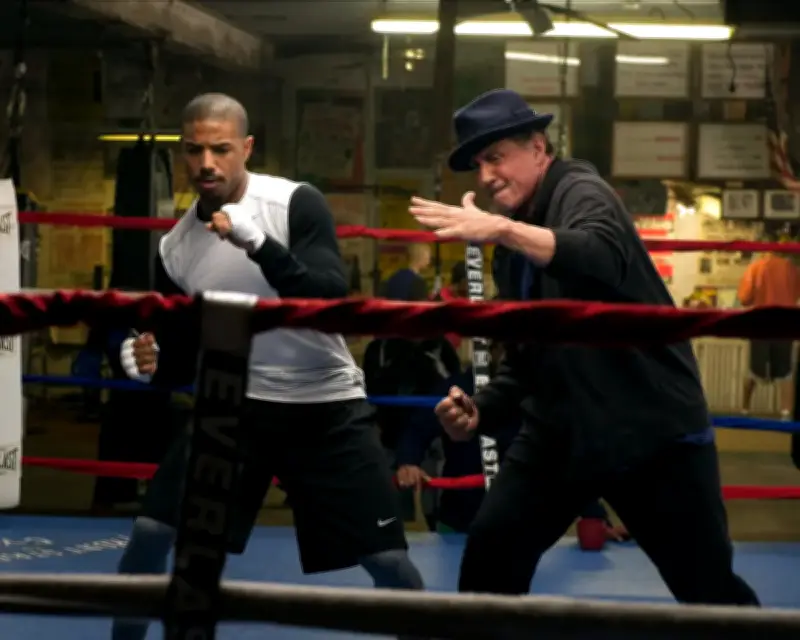
Michael B Jordan, star of the Creed franchise, describes the process of making the films as like "therapy", because he gets to immerse himself completely in his role. "I like living like a fighter, training like a fighter," he said. "I've broken my hand a few times doing this movie. Hands swollen. Like, I wanna feel it. I want to go home and ache." Sylvester Stallone's contribution to boxing has earned him a place in its international hall of fame.
The relationship between the sport and its fictional depiction has become circular. Stallone's 1976 script for Rocky was inspired by the bout between Chuck Wepner and Muhammad Ali the year before. In 2016, Liev Schreiber played Wepner in the arthouse biopic The Bleeder. Next month, the fight appears onscreen in Stallone's own biopic, I Play Rocky. As boxing's own popularity has declined, its appeal to audiences at one remove has never wavered.