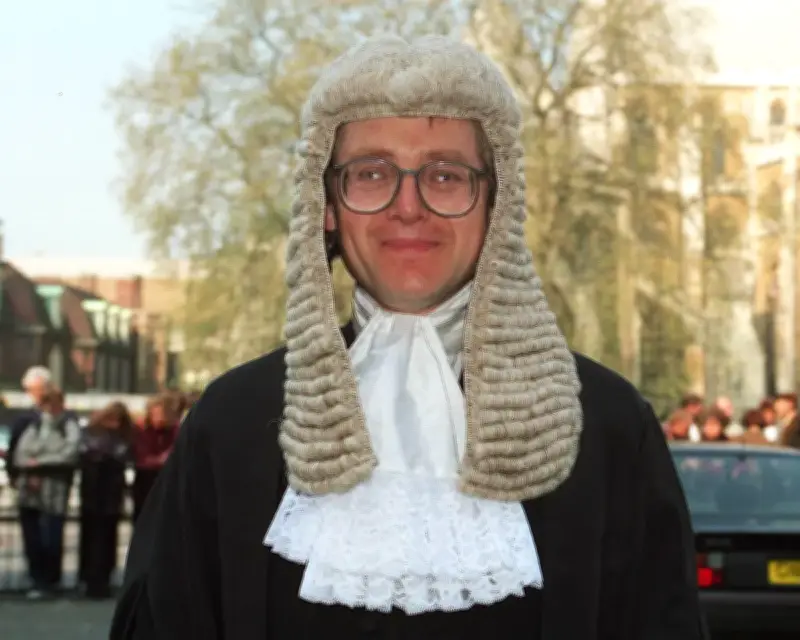
Sir Andrew Nicol, the high court judge best known for presiding over Johnny Depp's 2020 libel case against the Sun newspaper, has died aged 75. His career as a barrister and judge was marked by significant contributions to the defence of civil liberties, particularly in media and immigration law.
Early life and education
Born in Ashtead, Surrey, to Margaret (née Mason), a physiotherapist, and Duncan Nicol, a gas engineer, Andrew was educated at the City of London Freemen's School, Ashtead Park. He earned a law degree at Cambridge and a master's at Harvard before working in housing policy for the state of California from 1975 to 1976, followed by a year at a commercial law firm in Sydney. In 1977, he returned to lecture in law at the London School of Economics.
His path toward commercial law was interrupted when he became a pupil during the controversial ABC official secrets trial in 1978. On the first day, Jeremy Hutchinson QC discovered that Labour's attorney general, Sam Silkin, had secretly ordered jury vetting for “extremist opinions.” Andy was tasked with finding authority to object, leading him to the LSE library to retrieve Jeremy Bentham's 1821 book The Elements of the Art of Packing, as Applied to Special Juries, which denounced the practice. Hutchinson quoted it extensively in his submission that the trial was unconstitutional, later celebrated in a book by EP Thompson and a booklet by Harriet Harman.

Legal career and achievements
Called to the bar at the Middle Temple, Andy joined chambers at 1 Dr Johnson's Buildings, headed by Emlyn Hooson and John Mortimer, building a practice in immigration law and publishing Subjects, Citizens, Aliens and Others in 1990. He developed an interest in media law, acting for David Leigh and the Observer in 1986 in a case that stopped lower courts from withholding magistrates' names from the press. The divisional court declared, “There is no such thing as an anonymous JP.”
He successfully defended the New Statesman from a contempt of court charge for interviewing jurors in the Jeremy Thorpe trial of 1979, though he was reported to the Bar Council for wearing brown shoes, which traditional rules then forbade beneath a black gown.
Andy maintained his LSE lectureship until 1987, talent-spotting students like Heather Rogers KC and Mrs Justice Heather Williams for pupillages. In 1990, he co-founded Doughty Street Chambers, where his commercial knowledge proved invaluable; he served as treasurer and on the management committee. He was made a QC in 1995.
Trailblazing cases and legacy
Andy represented UK representatives of the African National Congress in a false imprisonment case against the apartheid South African government. In 1996, he established the police's duty under the Race Relations Act not to discriminate against Black victims of crime, even if they had not expressly requested help.
He was the intellectual architect of the appeal in the case of Kiranjit Ahluwalia, a battered wife who killed her husband in 1989 after an arranged marriage. Her trial had not noted her trauma and “learned helplessness,” leading to a murder conviction and life sentence. Andy's appeal argument of diminished responsibility was accepted by Chief Justice Peter Taylor, reducing the offence to manslaughter in 1992 and enabling her immediate release. The case has since served as a precedent for domestic violence victims.
In 1984, Andy and the author wrote the first book titled Media Law, originally considering The Journalists' Toothbrush as a title. It began as a slim volume but grew to over 1,000 pages by its fifth edition. Years later, his own opinion that a secret trial was not a trial at all was cited against him when, as a judge, he imposed a blanket secrecy order on a terrorist trial, leading to a rare appeal overturning his decision.
His judicial work was punctilious and learned. Despite social media criticism from Depp fans when he ruled against the actor, his decision was considered appeal-proof and was not undermined by the 2022 US proceedings, where jurors awarded Depp $15m on three counts of defamation and Heard $2m on one count of her countersuit.

Andy was a kind, unassuming man with an infectious sense of humour, generous in helping younger barristers. He served as presiding judge on the South-Eastern Circuit from 2011 to 2014 and as deputy chairman of the Boundary Commission from 2017 to 2020.
Politically committed to social justice, he was married in 2005 to Camilla Palmer KC, an equality law specialist and mediator at Doughty Street. They lived in north London, bringing up two sons, Robert and Jamie. All three survive him, along with a granddaughter, Lark, and his sister, Fiona. Andrew George Lindsay Nicol was born on 9 May 1951 and died on 22 August 2026.