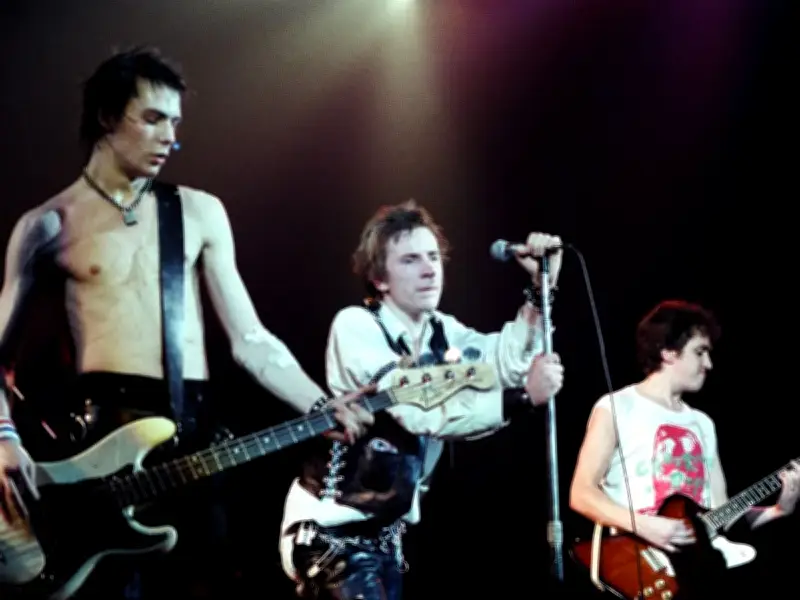
Fifty years ago, the Sex Pistols unleashed a torrent of profanity on British television, sparking a front-page fury in the Daily Mirror under the headline 'TV fury over rock cult filth' on December 2, 1976. The outburst, broadcast on Thames TV's teatime family show Today hosted by Bill Grundy, was heard by millions and came a month after the band released 'Anarchy in the UK,' marking the birth of punk music.
Frontman Johnny Rotten, clad in safety pins and spiky hair, snarled, 'I am an Antichrist … I am an anarchist,' horrifying parents while delighting their children. The ensuing movement—brash, discordant music, wild pogo dancing, and slashed, slogan-covered fashion—became a creative anarchy that defined a generation.
Punk's Deconstruction of Music
In his new book, Punk in 50 Pieces, author and cultural critic Kevin Dettmar relives some of the most influential songs of punk rock, new wave, and post-punk. He argues that punk deconstructed the accepted appearance of a popular song, becoming to music what abstract art became to painting.
'Before punk rock exploded, mainstream popular music was dominated by polished arena rock, disco, and progressive rock,' Dettmar says. Inspired by 1950s rock and roll and 1960s garage rock, punk stripped away commercial polish. 'Punk said f*** that, let's just strip it back to the studs. You had these people forming bands who couldn't actually play an instrument, but it didn't matter. It was more about attitude and energy, rather than being a prodigy. And, as a result, punk opened music up to a much wider swathe of artists.'
Dettmar notes that while keyboardists like Keith Emerson and Rick Wakeman used instruments costing as much as a house, punk musicians picked up—or stole—secondhand basses. For Siouxsie and the Banshees' first performance at the 100 Club Punk Festival in London in 1976, co-founder Steven Severin had picked up a bass guitar less than 24 hours before taking the stage.
Political Fire and Social Commentary
Political dissatisfaction fueled punk. The 1970s' economic crisis, marked by stagflation—stagnant growth, high unemployment, and soaring inflation—provided the backdrop. Dettmar says, 'Anarchy in the UK became the ultimate punk anthem, because it weaponised raw youth frustration into a direct, abrasive assault on a stagnant British establishment. The thing that struck me about hearing the Sex Pistols was that they were frightening. Johnny Rotten scared me. And there was no precedent for that kind of unapologetic anger and disdain. That was really exciting.'
In 1977, Ian Dury's 'Sex & Drugs & Rock & Roll' continued the conversation, with lyrics like 'Sex and drugs and rock and roll are all my brain and body need.' Dettmar notes it pointed out the 'very real sense of 'anything goes' that characterised the early years of punk.'
When Margaret Thatcher became Prime Minister in 1979, punk's anger intensified. Dettmar says, 'Youth unemployment was spectacular. Nobody could get a job. Everybody was on the dole and the fact that someone was addressing that struck a real chord. It was a collective release of anger.' The Clash's 'London's Burning' (December 1979) told of the capital's boredom, decay, and bleak economy, while 'London Calling' delivered an apocalyptic warning inspired by news of potential Thames flooding and the 1979 Three Mile Island nuclear accident. Dettmar says Strummer 'explicitly criticised people for ignoring real-world threats when he sang, 'while we were talking, I saw you nodding out.''
Punk also addressed sexuality. The Buzzcocks' 1978 'Ever Fallen in Love (With Someone You Shouldn't've)' explored forbidden attraction. Dettmar says frontman Pete Shelley 'purposely kept the pronouns gender-neutral ('someone you shouldn't've'). Because Shelley was bisexual, this choice allowed for plausible deniability during a conservative era, while making the agony of desire universally relatable to anyone.'
Punk's Evolution and Enduring Legacy
By the 1980s, punk gave way to post-punk—darker, experimental sounds from bands like Joy Division, Gang of Four, Wire, and The Cure—and new wave, which traded aggression for catchy pop melodies and electronic experimentation, with artists like Blondie and Talking Heads making punk's energy commercially viable.
Dettmar recalls American band The Germs, whose chaotic shows led to them booking under a fake name, GI (Germs Incognito), after being banned from LA clubs. 'Ultimately, pure punk was too chaotic to be sustainable,' he says. The Sex Pistols' 'God Save the Queen' was not completely banned from British charts, but its name was suppressed and it was blocked from the number-one spot.
Punk's spirit endures. Noel Gallagher called the Sex Pistols' 1977 album Never Mind the Bollocks the 'most influential record of all time.' Patti Smith described punk as 'an enduring idea and a state of freedom,' saying, 'It'll be around 200 years from now for the people who want it.' Dettmar notes modern acts like Yungblud and Fontaines DC channel punk's angst, while Olivia Rodrigo and Machine Gun Kelly have brought punk-inspired sounds to the Billboard charts. He concludes, 'One of the functions of rock and roll has always been to upset your parents, right? Kurt Cobain called it 'territorial pi**ing'. It's a way of sort of marking your territory. I'm going to play music that's horrible. That means you don't want to come into my bedroom. Nothing does that better than punk.'