Radio 3 will broadcast from six lighthouses around the UK coast this Saturday to mark the 200th anniversary of Longstone Lighthouse, with the story of Grace Darling's daring rescue at the heart of the programme.
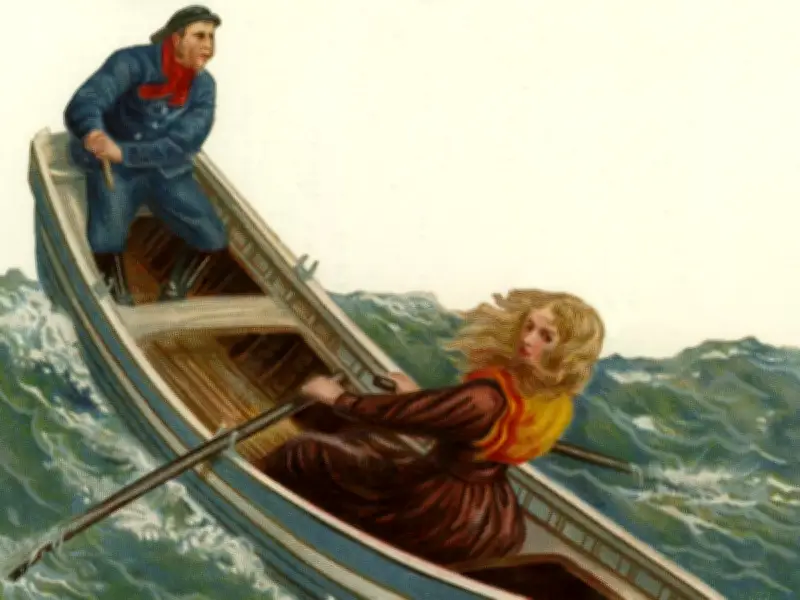
Grace Darling was 22 when she spotted survivors clinging to a rock in the North Sea from her bedroom window at Longstone Lighthouse. With her father William, she rowed out through the storm to rescue nine survivors from the wreck of the paddle steamer Forfarshire, cementing her place in history.
Grace Darling's legacy lives on
George Shiels, who gives tours of the Farne Islands and Longstone Lighthouse where Grace lived, said: "We still get lots of schoolkids coming here today. I think they still study her and they want to have a look at where she would have lived and what it was like. It's all changed a bit since then, though. But it's still a fantastic story."
The Radio 3 special, called Where the Light Sings, will feature a programme from St Aidan's church in Bamburgh, where Grace was buried, about six miles from Longstone.
Longstone Lighthouse, still in active use, was built in 1826, electrified in 1952 and fully automated in 1990.
The wreck of the Forfarshire
In the early hours of 7 September 1838, the paddle steamer Forfarshire, sailing from Hull to Dundee with around 60 passengers and crew, broke apart on Big Harcar, a low rock in the Farne Islands off the Northumberland coast. Forty-three of those on board drowned that night. Some scrambled onto Big Harcar and clung there until first light. Nine others escaped in the ship's own lifeboat and were picked up off Tynemouth.
George, who has worked for around 20 years as an attendant for Trinity House, the organisation that owns and runs most of England's lighthouses, said Grace and her father first realised something was wrong in the middle of the night. He said: "I think they kept an eye on the weather and everything during the night. And then you woke up and had to wait for daylight. The wreck happened fast. The captain got mixed up with the lighthouses, there was Longstone, and there's also a lighthouse on the Inner Farne."
"The conditions were bad, because the wind was up to the north, and it was really, really rough, so they had to wait until the low tide," he added.
Grace and her father rowed their small boat around the sheltered south side of the islands to reach the wreck, bringing back four survivors on the first trip and returning for the rest.
A Victorian celebrity
Grace's fame spread fast once the story broke. She received the Silver Medal for Gallantry from the forerunner of the RNLI, and Queen Victoria sent her £50 as a reward for her bravery. More than a dozen portrait painters travelled out to Longstone to capture her likeness, and letters, gifts and even marriage proposals arrived by the hundred. The Duke of Northumberland took on the role of her self-appointed guardian, managing the donations that poured in. The Times wrote: "Is there in the field of history, or of fiction even, one instance of female heroism to compare for one moment, with this?"
Longstone was first lit on 15 February 1826 and cost around £4,771 to build, including the keeper's cottage. Jennifer Lucy Allan, author of The Foghorn's Lament and a presenter on BBC Radio 3's Late Junction, said: "She was this early Victorian celebrity, and that means that she's still very well remembered now. But, actually, the story is about a really strong teenager who took a really bold decision."
"She was quite a young girl. She died at 26 as well, so there's this tragedy in her story. For me, all these places like Longstone are places where there's a lot of life and death present. People live there, there's really strong communities around there, but the sea remains this sort of unknown, or this territory that kind of takes life and gives it," she added.
The sound of the sea
Jennifer spent years researching foghorns for a PhD before writing her book, titled Fog Tropes: A Social and Cultural History of the Foghorn. She points to Robert Eggers' 2019 film The Lighthouse, in which a foghorn drone runs through almost every scene, as a clear recent example of the sound's hold on audiences.
"There's lots of ghost stories with a foghorn in, because they play into that same period, the 19th century Victorian ghost story, and the brink of industrialisation," Jennifer said. "And the sound of the sea is something that just resonates with everybody. The sea has lots of different characters, you can have a big roaring sea, or people listen to ten hour YouTube videos of the sound of the sea to put them to sleep."
Jennifer, who is due to join the closing broadcast, continued: "I love it when radio is on the move, because it takes you to places in a way that I don't think many other mediums can. To have it on the move in such an ambitious day, with so much going on, I think it's going to be amazing."
A 12-hour broadcast extravaganza
For Alex Anderson, director of Tandem Productions and mastermind of Where the Light Sings, the day is bigger than any single rescue too, in scale if not in emotion. He said: "It's a 12 hour extravaganza of lighthouse broadcasts in relay from eight in the morning till eight at night, all around the coastline of the United Kingdom. It really does take in all four nations, England, Wales, Scotland and Northern Ireland."
"One of the exciting things we are looking forward to is it's an opportunity to reach parts of the UK which don't often get on the airwaves. We wanted to get to some remote parts of the UK, and lighthouses definitely tick that box," he added.
Alex believes Grace Darling's story still touches a chord with listeners. He said: "It's just the sheer selflessness of it, the incredible bravery. Not the fact that she was a woman, but because she wasn't the keeper, her father was the keeper. Women weren't allowed to be keepers, it was a male job, but their offspring or wives sometimes accompanied them."
"She took it upon herself to rescue nine people in unbelievable conditions, in a tiny little boat that really wasn't designed for it. I guess that's why it resonated so widely, and continues to resonate. It's just such a selfless act of bravery, which is so very human," he added.
The day features live programmes from six locations: Georgia Mann at Dungeness Lighthouse, Tom Service on the Ardnamurchan Peninsula, John Toal at the West Lighthouse on Rathlin Island, Shân Cothi at Strumble Head, and Kate Molleson at St Aidan's Church in Bamburgh, looking out towards Longstone Lighthouse.
Alex added: "Lighthouses are quite emotional places when you start thinking about them. Most people have seen a lighthouse somewhere, and they're always in the distance, because that's the point of them, you're not supposed to get near a lighthouse."
"When you really think about why they're there, of course they're there because a lot of people died, fundamentally that's why they're built. They were then built to try and stop more people dying, which they did and continue to do. They are special places."
Radio 3's Where the Light Sings day of live broadcasts is on Saturday 26 September from 9am to 10pm and also on BBC Sounds, celebrating Longstone Lighthouse at 200 live from St Aidan's Church, Bamburgh from 4pm to 6pm.