The Museum of London’s new home is in two historic former market halls in Smithfield. A decade in the making, the museum will reopen in November in two restored market halls that will house 7 million objects and host late-night DJ sets.
Museum Director Envisions a Social Space
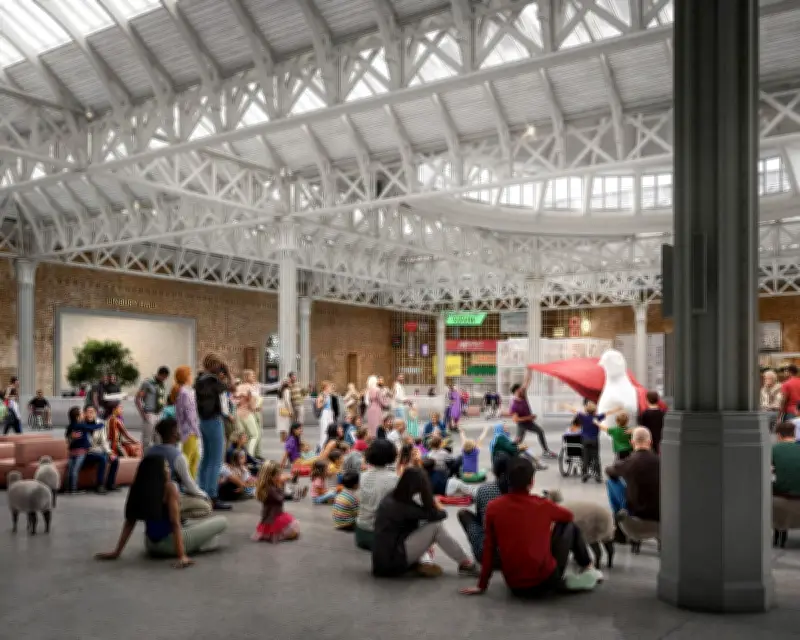
Sharon Ament, director of the new London Museum, says it will be “a social space for the city.” The museum will host afternoon tea events, monthly dinner clubs, and late-night DJ sets where visitors can mingle among the artefacts while dancing. “I want commuters to pass through the museum on their way to and from work. I want people to extend their evenings in a museum, in a way which is a different form of going out,” said Ament. “Maybe they’ll stay for an hour, maybe they’ll stay right until we close, maybe they’ll do a club night. We need to match our opening times to how people actually operate in their daily lives.”
Ament emphasized the museum’s responsibility to all Londoners, as it is funded by taxpayers. “We are funded by the taxpayers of London, so our responsibility is to all Londoners,” she said.
From Barbican to Smithfield
The institution, formerly known as the Museum of London, has been closed since 2022 when it vacated its eccentric former premises in the Barbican complex. Its new home, painstakingly converted over a decade from two historic former market halls in Smithfield, in the City of London, will open on 28 November. Paul Williams, principal director of the lead architects Stanton Williams, said the museum would be “an arena for public life.” “It’s not just about a container for objects, but it’s a space where people are going to interact with each other,” he added.
The cavernous market halls will be connected by a former London street, now glazed, with openings at either end to welcome visitors inside. What was once the trading floor of the Victorian General Market will host a full programme of cultural events, with the first, called London Tastes, focusing on the diversity of the capital’s food scene.
Collection of 7 Million Artefacts
Events will sit alongside the museum’s collection of 7 million artefacts, which include the Cheapside Hoard of 17th-century jewels, the vest worn by Charles I when he was beheaded in 1649, and a chunk of the Whitechapel fatberg, collected from the capital’s sewers in 2017. Other acquisitions made during the museum’s temporary closure include a police sentry box decorated with piranhas by Banksy in 2024 and the Bloomberg Collection of 14,000 Roman artefacts, discovered during construction of the news organisation’s headquarters in 2014 and donated to the museum last year.
The £437 million project has been funded by the corporation of London and the mayor of London, with a range of other donors including the National Lottery Heritage Fund.
A New Museum Model
“Moving into a market really made us think differently about how we could possibly be as a museum,” said Ament. “What we’ve all learned is that markets make absolutely fantastic museums, because of all the intrinsic qualities of a market that I don’t think are necessarily always built into museums. A market is a social space so we are a social place.”
She said this approach was something that many other museum directors had been “grasping towards,” but were often hampered by their institutional culture or historic buildings. Nonetheless, she said, “gone are the days where museums are led by [obsessions] of academics whose deep interest in Etruscan vases means that there is a very niche story to be told and a niche audience out there.”
“I see museum colleagues really opening their doors in new and profoundly exciting ways. We could all do it a bit more,” Ament concluded.