As Liverpool FC’s famous football stand, the Kop, marks its 120th anniversary, Mirror columnist Brian Reade tells its story in an exclusive extract from his book, The Kop. Reade shares the true significance of the stand, from its origins in South Africa to its place in football history.
From Spion Kop to Anfield
Near the top of a barren South African hill stood a hut where a guard charged a few rand for cars to pass through. On the back wall hung a Liverpool FC scarf. When Reade’s guide, Don, told the guard that Reade stood on the Kop at every Liverpool game, the guard said, “so welcome home, my friend,” which made Reade burst out laughing.
Reade was in the wilderness of KwaZulu-Natal, 6,000 miles from Britain, and a stranger was telling him this was his home. But as the hill was called Spion Kop, and Reade had been a regular on the Anfield version for 56 years, in a spiritual sense, it was.
At the scrubland peak stood long rows of mass graves with weather-beaten metal crosses but no information about those who lay below. It was eerie, bleak, and sad, like a forgotten graveyard on an abandoned island. Don saw Reade’s pained expression and said: “Well, you’ve always wanted to see where your famous Kop came from, so here it is. The site of the most incompetent display of generalship in the entire history of the British Army. And all those lowly Tommies from places like Liverpool paid a terrible price.”
In January 1900, during the Second Boer War, Spion Kop went down in legend as “The Acre of Massacre” due to hundreds of British soldiers being slaughtered in one bloody day. Such a terrible and pointless massacre had never before been witnessed by Queen Victoria’s army. When news reached home, the shocked public questioned the quality of military leadership, and some questioned the point of Empire.
Spion Kop then entered the English language as a description of a steep hill. As football boomed and clubs built large spectator embankments, some named their terraces in honour of local soldiers who had died there. Woolwich Arsenal (later Arsenal) built the first Kop in 1904, but it was the 28,000-capacity one at Liverpool’s Anfield in 1906 that would eventually send the phrase global.
The Kop Finds Its Voice
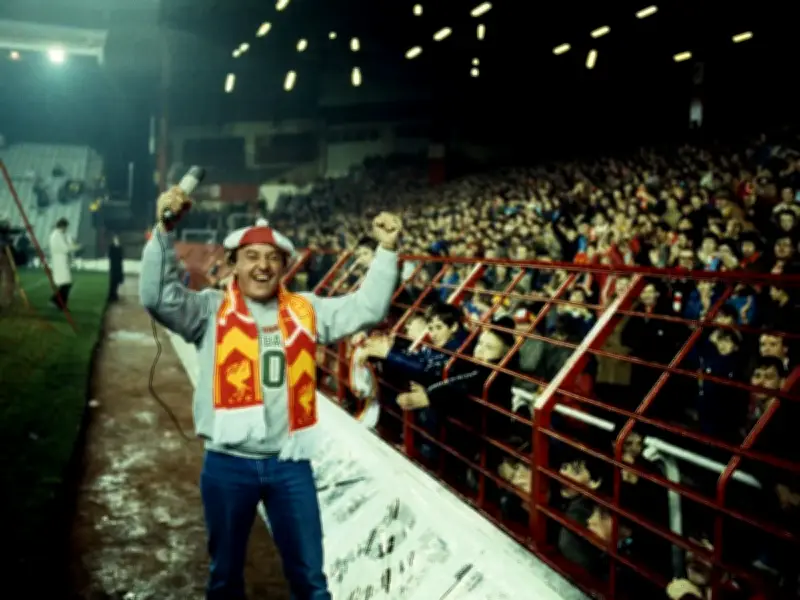
The Anfield Kop barged its way into the national consciousness in the mid-1960s due to a combination of Merseybeat, TV cameras, and Bill Shankly’s fresh, young side winning promotion to the First Division. As thousands more fans were drawn to watch an exciting Liverpool team beating all-comers under the charismatic Shankly, the Kop would be full an hour before kick-off.
To keep them entertained, a tannoy system was installed which played the top ten singles of the day. With Merseybeat dominating the charts, it turned into a mass Scouse singalong; the Kop swaying in time to the tunes and belting out the lyrics before inventing their own chants throughout the game. Everyone in red, whether wearing a scarf or a shirt, knew they had to perform for the benefit of each other. Liverpool found its collective voice, and it echoed far and wide.
Word of this terrace singing phenomenon spread rapidly, enticing news and culture outlets to send their cameras to Anfield to document it. Pink Floyd incorporated the Kop singing You’ll Never Walk Alone into their song Fearless, and a record company recorded an album of the fans belting out their repertoire, called The Kop Choir. Even the BBC’s serious current affairs programme Panorama documented the famous terrace, describing it as “as rich and mystifying a popular culture as in any South Sea island” with “a gay and inventive ferocity that is quite stunning.”
A Personal Rite of Passage
Reade first fell in love with the Kop from a distance—100 yards to be precise. As a seven-year-old, perched on his dad’s shoulders in the Anfield Road End in 1965, he later graduated to the front of that terrace with his older brother Vic for the rest of the 1960s. His rite of passage to the hallowed ground came the day after he turned into a teenager in 1970 in a full-blooded Derby. When he reached the top of the steps at the back of the Kop for his debut appearance and heard the songs starting to rise, he felt a tingle down his arms.
The first half was all tackles and skirmishes, but after the break Everton played like the League champions they were and took a two-goal lead. With 20 minutes remaining, Steve Heighway scored with a low shot from an acute angle, and a human wave lifted Reade up and almost unhinged his neck from his spine. When John Toshack’s head powered home the equaliser, he flew 30 feet forward and was hurled back up like whiplash. With six minutes left, and his ears ringing from 28,000 voices bellowing You’ll Never Walk Alone, Chris Lawler volleyed home the winner, and the closest state to pandemonium he had ever experienced broke out.
His thin body felt like it had been dumped in a spin-drier. He sank under to a darkness of trousers, was sucked up to the light, heaved back, tossed in the air, and fell into a gap in the crowd. But his feet weren’t touching the floor, and he just hovered, held up by sweating bodies, until he touched the wet concrete, feeling a stream of warm urine through his sock, and realised he had lost one of the Chelsea Boots that his mum had given him as a birthday present the previous day. As the game played out, what was left of his voice joined in the songs of celebration.
Outside Anfield, he checked his pockets and realised his bus fare had gone the same way as his Chelsea Boot. But its loss, like that of his shoe, was utterly irrelevant as he didn’t so much walk the six miles back home to Huyton as float. The Kop had made him petrified but left him smitten.
The Anthem’s Global Rise
If it hadn’t been for Merseyside rain, the Kop may never have turned You’ll Never Walk Alone into a global anthem of hope and solidarity. It was on a wet afternoon in 1960 that Gerry Marsden, on a break from the Cavern, sheltered in a cinema to watch his favourite comic act Laurel and Hardy. In between two of their films, they showed Carousel. Marsden nodded off, only to be woken by the opening bars of You’ll Never Walk Alone. He fell in love with it, put it into the Pacemakers’ live sets, and released it as his third Number One single in late 1963.
The Kop took it to their hearts, singing along to it during the pre-match playing of the top ten. When it fell out of the chart, they began chanting “where's our song? Where's our song?” By the next game, it was back. And like Gerry, when he got off his Mersey ferry, there it stayed.
However, it was in America that “our song” was ultimately given Anfield’s version of Royal Assent. In the summer of 1964, Liverpool undertook a North American tour at the same time Gerry and the Pacemakers were playing concerts there. When both were in New York, Marsden, a staunch Liverpool fan, invited the team to watch him play on the Ed Sullivan Show.
“I said to Ed, let's bring the boys on stage and we'll all sing You'll Never Walk Alone,” Gerry recalled in 2013. “We did the song to 66 million people throughout the States and as we were walking off the set, Shankly said to me: 'Gerry my son, I've given you a football team and you've given us a song.'”
The Kop: A Fan’s History of Football’s Most Famous Stand by Brian Reade (Quercus, £25), published October 8th. Copyright © 2026 Brian Reade.