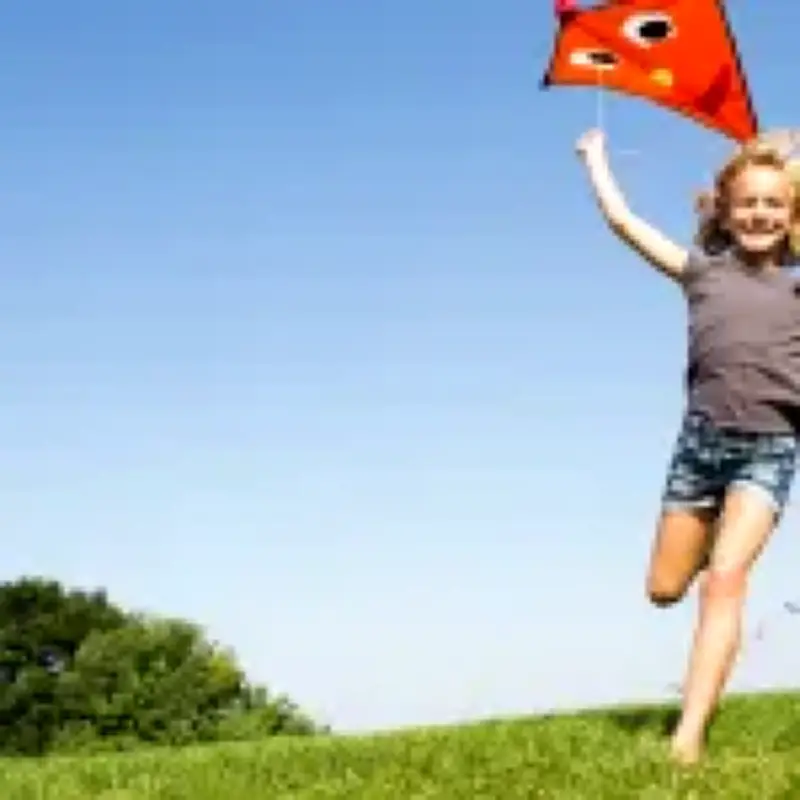
Up until very recently, I couldn’t have told you the last time I saw a kite. On the front of a twee children’s birthday card, perhaps. Maybe on the cover of an old Enid Blyton novel spotted through the window of an Oxfam bookshop. Or being enthusiastically recommended on TV by the immortal Cockney barrow boy Dick Van Dyke in Mary Poppins. But an actual kite, attached to an actual child and flying in an actual park? Not a clue.
Then, the other day, I noticed one. I should probably clarify that I don’t regularly hang around parks monitoring the recreational habits of local children. The kite caught my eye. They’ve the ability to do that, what with them being multicoloured and flapping about in your peripheral vision like they do. It made me smile slightly more than seeing a kite probably ought to. It wasn’t a full, beaming grin – I’m not an oddball. More the kind of gormless, faint hint of a smile you’d usually reserve for seeing a good dog in a pub beer garden.
A simple pleasure in a digital age
There were some kids running around beneath it, having what appeared to be a genuinely excellent time with a form of entertainment that could have been plucked straight from the 1950s. No screens. No charging cables. And no app tracking their location or mining wind speed data. Just a bit of cheap plastic, a couple of sticks, a very long piece of string and a few helpful gusts of wind.
Yep. An actual kite. Not an augmented-reality kite viewed through a £900 headset. The technology on display hadn’t advanced much since their invention in Ancient China about 2,500 years ago. The price has, but not by a lot. You can pick the things up in toy shops and online for not much more than a fiver.
Why kites still matter
Why was it pleasing to see? Well, there’s nothing innately amazing about kites. They go up, flitter about, crash down to the floor and tend to enjoy getting stuck in trees. Arguably, they’re even a bit rubbish. Most of the experience involves running around a field, park or beach like a lunatic while everyone shouts contradictory instructions at you. Then it finally takes off, everybody gets all excited and you spend the next few minutes standing completely still holding a piece of string. Or risking your life climbing a giant oak tree.
Crucially, though, they get people outside (inside kite flying is still quite niche). Getting fresh air, exercise and vitamin D. All the stuff that adults are forever claiming children don’t get enough of, usually while staring at their own phones.
Other endangered childhood pastimes
It did make me wonder what other supposedly endangered bits of childhood might still be out there, quietly carrying on without me noticing. For all I know, Britain’s playgrounds are absolutely plagued with marbles and pogo sticks. The Pog and Tazo trade could be booming to levels not seen since the mid-1990s. I’ve no idea. I’m a 41-year-old man. Kids don’t send me the minutes of their meetings.
The yo-yo surely deserves another go. It travels downwards and, if you’re reasonably competent at messing about with the thing, it comes back up again. It teaches kids that what goes up must come down. But what goes down doesn’t always come back up again. Which is fairly profound. Well, sort of.
Could be that hopscotch is due a resurgence too, although we’d probably need to check that the name isn’t offensive to people from north of the border first. We live in more sensitive, kinder times now, of course. In a similar vein, it’s probably wise to let the Health and Safety Executive carry out a full risk assessment before allowing British Bulldog to re-enter UK playgrounds.
And autumn’s on the way, which means there’s hope for the return of conkers. A sport in which children drill holes through horse chestnuts, thread them onto bits of old shoelace and violently smash them into each other’s horse chestnuts/hands/heads until one of the conkers disintegrates or one of the kids has to go to the school nurse. It’s a small wonder it’s never been made into an Olympic sport. One where soaking a nut in vinegar counts as doping.
Room for both old and new
I’m not suggesting that the nation’s children have suddenly decided to abandon their smartphones, tablets and games consoles and return en masse to some imagined golden age of rosy-cheeked post-war childhood hobbies. Because they haven’t. And nor should they. Modern entertainment is pretty good. That’s why everybody likes it so much. There’s room to occasionally pretend it’s 1951, for the odd afternoon, at least. Go fly a kite. Get a yo-yo. Jump on a pogo stick. Draw a hopscotch grid on the pavement (provided the local council has granted written permission for you to do so, of course).
Only the kids I saw weren’t being nostalgic. They couldn’t have been. Nostalgia for them would be remembering the last series of Bluey. Flying a kite wasn’t kitsch, retro chic or a charming throwback to a simpler age before the distractions of TikTok, Minecraft, Roblox and cut-price generic tablets with rubberised neon green covers. It was just something quite fun to do for an hour.
Maybe that’s what’s reassuring. For all the warnings that young ‘uns are doomed to spend their entire childhoods staring glassy-eyed at screens, sedentary and sedated, apparently some of the most primitive entertainment we’ve ever invented can still appeal. Sometimes all you need is an open field, a bit of wind and five quid’s worth of red and yellow polyethylene.
That’s the hope, anyway. Perhaps I shouldn’t read too much into a few kids and one kite. For all I know, all their classmates were sitting indoors playing Kite Simulator on a knock-off supermarket iPad.