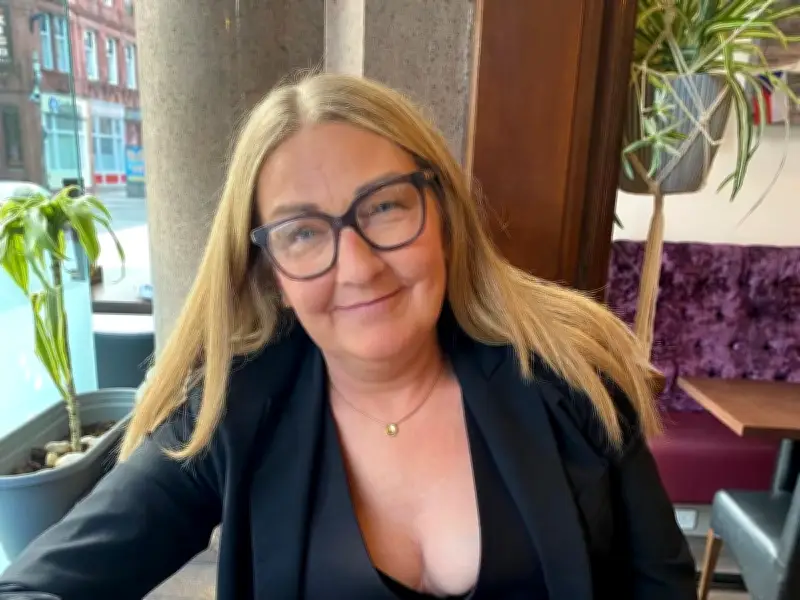
A woman from Bolton who was given just 48 hours to live before receiving a double lung transplant is now lighting up landmarks across Greater Manchester to raise awareness for National Organ Donation Week.
Heather Bluer, 47, spent years in and out of hospital as doctors struggled to diagnose her condition. It was not until 2024 that she was told she had only days to prepare for life-changing surgery.
A lifelong battle with breathing problems
As a child growing up in Bolton, Heather was prone to chest infections and respiratory problems. Those issues continued into her early 20s, until a chance consultation with a doctor finally provided an explanation. She was referred to a specialist clinic in Birmingham and, at the time, was doing well, but she was not followed up.
During the Covid pandemic, Heather was shielding strictly. When restrictions began to ease, she started experiencing episodes where she felt she could not breathe. At first, she thought they were panic attacks. Speaking to Manchester Evening News, she said: “I'd been stuck inside for a long time and reintegrating and knowing the risks. So we just put it down to anxiety.”
In October 2021, her health deteriorated rapidly. Again, the symptoms were attributed to stress and anxiety. By March, Heather was still working remotely and conducting hearings from home, but she was becoming increasingly unwell. During one hearing, she suffered another episode and a colleague told her she needed to stop working and see a doctor. Her concerns were repeatedly dismissed as anxiety and depression, with medication prescribed over the phone.
Diagnosis and a race against time
Gradually, her condition became so severe that she stopped leaving the house. She could barely move around her home and developed severe swelling in her legs. She recalls: “I was literally crawling around the house.” The swelling became so extreme that, after walking downstairs in the morning, her legs would swell from her ankles to just below her chest. “I couldn't move, and I would have to lie down with my legs in the air to get rid of the oedema.”
Eventually, she reached breaking point. “I just said to him, ‘Look, I'm dying. There is something seriously wrong. I am dying and you need to do something.’” Blood tests were finally carried out and Heather was sent for a heart scan. She was diagnosed with pulmonary hypertension. Doctors believed the problem was not primarily with her heart, but with her lungs.
She was sent urgently to specialists. It was the first time in six or seven months, Heather says, that anyone had checked her oxygen saturation levels. “The next thing, there's alarms going off, they're swinging me onto a bed, they're cutting my clothes off, they're screaming, they're hooking me up to everything,” she says. Doctors told her that her oxygen levels were not compatible with life. “They couldn't understand how I was alive, let alone functioning.”
Three years of hospital battles
What followed was a three-year battle in and out of hospital, as her health continued to deteriorate. Of those three years, she estimates she spent only around six months at home. At one stage she required 18 hours of care a day. Her daughter, who was just 13 at the time, became part of the daily reality of caring for their mum.
Heather remembers just how difficult it was to explain to people what living without enough oxygen felt like. “I laugh at my daughter because my daughter would say, ‘Mum, I've got a cold, I can't breathe,’” she says. “You've no idea. I mean, it's impossible to explain to somebody when you say you can't breathe.”
Breathing became an exhausting physical task. She could not brush her teeth because having something in her mouth while trying to breathe was too difficult. She struggled to eat. Even moving from her bed to the sofa could leave her fighting for breath. “You don't appreciate breathing. You just take it for granted. You do it without thinking.”
During her years in hospital, Heather suffered a series of further medical crises. She developed a pulmonary embolism which doctors could not treat in the usual way. At one point, she was given 48 hours to live. She survived. A week later, she was told she might not make it through another day, or certainly the weekend. She survived again. There were infections, complications and Covid. Then, in March, she contracted Covid again. “That basically was the final straw,” she says. “That was just a downward spiral.”
If she was considered too unwell, she could not undergo a transplant. Every time she was admitted, she was effectively paused on the transplant list. “I'd be in for a couple of days, home for a few days, in for a couple of days, home for a few days.”
A new mission
In June 2024, Heather attended a regular appointment at the transplant centre. She needed to be placed on the urgent transplant list. On the Monday, she was told she had been accepted onto the urgent list. She would need to be admitted to hospital to keep her alive while she waited. On Wednesday afternoon, the phone rang. There was a donor. Heather went into hospital, underwent the necessary checks and, the following morning, went into surgery. She received a double lung transplant. “I'm alive,” she says. “I'm breathing. I have new lungs.”
Two years on, Heather is acutely aware that a transplant is not a cure. “It’s a treatment,” she says. Life after transplant comes with its own demands. She is immunosuppressed and must take medication every 12 hours without missing a dose. She is highly susceptible to infections and has experienced significant side effects from her medication. She has developed osteoporosis and cataracts. Earlier this year, she fell and broke both arms, suffering multiple fractures. “I've got quite good at that,” she jokes. But even when the physical consequences of transplant become difficult, Heather keeps returning to the same perspective. “Sometimes I do moan about it,” she admits. “But then I give myself a reality check because I feel bad moaning that I'm alive.”
Now, Heather wants to use her experience to help other people. She has recently been approached to become a trustee of New Start, the charity connected to her transplant community. The organisation has been established for around 20 years and, until recently, had been entirely volunteer-led. This year it secured funding for its first member of staff. For Heather, becoming involved is another way of turning an experience that nearly killed her into something that might help someone else.
Heather and another double lung transplant patient, Natalie Kerr, are aiming to light a different landmark across Greater Manchester pink each day of that week, as part of the NHS national initiative to raise awareness for National Organ Donation week (21-27 September). On Sunday, they'll be lighting up Wythenshawe Hall at 7:30pm, with Wythenshawe centre having just celebrated its 1,500th life-saving transplant, the medical team won a National Excellence Award, and their patient squad just brought home the trophy for the Best Heart and Lung Team at the British Transplant Games.
Heather shared: "It's fantastic. You know, the support that the people are showing is great. But like I say, it's just a case of doing everything we can to raise awareness. Because people hear about transplants and donations, but I think, before I needed a transplant, I never really thought about it and you don't, but then when you need it or when somebody now needs it, it's a very different story."
She went on to praise the help of Kylie Ward from Manchester City Council who helped her organise the lighting up of various landmarks, and Jon Drape from Engine No.4 who also helped to organise and fund their mission. They've already lit up Chorley Town Hall, Adlington Village and Rivington Gardens, and are excited to continue to raise awareness.