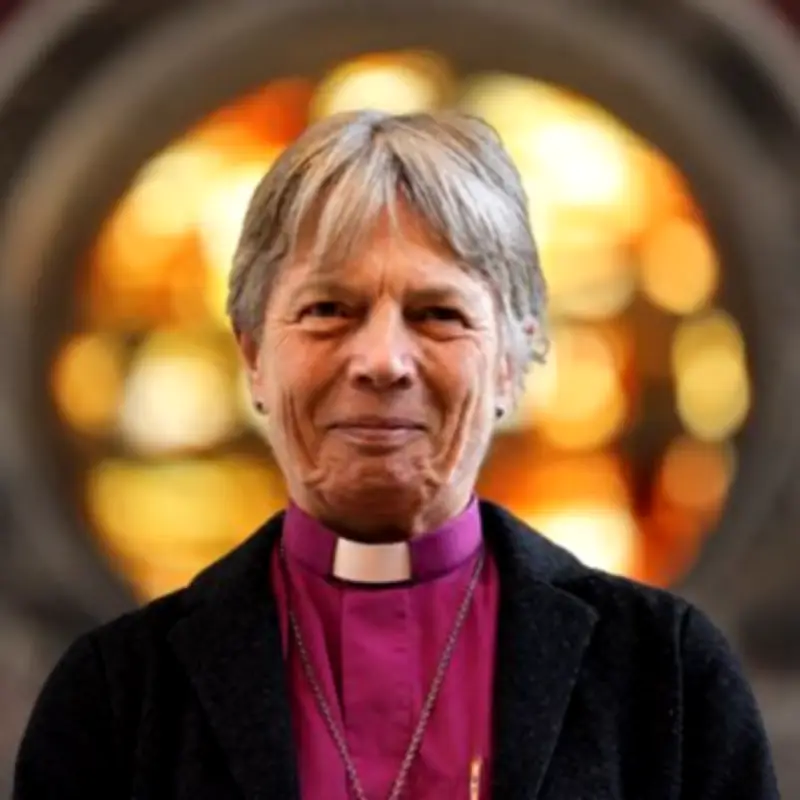
When Cherry Vann became Archbishop of Wales last year, everyone wanted to talk about one thing. It wasn't that she had become the most senior figure in the Church in Wales, nor that she was the first woman to lead it. It was that she was gay.
For Archbishop Vann, the prospect of that conversation becoming the focus of worldwide attention was overwhelming and daunting. The headlines came quickly, along with labels like trailblazer, pioneer, and history maker. Yet when she learned she topped this year's Pinc List, she was genuinely surprised.
"I was born in what was then a little village in Leicestershire," she says, reflecting on her journey to the top of the church ahead of Pride Cymru weekend. Raised alongside her younger sister amid farmland, she grew up in a household where faith was woven into everyday life.
"We were a religious household," she tells WalesOnline from Newport Cathedral at Stow Hill. "My mum and dad took us to church from our earliest years. I spent my formative years as part of a church community, so it's very much part of my DNA."
Church was constant, but so was a growing sense that she was different. Long before she had the language to describe her sexuality, she recalls recognizing that the future others imagined for her didn't feel like her own.
"I can remember — I don't know how old I was, but I certainly wasn't a teenager, probably eight — we were standing in the kitchen and my aunt said to me: 'Oh, I'm sure it won't be long before we're hearing wedding bells and coming to a christening.' And I knew then that that wasn't going to happen. I didn't know why. I didn't think logically it was because of my sexuality, but I just knew I wasn't going to get married and have children as expected."
As she grew older, that feeling became clearer. "Of course, I fell in love with a girl and then it became very clear what my sexuality was."
What stands out as she reflects on those years is not a crisis of faith but the tension between personal conviction and institutional teaching. "I've never doubted that God loved me," she says. "I've never doubted that God made me who I am, and I've never doubted that being who I was was right. But I did know that other people disapproved and that the church's teaching was against being gay and in a gay relationship."
She learned to compartmentalize. "I learned to hide it," she shrugs. "I learned to talk about 'me' instead of 'us', and 'I' instead of 'we'." Her first relationship was long and significant, beginning while she was still at school and continuing after both she and her partner left for different colleges.
Over time, navigating the gap between faith and sexuality became a familiar balancing act. "I guess it's been over the years that I've had to learn to navigate my sexuality with what I think my faith says and with what other people think my faith says."
That debate, she says, remains unresolved within parts of the church. "There are those who think that God creates us as we are, God loves us as we are, and wants us to be happy and fulfilled. And there are others who think very clearly that this is wrong. I've been told that I shall go to hell. You learn, as you grow up and become an adult, how to navigate that and where you have to sit in that."
Despite the opposition, she never wavered in her belief that God was calling her to ministry. "I knew that was what I wanted to do and I knew that was what God wanted me to do," she says. Yet she acknowledges the emotional toll of concealing such a significant part of herself. "I guess again, it's just, and looking back on it, you think that there's a real dishonesty about this, you know? Kind of presenting in a particular way, but knowing inside that you're quite different. That does something to you."
Still, the feeling of duty was overwhelming. "That sense of call was so strong that I just went ahead. I passed whatever interviews I had to do and I went through the training, and you just learn to live this double life, which is an appalling way to have to live, but you just do it because that sense of call was strong. And I thought: 'Well, you know, God will find a way of helping me.'"
She says she has never felt conflicted about her faith alongside her sexuality. "Your faith is as much a part of you as your sexuality," she says. "And that's the dichotomy that certainly gay Christians live with, and each of us has to choose how out we're going to be. I'm afraid I wasn't very brave. I chose to hide. Not pretend — but hide. Others choose to campaign and be very much out there. I've admired people who had the courage to be out. I never did."
For years, only a handful of people knew she was in a relationship with Wendy Diamond, the woman who would become her lifelong partner. To many others, they were "just good friends." It was her relationship with Wendy that prompted her to speak about her sexuality to her family. By the time she told her parents, her sister had already known for several years.
"I came out to my sister first. She was at university in London and I was in London as well. I can remember going up to her and talking about it. She was absolutely fine — very supportive and I knew that that was okay. It was a bit longer before talking to my mum and dad, and that was when I'd met my now partner and we knew that this was to be lifelong. I thought: 'Well, I'm just going to have to tell my mum and dad.'"
Their reaction was not what she had feared. "My mum wasn't at all surprised," she recalls with a smile. "I don't think either of them were surprised, but my mum knew because I'd always had some really strong friendships with women, and I think it wasn't a surprise at all to her — she was fine. My dad was okay, but I think emotionally he didn't quite know how to take it. He wasn't hostile or difficult, but he was just much more reserved. I think he needed a bit more time to compute that he had not just a gay daughter but somebody who was in a same-sex relationship."
One of the most significant conversations came with her mother, whose Christian faith was deeply important. "My mum, who was a very strong Christian, asked me about the Bible and how I reconciled some of the things it says about gay relationships, and we talked about that. I said how I understood the Bible and God's will for our lives, and she was fine. They were both amazing after that. They didn't hide it from their friends. They always talked about Cherry and Wendy. We were there at their golden wedding anniversary celebrations, with all the family, as a couple. There was no shame at all. It was just extraordinary. My parents were still very proud of me as a daughter and they took Wendy to their hearts. They were hugely supportive, to be honest."
But publicly embracing her identity on a public stage didn't come until she was in her sixties, prompted by an unexpected opportunity. About seven years ago, she was asked whether she would be happy for her name to be put forward as a possible next Bishop of Monmouth. "I said yes because there was no reason to say no," she recalls. "And then, to my surprise, I was elected." What followed was more than a new role; the appointment became a catalyst, forcing her to consider how she would step into one of the church's most senior positions.
For decades, she had lived with her sexuality largely in the background. But becoming a bishop made her realize she could no longer separate her public role from her private life. "I thought: 'I can't start this job as a bishop without being out about who I am.' So, at the grand age of 62 or whatever it was, I came out and said I'm in a civil partnership — as I was by then."
It thrust her into a level of public scrutiny she had never experienced before. Having spent so long keeping that part of her life private, suddenly having to talk about her sexuality in interviews became one of the most challenging aspects of her appointment. "The hardest things were the interviews with the BBC and ITV; not because they wanted to interview me about becoming a bishop — that was the easy bit — but because what they were really interested in was my sexuality and I was so unused to talking about it."
Over time, she came to understand why people were so interested. "I've learned over the past six years that people are interested not in an inappropriate way, but just the fascination of how somebody can inhabit a role in such a senior position in the church and be openly gay. I kind of understand that. It is so significant that the church has chosen to appoint somebody in a civil partnership to be a bishop and then we elect them to be the Archbishop of Wales. It wasn't my idea or my choice. I think that says a lot about the Church in Wales. It's moving forward. It's able to celebrate the wholeness of who I am. Not just that I can be a good bishop, but actually I can be a good bishop as a gay, civilly partnered person, and I think that sends wonderfully affirming signals to LGBT+ people and couples who perhaps aren't finding it so easy, either with their family or with their workplace or with a school or their college or whatever it is."
That visibility has resonated far beyond Wales. Since becoming bishop and later Archbishop of Wales, she has heard from LGBT+ people across the world who have seen their own experiences reflected in her story. Yet she views that visibility not simply as a privilege but as a responsibility. "I believe I'm where God wants me to be and God is using me for who I am and that — happily — part of that is to affirm for gay people that they're okay and they're loved."
At the same time, she is acutely aware that her position remains controversial for some within the church. "What I have to remember, of course, is that in my church, in the Church in Wales, there are people who don't believe that gay relationships are all right; they believe they go against God's will. Some of them call on me to repent and presumably want me to leave my partner as well. And I have that kind of tension to hold because they are as much a part of the church as I am and somehow we have to find a way of living together well with those differences of opinion."
Rather than avoiding those tensions, the archbishop has actively sought to create space for conversation between people who fundamentally disagree. "I've convened meetings. I said: 'Look, we just need to talk. We need to acknowledge that we disagree. I read different things in the Bible to the way you read the Bible, but we are all part of the church and we need to find a way of working together, living together and loving one another.' I think this is one of the really important things — modelling to the world that it's possible to live well and lovingly and kindly with people you don't agree with. Because we look around the world and when people don't agree they just dismiss them, they fall out, they start wars, they start arguments, and that's bad news for everybody."
That commitment is central to her ministry and to her understanding of the church's role in an increasingly polarized world. "So what I'm hoping, in my own small way, in relation to sexuality is — yes, we disagree and we disagree vehemently. However, God has made each one of us, God has called us to be members of his church, and God is inviting us, I believe, to learn to love one another as he loves us; and that is my mission."
That mission, she says, is often reflected in everyday encounters across the Diocese of Monmouth, where Wendy frequently joins her at church events and services. "Wendy comes with me when I go out to churches on a Sunday, when I'm licensing or confirming or whatever it is, very often Wendy will come with me. And people have been amazing. Not a problem at all. People have referred to her as my wife. We don't use that kind of terminology. I don't see Wendy as my wife, she doesn't see me as her wife, we don't use that language. But how affirming for people who've never met us before to just celebrate and affirm who we are and for it to be quite normal really. It's no big deal. You know, this is Wendy's partner, this is Cherry's partner."
That sense of affirmation was reflected in her recent recognition on the Pinc List, where she was named the most influential LGBT+ person in Wales in 2026. "It's completely and utterly unexpected, but a huge honour, and I think something that I hope all LGBT+ people in Wales can celebrate really because it's not just about me," she says. "I happen to be gay, a civil partner, and the Archbishop of Wales, but I think that all gay people can celebrate for themselves, because in a sense it's a recognition and an affirmation of them and their relationships and their lives and their struggles and the possibilities that I think all of us have to live openly and honestly, fully, and in a way that everybody can celebrate and affirm."
Despite the progress she has witnessed, she believes the church still has a long journey ahead. "I think it's moving. I think we have a long way to go because gay Christians still don't know which churches they're going to feel safe in. The Church in Wales affirms and celebrates gay people and we now are able to bless same-sex relationships. But I know that a lot of churches wouldn't feel comfortable with gay people in them and would struggle if that gay couple walked in. Not all of them by any means. A lot of them would be affirming. But I think if you are a gay person, then you're never quite sure whether you're going to be accepted, because you've lived with that fear or that knowledge that some people don't agree or can be hostile or even violent. A lot of gay people are still attacked and verbally abused because they're gay. So I guess even walking into a church, there are gay people who would think: 'Am I safe here? Can I come out here? Can I be truly me here?'"
Her hope is that churches become places where those questions no longer need to be asked. "I think what I would hope, as we move forward, is that churches would be places of safety and welcome and sanctuary for gay people, where everybody — not just gay people but everybody — can be themselves, be who they are, be who God has created them to be."
Reflecting on years of concealment, she says: "I could say, well, you should have been more courageous. You should have been more brave. But actually that wasn't who I was. I was a very shy person. A very strongly introverted person. And it just wasn't me to be out there in that kind of campaigning way. I didn't need to be. It was all okay in the end."
Today, as the first openly gay archbishop in the Anglican Communion, she knows there are Christians around the world grappling with the same questions she once faced. For them, she has a simple message: "God loves you as you are. I absolutely believe that. God loves us as we are and God works with us to help us become the fullest person that we can be. And I don't believe that God loves me any less because I'm gay, because that's how he created me."
What advice would she give to that little girl in Leicestershire? "Everything is going to be okay."