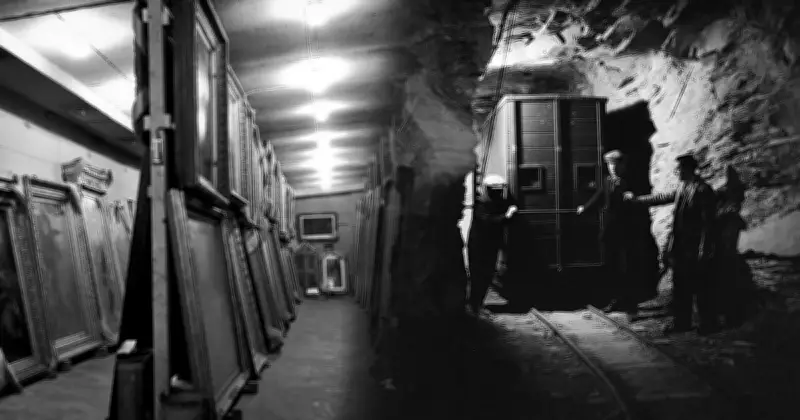
In the late summer of 1941, lorries from the London Midland & Scottish Railway Company and canvas-covered trucks from the Great Western Railway were seen on the cloud-capped slopes of the Ffestiniog hills in remote North Wales. These vehicles were not on railway business and carried no passengers. Instead, they transported goods worth the equivalent of millions of pounds today: some of the nation's most valuable artworks from the National Gallery. Their secret destination was a series of underground chambers in a slate quarry near the struggling Welsh mining town of Blaenau Ffestiniog.
The greatest evacuation of art treasures in British history took place 85 years ago this summer, with precision, frayed tempers, cost-cutting, and shenanigans reminiscent of a military campaign. The relocation to repurposed subterranean caverns in disused Manod Quarry, 250 miles from London, may have saved some of Britain's best-loved paintings from destruction by Nazi bombs.
Masterpieces and Secrecy in the Welsh Hills
The 2,000 paintings included masterpieces by Rembrandt and Van Dyck, as well as Jan Van Eyck's Arnolfini Marriage Portrait, a favourite of visitors to the National Gallery since 1843. Lorries were conspicuous on the little-travelled lanes, and gossip was rife in nearby towns and villages. Captain John Sydney Matthews, Manod Quarry's owner, attempted to silence speculation by telling the owner of the local paper shop that the quarry was being used to store lorry loads of butter.

The first paintings arrived at the quarry on August 12. By September 16, all 2,000 artworks had been moved into their new home. Many of these priceless works had been out of London for at least two years, hidden in different locations. Almost a decade had passed since the first meeting of the Museums and Galleries Air Raid Precautions Committee in 1933, the year Adolf Hitler became Chancellor of Germany.
Churchill's Orders and Quarry Construction
The Committee's plans had not included a Welsh quarry plagued by damp and possibly subsidence. National Gallery director Kenneth Clark originally considered sending the paintings to Canada for safekeeping, but Prime Minister Winston Churchill halted that scheme. "Hide them in caves and cellars, but not one picture shall leave this island," Churchill told Clark. By the time workmen had finished constructing special galleries in Manod Quarry, Churchill's 'caves and cellars' were six underground brick structures built within large, dark caverns. Building work was undertaken as cheaply as possible, with the Office of Works scrutinising every estimate. Around £65,000 in current values was spent building a new road to the quarry entrance, as the quarry's only link to the outside world was a five-mile private track through the mountains of Snowdonia.
Before the paintings' arrival at Manod Quarry, many had been temporarily rehomed in private houses, mostly in North Wales, an area considered unlikely to attract enemy bombing. Other houses included Old Quarries in the Cotswolds village of Avening, protected by anti-tank ditches, which belonged to Lord Lee. Lord Lee hung all 222 paintings sent to him and requested his servants to take special care of them, including nighttime patrols.

Eccentric Hosts and Quarry Conditions
A debate about protecting the paintings from theft led to heated arguments on the Museums and Galleries Air Raid Precautions Committee. One member insisted that policemen carrying shotguns would draw attention to the paintings' whereabouts. Another claimed the paintings were in no danger of burglary as "the criminal classes who might wish to steal property from these places have anyway been conscripted into the services." Instead, the evacuated paintings were in more danger from eccentric, bad-tempered, or uncooperative hosts. At Crosswood House, near Aberystwyth, the Earl of Lisburne created difficulties for gallery staff, refusing to put the heating on for winter storage. He was so irritated at being expected to fire up his antiquated heating system, which burned ten tonnes of anthracite a week, that he decided to rent his house to a girls' school, a threat that encouraged gallery authorities to pay him £80 a year towards running costs. Even then, Lord Lisburne disliked sharing his house with curators and security staff and insisted an extension be built to accommodate them where he didn't need to encounter them.
At Penrhyn Castle outside Bangor, owned by Hugh Napier Douglas-Pennant, 4th Baron Penrhyn, a childless divorcee with a fierce temper and a taste for strong alcohol, similar problems arose. "The owner is celebrating the war by being fairly constantly drunk," one gallery worker wrote to his superiors in London. A drink-driving accident briefly kept Lord Penrhyn out of gallery staff's hair, but other problems followed, including his exploration of renting the castle to a girls' school and a deal with the Daimler Motor Company.
Successful Storage and Return
When a scientific advisor to the National Gallery discovered Manod Quarry, it seemed like an answer to a prayer. Building work included installing a telephone system and an air-conditioning system intended to maintain temperature and humidity levels. This was so successful that, in 1944, a gallery report noted the good condition of the paintings and drawings in underground storage, "with no sign whatsoever of deterioration due to occupation of the quarry." News of the evacuation spread quickly, and by the end of the war, paintings from Buckingham Palace, Windsor Castle, and King George VI's private collection had also been temporarily rehomed in the quarry.
In the summer of 1941, transfer of all 2,000 paintings was organised with military precision. Paintings arrived at the quarry at a rate of 400-500 a week. A team of 20 men, including a handful previously employed as rail track inspectors, unloaded the lorries by hand. Where a bridge crossed the access road, the road level was lowered to allow the largest paintings under the bridge. Charles I on Horseback caused the biggest headache, clearing the bridge by a mere three-quarters of an inch, largely on account of its weight, which forced the lorry down on its suspension. Three years later, the whole operation was repeated in reverse. By December 1945, all 2,000 paintings had safely returned to Trafalgar Square. It was the greatest transport of artworks until perhaps the arrival of the Bayeux Tapestry at the British Museum last month.