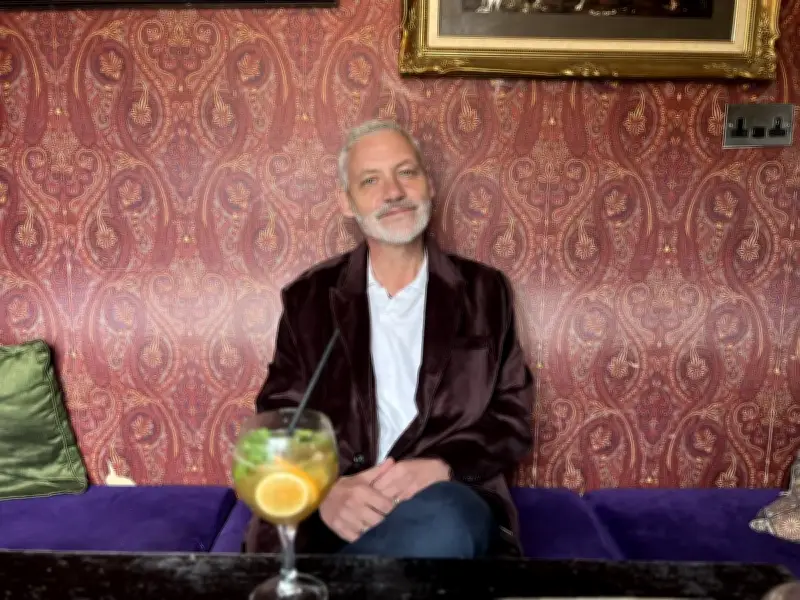
Wigan-born horror author David Barnett has revealed how the legend of Red Clogs, the bogeyman of his Ince childhood, inspired his folk horror stories.
Growing up in Ince-in-Makerfield, one of his earliest recollections of folk-horror-type lore is the childhood memory of Red Clogs – the Wigan bogeyman who haunts the local community.
The story goes that Red Clogs is the ghost of a tragic miner who was killed in an accident. The legend says the sound of his distinctive clogs could be heard after dark while walking near the old industrial and pit sites.

Red Clogs legend varies across Wigan
“It's interesting because I did a little bit of research when I was writing, and people in different parts of Wigan had a slightly different version of Red Clogs,” David said. “But it was always a spirit or a ghost or a presence that haunted mining communities.
“And it varied between being a ghost of a miner who was killed or a malevolent spirit who killed people or kidnapped kids. But the unifying feature was where the name came from. Its clogs were red because they were dripping with blood, usually from kicking someone to death.
“So not a nice piece of folklore, but it's very much a very Wigan, Greater Manchester, bit of folklore. It does spread slightly beyond Wigan borders; you hear bits of it from Warrington and Bolton and stuff like that.
“But it's one of those very specific Northern mining community bits of folklore that is almost unique to the area where I grew up.”
Such apocryphal tales are gold for David, who finds the post-industrial landscape of Northern England fertile ground for horror as any isolated cabin or ancient woodland.
Flying the flag for the North
“You can set a book in London and everyone recognises it,” the 56-year-old adds. “But you set a book in Wigan and it becomes possibly more of a challenge for people. But I'm really determined to fly the flag for the North.”
The bulk of David's writing is set in the North. His horror novel Withered Hill is set in a fictional Pennine village, while Scratch Moss, which came out earlier this year, is set in Wigan but “given a different name.”
“I think the landscape and the folklore and the history of the North feeds into my work a hell of a lot,” he says.
Born in 1967, he was raised as an only child in a terraced house in Ince, Wigan. His dad was a builder, while his mum worked in accountancy and secretarial roles.
Growing up as the “weird kid” in the 1970s and '80s, he was an avid reader of comics, as well as science fiction and horror novels by authors like Ray Bradbury and Stephen King, books he'd borrow from the mobile library that visited his street.
“Being an only child meant during downtime, or when I was left to my own devices, I would generally pick a book up or a stack of comics, or see if there was a Monday matinee on the TV to watch,” David said. “Maybe if I'd had siblings I'd have had less time to do that sort of thing, who knows.”
But like many kids who grew up with a love of fiction, his career as a writer would start in reporting facts, becoming a journalist.
After graduating with a journalism qualification from Preston Polytechnic, at age 19, he secured his first role at the Chorley Guardian, beginning a career in regional journalism that would span several decades.
In the early '90s, he would become a reporter in his hometown at the Wigan Evening Post before later taking a job at the Lancashire Evening Post.
In the early 2000s, he began plying his trade at the Telegraph and Argus in West Yorkshire, where he still lives with his wife Claire. They have two grown-up children together.
From romcoms back to horror
It was while at the Telegraph and Argus that David's interest in fiction writing was rekindled, with a number of books published by small presses that specialised in “weird” and supernatural fiction.
But it was after being made redundant in 2015 that he decided to try to make a full-time career as a fiction writer – surprisingly, in a completely different genre from horror.

“I had a total sea change and started writing romcoms! Which was a weird kind of turnabout,” David said. “That happened because I was in a conversation with a publisher, and we got talking, and came up with an idea that became a book called Calling Major Tom, which was essentially set in Wigan. That was published in 2017.
“So for the next seven years I did sort of like usually Northern-based comedies and romcoms, so I did several of those.”
David's career writing Northern romcoms proved successful. Calling Major Tom was a massive bestseller, published in 16 languages.
After several successful romcom novels, David says he wanted to get back to his “weird roots” and horror. “Which is why I started writing folk horror,” he says.
Folk horror is a subgenre of horror fiction and film that uses regional folklore, isolation, and rural settings to create a sense of dread. The terror often stems from an outsider encountering a world still governed by archaic traditions and pagan rituals rather than traditional supernatural monsters, with perhaps the most famous example being the 1973 British film The Wicker Man.
And it's horror as a genre that David finds freeing, and one that goes way beyond the scares of the monsters themselves, written into its pages.
“We like to be scared within the parameters that we're actually going to be safe. So we apply that same sort of process to reading a horror book or watching a horror film. We know there's going to be something terrible happening,” David says.
“But I think in terms of writing, it allows you to look at society and contemporary events through the lens of horror. Most horror films are not actually about the monster; they're not about the zombie or the vampire, they're about some other issue or some other topic, and you use the mechanics of horror to be able to explore that.
“I think horror also allows us to envisage the worst possible scenario – i.e., getting attacked by some terrible monster or living through the end of the world or whatever that scenario is – and it allows us to envisage that and perhaps look at solutions to how we could get through it in fiction.
“So while a lot of horror might seem bleak, it's actually quite optimistic, because usually the human condition wins through. And it gives us a chance to explore really bleak, awful scenarios, but with a chance that we can get through them and find a solution.”
David's latest book, Twisted Pike, is the fourth in what he calls a “very loose” series of folk horror novels, the first being Withered Hill, followed by Scuttler's Cove and Scratch Moss. However, he says they can all be read as standalone novels without having read the others.
Twisted Pike is set back in the fictional Pennine village of Withered Hill, where “outsiders aren't welcome”, but a film crew find themselves there to make an independent horror movie, and end up finding something far more sinister.
“The people in Withered Hill are used to living a certain way, and they've been doing that for so long that even though it involves quite terrible things when viewed from the outside,” David says. “They've been doing it so long that they've perhaps stopped questioning it, and they just got used to it because it's how things have always been done. I think that's one of the aspects of looking at the real world through this fictional lens.”
So what horror movies and novels does David rank among his all-time favourites?
“I love The Wicker Man, as you would expect writing folk horror,” he says. “It was such a shock to watch that the first time [...] I do like a lot of old classic films, I love Hammer movies, sit me in front of a Hammer movie like Captain Kronos – Vampire Hunter or The Vampire Lovers or something, and that's me happy.
“People think Hammer films are a bit schlocky, but when you actually watch them, most of them are really intelligent and well-staged and well-written, great stuff. I love Night of the Demon, which is a film from the '50s and based, very loosely, on an M.R. James story called Casting the Runes. And I love that because unlike a lot of horror or supernatural stories of the time, it doesn't tease you with the monster, it shows you the monster in the first five minutes and says, 'Right! This is what we're all about!'”
More recently, there's been an absolute wealth of brilliant horror in the past few years. Sinners, Heretic, which is the Hugh Grant film. Weapons is brilliant, and so are Backrooms and Obsession.
“People are doing so much with horror, they're really pushing the boundaries of what horror can be, and using, as I was saying before, examining an aspect of society and modern life using the horror lens to cast a different light on it.
“I think we're living in a golden age of horror, definitely, both on screen and in print.”
David's latest folk horror novel, Twisted Pike, is out on October 1 but is available to pre-order now on Amazon.