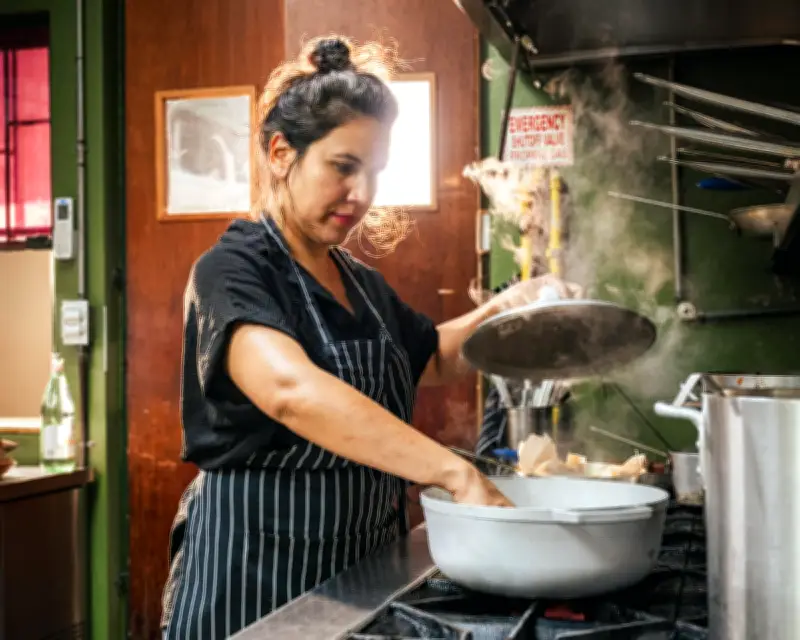
Patty Rodriguez used to dread caldo as a child in southern California, especially in summer. She would swirl the chunks of fish with her spoon and imagine a magic trick making the dish disappear. When she asked her family why they served it more often in hot weather, her mother and aunts replied: "This is not a hotel. You don't choose what you want to eat. You're going to eat what we make."
As an adult, Rodriguez realizes that caldo – Spanish for broth – was a low-cost meal that could feed her Mexican American household for several days. It gave her family the nourishment and hydration they needed during the summer heat.
Caldo is eaten across Latin America, with regional versions in Mexico, Puerto Rico and El Salvador. It usually contains whole pieces of meat and vegetables such as carrots, potatoes and corn on the cob. Although it is served all year, it becomes paradoxically more popular during the summer in some cultures. For first- and second-generation Latin Americans, the dish is a cultural touchstone that ties them to their heritage and to their families.
From rejection to love
Rodriguez, now co-founder of Lil' Libros, a children's bilingual media company, spent 20 years as a radio producer, often the only Latina in her workplace. She ached to share her culture with her colleagues and audience. Her feelings about caldo shifted as she learned to accept her Mexican American identity. "I was rejecting not just the food," she said, "but I was rejecting my identity."
Today, Rodriguez feels joy when her mother calls to say she has made caldo de pollo, a chicken version of the broth. "I get the kids in the car and I drive to my mom's house," Rodriguez said. "I want my children to experience this with her."
A dish that builds resilience
Ramon Guzman, 33, a creative director at Crazy Gorilla and Vezcos Media, has complicated feelings about caldo. He makes YouTube comedy skits about Mexican American culture and has joked about the dish in several videos over the past decade. In a 2021 video, he imitated a Mexican mother who refused to let her son use the air conditioning and made him eat caldo while he sweated through his shirt.
The skit mirrored his childhood as a first-generation Mexican American in San Bernardino, California. "The main emotions were confusion and suffering," Guzman said. "I did not enjoy eating caldo in the summer. I'm already sweating, and then eating the caldo makes me sweat even more."
He now understands that the dish comforted his mother, whose own family made it for her when she was growing up in Mexico. Caldo has followed him into adulthood; his girlfriend, also Mexican American, serves it to him more often in summer because that is when she craves it most. With its salt and nutrients, Guzman compares caldo to "a Mexican Gatorade".
He sees caldo as a way to pass down pain tolerance through generations. He describes eating it in summer as "layers and layers of a little pain" that help people endure life's ups and downs. "I will try to dabble in it and make my own version of it whenever I have kids," Guzman said. "It makes you a bit stronger and more resilient … I'm sure I'm going to be thinking of my mom when I feed it to my future kids."
A taste of Puerto Rico
Caldo is also a summer favorite in Puerto Rico. At Cocina al Fondo, a restaurant in San Juan, chef Natalia Vallejo said diners request caldo de gallina – a stew of hen meat, plantains and herbs – more often during the summer. "This dish is deeply connected to my childhood," she said. "The recipe is inspired by a caldo my paternal grandfather used to make. He cooked it over a wood fire. It's a dish that evokes memories for Puerto Ricans and brings out many emotions."
Vallejo, who won the James Beard Best Chef: South award in 2023, sees caldo as a doorway to her past. Her family used the broth in other recipes too. "My favorite memory is that we used the broth to make wood-fired chicken and rice, which was wrapped in banana leaves," Vallejo said. "It was delicious."
Honoring roots through food
For Aelen Trujillo, 24, a content creator and stay-at-home mom, caldo had a practical role on the hottest days: it kept active cooking time short. While the broth simmered on the stove, her Mexican grandmother would leave the warm kitchen so she would not overheat. Trujillo now cooks caldo for her family in summer because it reminds her of that grandmother.
She makes sure her young children eat recipes from both their Mexican and Central American heritages so they remember where they come from. "My grandparents once they came here they had to assimilate and they didn't have a lot of things. A lot of the culture or the tradition that they had growing up you never really celebrated," said Trujillo, who is a first-generation Mexican and Honduran American. "Food was the only way that I was able to connect with my culture and feel more Mexican or to touch those roots."