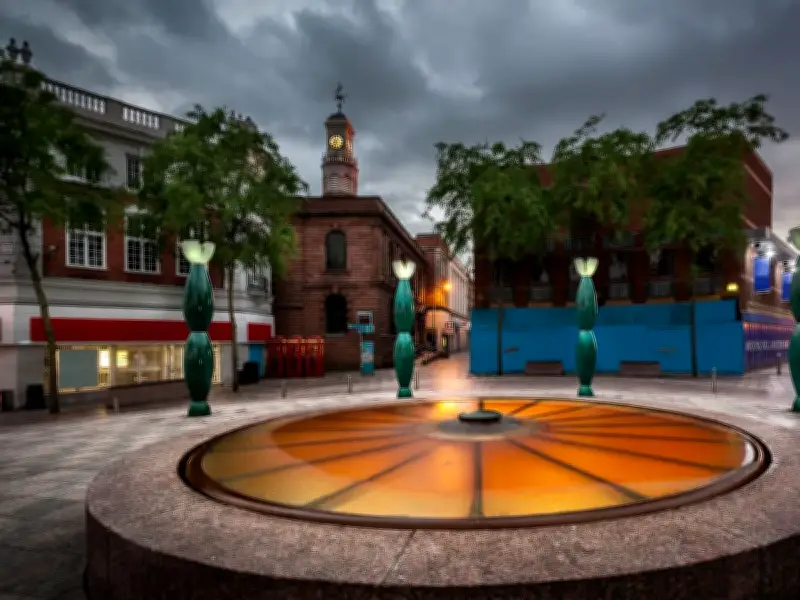
Warrington, once the academic centre of the North and nicknamed the 'Athens of the North', is now an overlooked town with a struggling high street, according to a new book. In Where Tourists Seldom Tread, author Christopher Moss explores some of the country's destinations least likely to inspire tourists.
"None of the towns in this book has an overtourism problem. But they are all worthy of visitors; they are all intriguing, complex, multi-faceted," Chris explains. The book begins in a town close to where he grew up, and he takes a circular walk along the banks of the River Mersey and the Manchester Shipping Canal.
A Town of Contrasts
Warrington has had a recent-ish facelift, having been designated a New Town in 1968. Large numbers of houses were built to the north and west of the town, making it the largest conurbation in Cheshire, twice the size of Chester. Despite its size, it's a place most people beyond the county's bounds will know little about.

Rugby league followers may know of the hugely successful Warrington Wolves, the only British club to have played every season in the top flight. Military enthusiasts may know of RAF Burtonwood, the largest US Army Air Force base outside the United States during World War II. Furniture fans will know that Warrington welcomed the UK's first ever IKEA in October 1987.
Understated and Off the Tourist Trail
Chris writes: "Warrington's inner-edges are cookie-cutter Anglo-American: roads, roundabouts, strip malls, fast-food outlets, big boxes, big car parks filled with big cars. There's a new bus station that's so underwhelming it's almost invisible."
Venturing further into the centre, Chris' early exploration uncovers little to write home about. "How many shuttered charity or chain stores can we walk past without getting dispondent?" he asks. "Mid-sized town shopping centres are, the standard narrative runs, all the same, all full of empty units."
A Rich History
While the "faux market hall" that serves as Warrington's food hall may suggest the town is struggling to grasp what it should be in the here and now, it's a place with a lot of history. This is most evident in the Oliver Cromwell statue, presented to the town in 1899 despite considerable opposition from the local Irish community.
During the Civil War, the Lord Protector ordered his forces to march on Warrington, where the 7th Earl of Derby had stationed royalist troops. In a bid to stall Cromwell, Derby ordered the town to be set on fire. Today, Cromwell stands in front of Warrington Academy, "an almost elegant, vaguely Georgian building."
The Athens of the North
Back in the mid-18th century, local minister John Seddon opened its doors in a bid to train ministers of Nonconformist chapels, at odds with Oxford and Cambridge's refusal to admit anyone but Anglicans. Foreign languages, English literature, and chemistry were taught at the academy, including by Joseph Priestley, the man who discovered oxygen and invented fizzy water.
"The academy lasted only until 1783, but it had a significant impact on intellectual life in the North-West," Chris writes. The presence of the academy and work its members did was enough to earn Warrington the nickname "the Athens of the North". "Warrington might have become a northern Oxford, an Edinburgh on the Mersey," Chris opines.
In more recent years, Warrington has found itself not at the centre of British academia, but its transport network. Roman-roads criss-crossed the town, hundreds of years before the Manchester Ship Canal and the M6 came through. By some measures, Warrington is the Los Angeles of Lancashire, thanks to a network of motorways as densely packed as the car-loving Californian city.
Chris does not sugarcoat his view of Warrington, but he is also steadfast in his commitment to draw out what is good and often overlooked in a place. "Warrington has always been halfway to elsewhere, a logistics hub long before everywhere else became logistics hubs," he writes. Where Tourists Seldom Tread is available in hardback for £19 and ebook for £12.99 on bookshop.org.