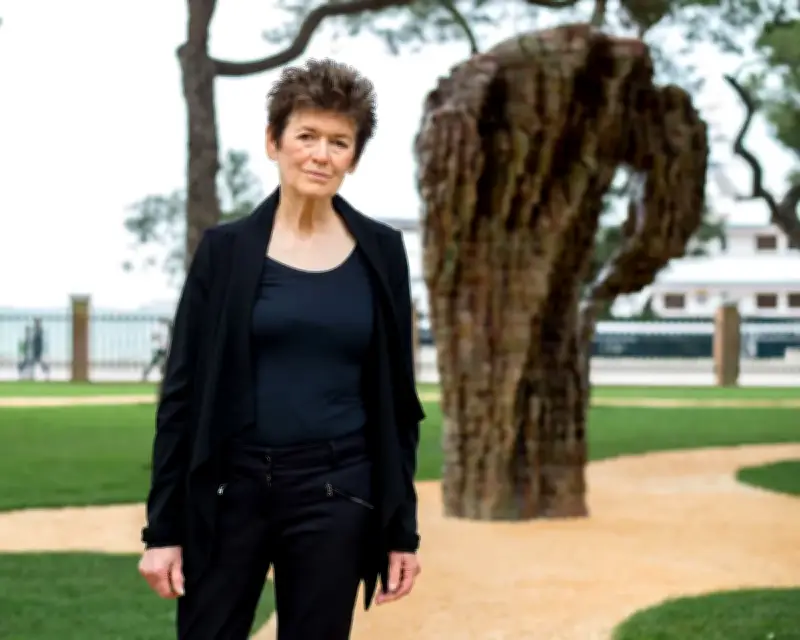
Ursula von Rydingsvard, the American sculptor whose large, complex works were often built from cedar beams, has died aged 84. Her death was announced in an obituary published by The Guardian.
Early Life and Career
Born in 1942 in Germany, von Rydingsvard was the fifth of seven children of Ignacy Karoliszy, a Ukrainian farmer, and his Polish wife, Kunegunda. During the second world war, her father was coopted as a forced labourer by the Nazis. After the war, the family moved between displaced persons' camps in Europe before emigrating to the United States in 1950, settling in Plainville, Connecticut.
Her early experiences with wood influenced her art. "I come from a long line of Polish peasant farmers," she said. "They were surrounded with wood – wooden homes, wooden fences, wooden tools to farm the land." In the camps, she slept on wooden bunks, and her mother hung a wooden spoon around her neck so she would always have something to eat with.
Artistic Breakthrough
Trained at Columbia University in the early 1970s, von Rydingsvard initially struggled with minimalism. "The work was so clean!" she said in a 2013 interview. "All those intellectuals, clean, clean! Nothing felt gritty or sexy." Her breakthrough came when a fellow student brought her cedar beams. "The moment my circular saw hit the wood, I was like: 'Oh, my god.' The cedar itself felt soft. It felt like the colour of skin."
Her first major recognition came in 1988 with an exhibition at Exit Art, a gallery for under-shown artists. Reviews were uniformly enthusiastic, allowing her to make art full time after years of teaching at Yale.
Major Works and Legacy
Von Rydingsvard's work was acquired by major institutions including the Whitney and Metropolitan Museums and the Museum of Modern Art in New York, and the Walker Art Centre in Minneapolis. Her piece ence pence, which appeared on a hillside above Wakefield in 1997, was two metres high and wide by five metres long, made of wood despite its stone-like appearance.
She returned to the bowl form in works like Ocean Floor (1996), a cedar dish with sacks made from dried cows' intestines. "Being big doesn't mean being invulnerable," she once said. She is survived by her three grandchildren.