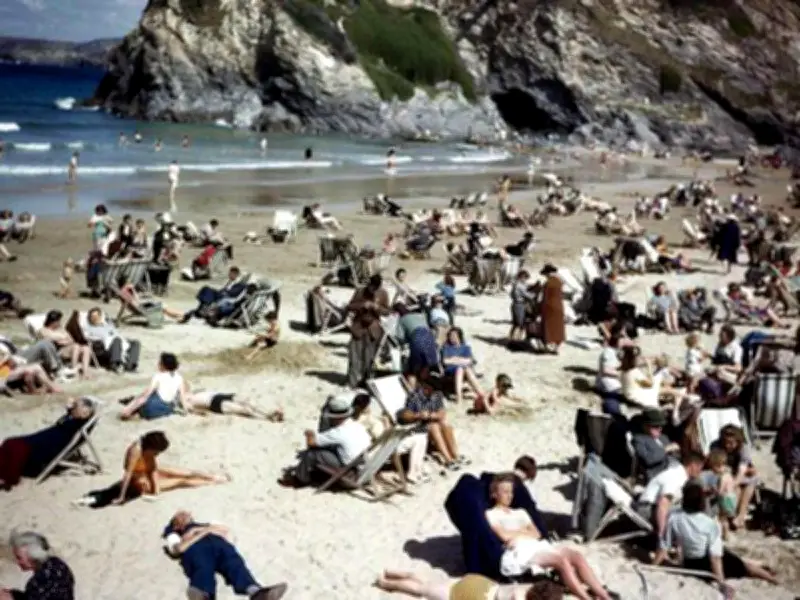
A mysterious 1940s beach photograph has ignited time travel conspiracy theories after a man in a brown suit appears to be looking at what some claim is a modern-day smartphone. Others, however, insist he is merely rolling a cigarette.
Photo sparks debate
The image, showing Britons enjoying a seaside day out during the Second World War, features a man standing in a brown suit, gazing down at what looks remarkably like a smartphone - a device that did not exist in the 1940s. This has led some social media users to dub him the "texting time traveller."
Despite the buzz, many have dismissed the claims as "ridiculous," arguing that he is simply rolling a cigarette. One user commented: "I think that chap is rolling a cigarette!" Still, some remain convinced the photo serves as proof "that time travel is real."
Other vintage footage
The debate extends to other vintage photographs and footage. A clip from 1938 purportedly shows a young woman holding something to her ear as she walks towards the camera. Some conspiracy theorists believe she was speaking on a mobile phone, long before such technology was invented.
In the footage, she appears to be chatting while strolling through a crowd, with a device pressed to her ear, before lowering it as the clip ends. The object looks like a dark, hand-sized device, roughly the size of a contemporary mobile phone.
The mystery deepened when a YouTuber claimed the woman was their great-grandmother and that she was genuinely using a mobile phone. According to YouTube user Planetcheck, the gadget was an experimental wireless phone created by industrial giant Dupont at their facility in Leominster, Massachusetts.
Stephen Hawking's views
Stephen Hawking was both a skeptic and an engaging theorist on time travel. In 2009, he hosted a "Time Traveller Party" at the University of Cambridge, sending invitations only after the event had ended. No guests arrived, which he cited as experimental evidence that backward time travel is not possible.
He also questioned: "If time travel is possible, where are the tourists from the future?" Hawking was deeply skeptical of traveling back in time, arguing it would create complex paradoxes and that the laws of physics likely have "chronology protection" mechanisms to prevent such scenarios.
Unlike the past, Hawking believed traveling into the future is scientifically possible, citing time dilation, where time passes more slowly for an object moving near the speed of light. He acknowledged that the quantum world contains tiny "wrinkles" or "tunnels" in spacetime but doubted they could be stabilised or enlarged for human travel.