Tate Britain's new exhibition, “The 90s: Art and Fashion”, has been criticised for reducing the Young British Art of the 1990s to a stylish pose, favouring fashion over the intelligence and emotion of the era's best work. Curated by former Vogue editor Edward Enninful, the show mixes art and fashion with the emphasis very much on the latter.
A Decade Reduced to Style
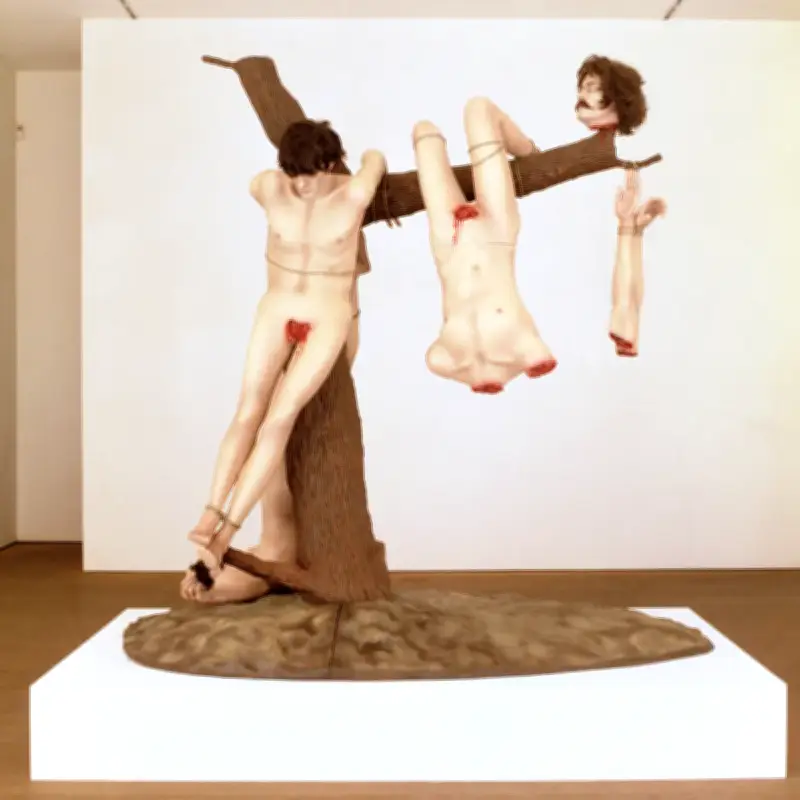
The review notes that the show brings Jake and Dinos Chapman closest to a moment of depth with their sculpture Great Deeds Against the Dead, based on a Goya print of Napoleonic war atrocities. The work, a display of dismembered, bleeding nude corpses hung on a tree, asks questions about war and art, the representation of pain, and whether art can have a moral purpose. The best British art of the 1990s was like that, coming on as brash, vulgar, macabre, yet also unexpectedly intelligent and emotional. Unfortunately, the review argues, this show is neither.
There is more about Isabella Blow than Rachel Whiteread, who is represented by an early cast of the inside of a hot-water bottle. Damien Hirst has a couple of small, harmless-looking sharks balanced on a circular rail, but the review suggests there is no chance of understanding from this how his early work seemed to confront the tiger shark's maw of death.
Fashion Versus Art
The review describes the exhibition as “not a real exhibition” but “a magazine spread”, with the breathless superficiality of a glossy layout. Setting fashion photography alongside works of conceptual art is called “a terrible idea”, reducing the art to another stylish pose.
Juergen Teller's 1996 photograph Kristen McMenamy No 3 is hung next to Sarah Lucas's 1997 work Chicken Knickers. The review contrasts the two, suggesting Teller's image lacks poetry or meaning, while Lucas's photograph of a raw chicken stuck to someone's knickers is funny – “a great deed against a dead chicken from an artist with a genius for estrangement”.
Missed Opportunities
The show has an entire room full of party pics depicting the club scene, but the review notes that another point of the 90s was that mainstream British pop was revived, with no space found for Oasis or Blur. The room dealing with “body horror” is dominated by Alexander McQueen's costumes, described as mannered and pretentious, while pompous, awful images shot by Sean Ellis for The Face take up an entire wall.
Other fine artists don't fare so well. Helen Chadwick gets two tokenistic eerie photoworks, while the death-obsessed art of Hamad Butt is squeezed to the end of the gallery. Chris Ofili is namechecked with No Woman, No Cry; Tracey Emin gets one neon. Other artists are noticeable by their absence, from Jeremy Deller to Mat Collishaw to the late Christine Borland.
After just seven rooms the exhibition suddenly ends. The review concludes that even if one doesn't believe some of the art of that time is powerful and enduring, it surely deserves enough space to be seen and judged. The 90s is at Tate Britain, London, from 8 October 2026 until 14 February 2027.