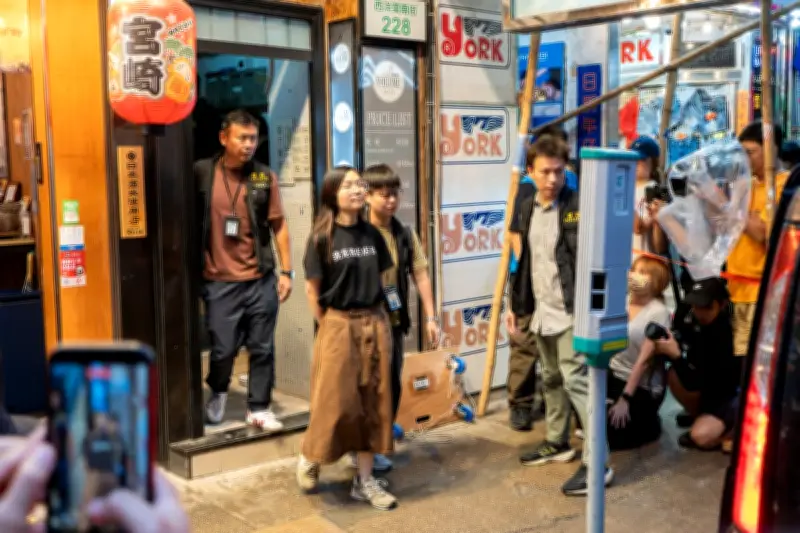
A T-shirt slogan that read 'I am a bookstore employee' has gone viral in Taiwan after Hong Kong national security police arrested five people during raids on two independent bookstores last week. The arrests were made on suspicion of displaying and selling publications with 'seditious' content, a national security crime carrying a maximum sentence of 10 years.
Widespread support on social media
Since the raids, the phrase has spread widely on Taiwanese social media as people express concern for the fate of Hong Kong's booksellers. On the social media platform Threads, booksellers, lawmakers and activists shared the hashtag 'I am a bookstore employee' to show their support. Taiwan's president, Lai Ching-te, also weighed in, writing on Facebook: 'Ideas and words should never be silenced by political pressure'.
Arrests and bail
It is the third time in recent months that people in Hong Kong linked to independent bookstores have been arrested. The Hong Kong authorities have not specified what the allegedly seditious books were in the latest raids. However, after the arrest, Hong Kong's security chief, Chris Tang, said that booksellers had a responsibility to ensure their books were lawful, 'just like merchants selling food have to make sure their food won't make people sick'. All five arrested have since been released on bail.

Book sales rocket in Taiwan
Reports that the offending books may have included Let Only Red Flowers Bloom: Identity and Belonging in Xi Jinping's China, written by NPR journalist Emily Feng, prompted a run on the book in Taiwan. The Taiwanese publisher, Acropolis Publishing, ordered an emergency reprint of 10,000 additional copies last week. Sara Sung, a senior editor at Acropolis, said some readers were buying copies as 'a statement of democracy and freedom'. 'They're showing that they will not be silenced or intimidated by censorship from China,' Sung said.
Chang Hui-ju, the owner of Touat Books, an independent bookshop in Taipei, said she was completely out of stock of Feng's book. 'Before this, hardly anyone paid attention to it,' Chang said. 'But right after the incident, the book sold out everywhere.' Another Taipei store, Kuo's Astral Bookshop, also sold out. One customer, Wu Jia-xuan, said she was not normally interested in China-related books but that her interest had been piqued by the Hong Kong arrests. 'The fact that it had been banned only made [me] more curious,' Wu said.
Background of Lam Wing-kee
Feng's book examines Chinese leader Xi Jinping's ideological control over the country. One chapter, titled The Bookseller, focuses on the prominent Hong Kong bookseller Lam Wing-kee. Lam was arrested by Chinese authorities in 2015 but later escaped custody and fled to Taiwan, where he re-opened his bookstore, Causeway Bay Books, in Taipei. Lam died earlier this month and the fate of his Taipei store is uncertain: the closed-up shopfront is covered with notes, flowers and cans of beer left by his supporters.
Political context
Taiwan has never been part of the People's Republic of China, but Beijing has long claimed the self-governing island as part of its territory and has vowed to unify it with China. One path to peaceful unification suggested by Beijing is for Taiwan to be ruled under a 'one country, two systems' framework, similar to Hong Kong. Over 80% of Taiwanese reject that idea. In Taiwan, politicians from the ruling Democratic Progressive party (DPP), which rejects closer ties with China, have pointed to Hong Kong as an example of the dangers of Chinese rule. On Monday, DPP legislator Wu Pei-yi accused China of 'burning books'.
However, rhetorical support for Hong Kong has rarely been matched by practical policies such as taking in refugees. Lev Nachman, a professor of political science at National Taiwan University in Taipei, said that for DPP politicians, 'it's very easy to use Hong Kong as a way to frame what will happen to Taiwan if the People's Republic of China is able to "unify" Taiwan', but actual support has been 'shallow'. For Chinese people, Taiwan is now the last place in the Chinese-speaking world where they can freely access books without the threat of Communist party censorship.