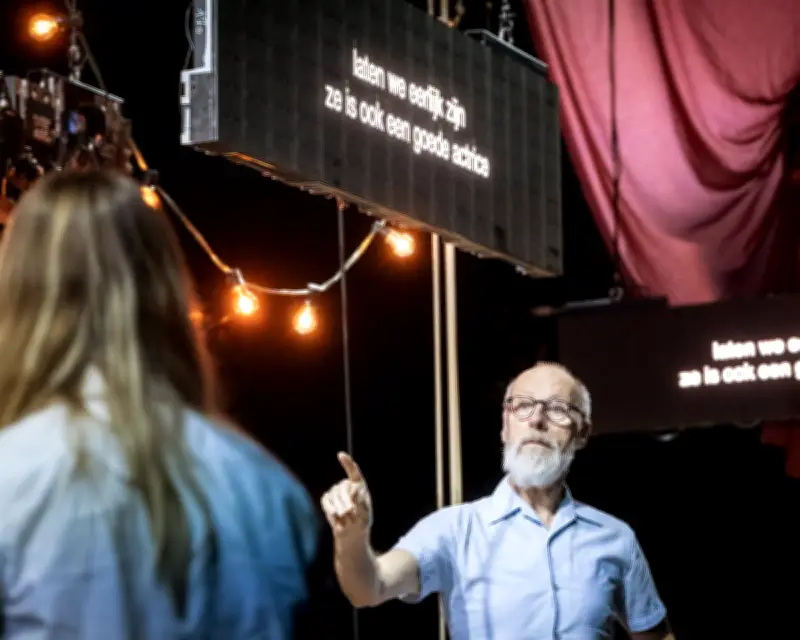
The silence in this adaptation “after” Anton Chekhov’s The Seagull is startling. Performed straight through at two and a half hours, the intakes of breath, tears, screams of anguish and, of course, the gunshots when they come arrest the senses. So do the intermittent spoken words, which sound almost like an intrusion, and occasional lines of music.
An Ambitious Sign-Language Production
Directed by Stijn Van Opstal, this is a sharp, ambitious, modern-dress chamber piece at the Edinburgh international festival by Belgian theatre companies Toneelhuis and Olympique Dramatique, with numerous translators and adapters. For the first 30 minutes, there is just signing on stage (Flemish Sign Language translated into British Sign Language), with screens translating dialogue.
The story is the same but appears new and visceral. Konstantin (Yana Wuytjens) is an aspiring writer intent on discovering innovative forms of storytelling, but is overshadowed by his grand actor-mother, Arkadina (Sofie Decleir), who comes back to the family’s country estate with her lover, Trigorin (Serge Vlerick), in tow. He is a distinguished novelist and his presence gives rise to a love triangle involving Konstantin’s companion, Nina (Yousra Boukantar), who is an aspiring actor.
Expressive Performances and Theatrical Tricks
Performers are a mix of D/deaf and hearing, magnificently expressive across the board – though Lobke Leirens, as ancillary character Masja, has a particularly formidable presence. Arkadina is a good blend of thespy self-importance, charm and maternal concern. Konstantin is performed by a woman, which makes his relationship with Nina somehow more tender and intimate, while Wuytjens brings a good blend of anger, tantrum and earnestness to the part.
Characters swill in boredom and sometimes seem ridiculous. Humour sits close to anguish. Sound clangs. Damiaan De Schrijver and Van Opstal’s set design on a traverse stage exposes the construction of its effects. A host of techniques amplify the sense of overt theatricality.
Puzzling Choices and Unanswered Questions
Actors bring on the props, sometimes create sound effects and take up the wooden boards towards the end, which brings a plaintive, packed-up, autumnal quality to both the summer home and the drama. But the production is hampered by too many of these techniques; they come to seem like tricks, there for the sake of clever contrivance. Why, for instance, is there a seemingly random freezing of some scenes? Why do the surtitles become non-grammatical and seemingly a literal translation before returning back to standardised English? What, for that matter, is the point of the square brackets of the title? These questions are frustratingly unanswered.
Then again, at its best, this play dazzles and contains a fresh, dangerous quality, as physical as a gut-punch in its climatic moments. Silence has never sounded louder or more loaded. At Studio theatre, Edinburgh, until 11 August.