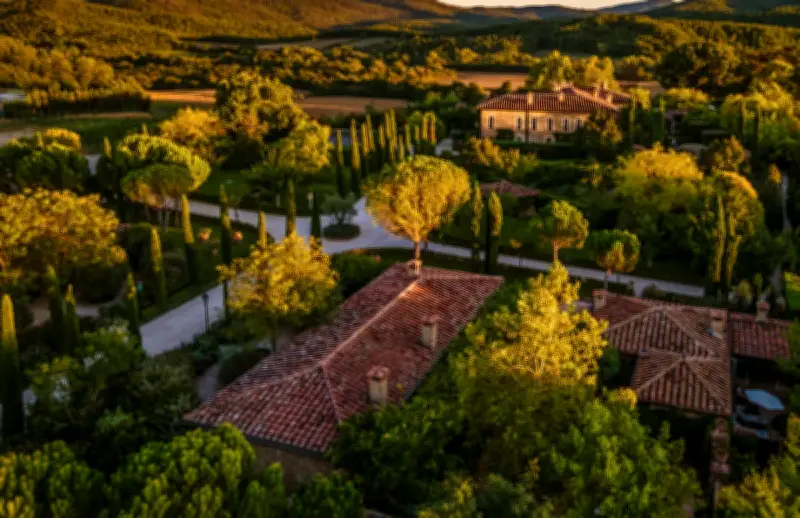
Seed to Skin, a skincare brand grown, harvested and produced entirely on a 300-acre organic estate in Tuscany, has built its reputation on a process founder Jeanette Thottrup calls “360-degree bio-autonomy”. The brand operates from Borgo Santo Pietro, a hotel near Siena that sits beside the medieval hamlet of Palazetto and includes vineyards, cypress-lined paths and its own skincare laboratory.
From Notting Hill to an abandoned estate
Danish couple Jeanette and Claus Thottrup left Notting Hill for Tuscany in 2001, seeking to escape the pace of urban life. They discovered an abandoned estate dating back to 1129 and spent the next 25 years transforming it into the now-renowned Borgo Santo Pietro. Seed to Skin was never part of the plan.
“It was something else, very personal,” Thottrup explains. When she arrived in Tuscany, she was trying to conceive. After conventional treatment failed, she turned to herbal medicine, acupuncture and a lifestyle overhaul. “Two years later I had my son. That experience changed how I understood the body.”
The couple learned that the estate and its herbs had long been used for healing, with pilgrims treated there on their way to the nearby abbey of San Galgano. “That’s what the land had always done,” says Thottrup. “And that continuity is still present. The farm, the herb house, then the lab and eventually Seed to Skin. We never began with a plan. We followed what the land seemed to ask for.”
A decade of formulation
Thottrup subsequently studied natural medicine and brought in cosmetic scientist Anna Buonocore. The pair spent 10 years developing the formulation system before launching the first product in 2018. In a process almost unheard of today, Seed to Skin’s botanicals are grown on the certified organic estate, harvested and processed in its own herb house, then formulated and produced in the lab. Finished formulas are sent away for independent clinical testing.
Thottrup describes the model as combining natural ingredients with advanced biochemistry to improve their stability and performance. “I wanted the richness and complexity of nature, with efficacy that could be measured and proven,” she says.
Asked why she keeps so much in-house when outsourcing would be cheaper, she says: “Because outsourcing means handing over the part of the process where integrity is either kept or lost.” She points to the hypericum and calendula macerated oil used in her favourite Recovery Cream, priced at £218. Made through a slow infusion of hand-harvested botanicals, it is the kind of ingredient that makes little commercial sense. “No supplier would produce that for us, because it is slow, seasonal and small in volume,” she says. “Had we outsourced, that oil would not exist.”
Growth at the expense of the product
There is a cost to this approach. “We have grown more slowly than we might and turned down things we could not supply,” she admits. “But I have never believed that growth should come at the expense of the product.”
For Thottrup, being able to take this route is a privilege, but that is rather the point. “True luxury is knowing exactly where something comes from, how it was made and why every decision was taken along the way.” Her skincare advice is similarly measured: “Do less, more consistently.” Coming from a woman who spent a decade perfecting a cream, it is advice worth taking.