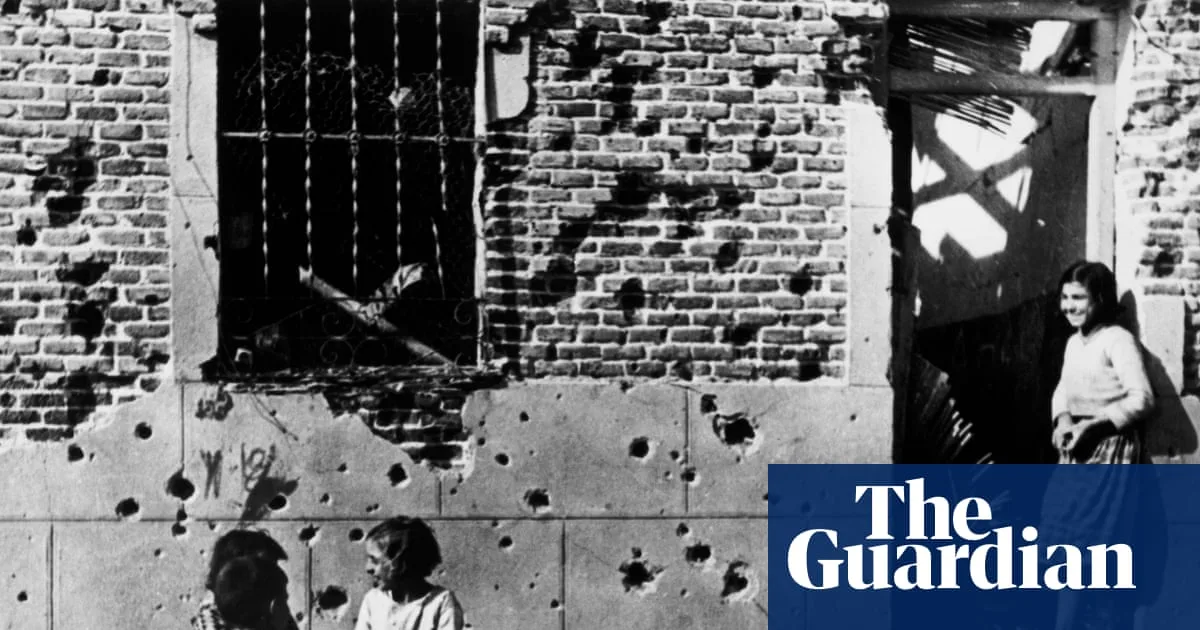
One of Robert Capa’s most celebrated photographs, showing three children on a rubble-strewn pavement in Madrid’s Vallecas district during the Spanish Civil War, has become the focus of a dispute between the city’s conservative council and campaigners who have long sought to preserve the building where it was taken.
The picture, captured in late 1936, showed the civilian toll of aerial bombing by Nazi Germany and fascist Italy in support of Francisco Franco’s coup. The single-storey house at 10 Peironcely Street, which appears behind the children, has been at the centre of a campaign to rehouse its residents and turn the site into a memorial to the photographer and the atrocities of the war.
Although tenants have been moved to better accommodation, the current council has abandoned plans drawn up by its leftwing predecessor to create a standalone Capa museum. Instead, it intends to open a youth centre in 2028 under the name the Robert Capa Cultural Experimentation Centre, with only a small space dedicated to the building’s history. The project would be handed to the José María de Llanos Foundation, sidelining the Save Peironcely 10 platform that fought for years to secure the building’s future.
José María Uría, coordinator of the platform’s efforts, accused the council of acting “in a rather opaque way”, noting a “180-degree turn” in its approach. The International Centre of Photography (ICP), custodian of Capa’s legacy, has objected strongly, warning it will not authorise the use of the photographer’s name for any project at Peironcely 10 that is not led and approved by the Save Peironcely 10 platform. In a letter to the council, the ICP said the site was “an irreplaceable site of universal historical significance”.
The Capa House museum in Leipzig, Germany, which occupies another site linked to the photographer, also expressed support for the platform and said Madrid could have become “a crown jewel of work for peace and international cooperation”. The council said it was taking legal advice on whether to keep Capa’s name in the project’s title, but insisted the purpose of the proposed centre was more important than its name.