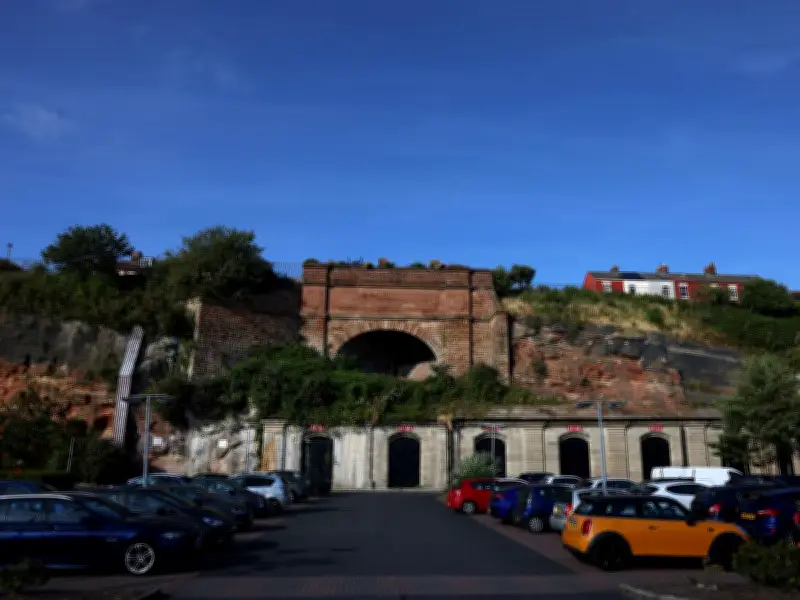
The imposing brick structure towering over a BMW garage and Chinese restaurant on Riverside Drive is one of the last remaining pieces of the Liverpool Overhead Railway. Thousands pass the remnants daily, but many are too young to remember the railway, which was part of daily life for Scousers from the 1890s to the mid-1950s.
A vital transport link
Local historian and author Ken Pye remains fascinated by the lost structure, affectionately known as the Dockers' Umbrella. He told the ECHO: "It was very very popular and well used, it was a very vital transport link not only for getting the dock workers from the Dingle where we can see the Southern Extension today, but actually moving people between the stations along the full route of the railway."
"It carried not just dockers, although they were the principal passengers, but also seafarers as well going to join their ships, people going into or out of town, people going into town shopping, all the shop workers. There's lots of offices; you've got the Liver Building, the Cunard Building, the Port of Liverpool Building, you've got all the other office buildings, the insurance companies, shipping offices, and everything, all in the city centre. Their workers had to get to and from work, too."
The Southern Extension tunnel
The Southern Extension's tunnel entrance, almost the only sign left of the railway's existence, sits above Riverside Drive. When the railway was in use, trains would pass through it before beginning and ending their journeys at the underground terminal at Dingle Station. The main stretch of the Overhead Railway was built in 1893, and it was extended southwards three years later.
Ken said: "It was actually decided to extend the Overhead Railway southwards to service a large district of hundreds of terraced houses that had just been built at the south end of the city at the Dingle. Now, from here, many hundreds of dockers and office workers were travelling daily into the city, mostly by tram and omnibus, and some were walking, of course."
"The extended railway would now relieve the pressure on the local tram and bus network. And if you drive along past Herculaneum Dock on Riverside Drive and Sefton Street, you can actually see the porticoed archway that is the opening of the tunnel that leads into the cliff under the Dingle to the Dingle station. The tunnel carried this extension to this remarkable underground station, so it actually meant the overhead actually had an underground bit as well [at Dingle Station]."
War and closure
During World War II, Liverpool was the most heavily bombed city in Britain outside of London. The Overhead Railway was regularly bombed but was almost immediately rebuilt every time because it was that important for transporting workers. There were 25 stations on the route.
As the decades passed and the decision was made for the railway to close permanently, Ken remembers being on board for one of its final journeys. He said: "My mother decided, as it was my fifth birthday to take me on a trip along the full length of the Overhead Railway because everybody knew it was about to close. So she said, 'Come on, I'll take you on a trip on the Ovvy [a nickname for the railway].' She was determined that I'd have the opportunity to travel on the Ovvy just once before it disappeared forever."
He said that despite being just five when he made that journey, it has left an indelible mark. "I had my short trousers on, and I remember my bare legs in my short schoolboy trousers pressing against the smooth, polished slats of the curved wooden seats. I can still feel it now."
"With a startling suddenness, we seemed to shoot out into dazzling sunlight, only to be shrouded on either side by the zigzag, zigzag shadows of the great iron bridge that carried our old, jangling carriage above the Herculaneum Dock."
A sense of loss
As he looks back at the impact the railway had on the city, it was hard for him to not feel a sense of loss. He said: "It was immediately felt when they closed it down. If we had it now, of course, you can imagine what a tourist attraction it would be. The city is the less for the loss of the Overhead Railway."