Professor Bettina Varwig wants to get us moving – and feeling, and listening, but primarily moving. The University of Cambridge academic says classical audiences today are “asked to leave our breathing, pulsing, feeling bodies at the door”. In concert halls we are told not to move or make a sound, subdue all the things that make us human. Whatever you do, don’t give in to the things your body is viscerally telling you when you experience a piece like Bach’s St John Passion, the way the music churns emotions and agitates your sinful heart. You have to listen passively, you can’t sigh or cry or clap in the wrong place, even if that’s what your whole being is telling you that you need to do to communicate the corporeal and spiritual pain the music is putting you through.
Historical evidence of bodily response
Varwig’s research focuses on how 17th and 18th-century listeners responded to music. “When you read about how music affected listeners in Bach’s time, their testimonies are striking in their bodily intensity,” she says. “Music contracted their innards and made their hearts leap. It could taste like vinegar in your throat. It could melt your earwax. It could draw your soul out of your body.”
Her research has unearthed a wealth of evidence of listeners feeling the physical and spiritual affects of music. “Philosophers, music theorists, theologians, devotional writers, poets, anatomists, medics and listeners described music as moving, ravishing, painful, dangerous, curative and miraculous,” Varwig says. “Music could soften your heart, pierce your brain, make your teeth grate and rattle, constrict your chest like it was bound with ropes, or flood you with honeyed sweetness. It could enter your body through the pores of your skin and spread contagiously between people. It could induce melancholic disorders or drive out the plague.”

Workshop at Royal Academy of Music
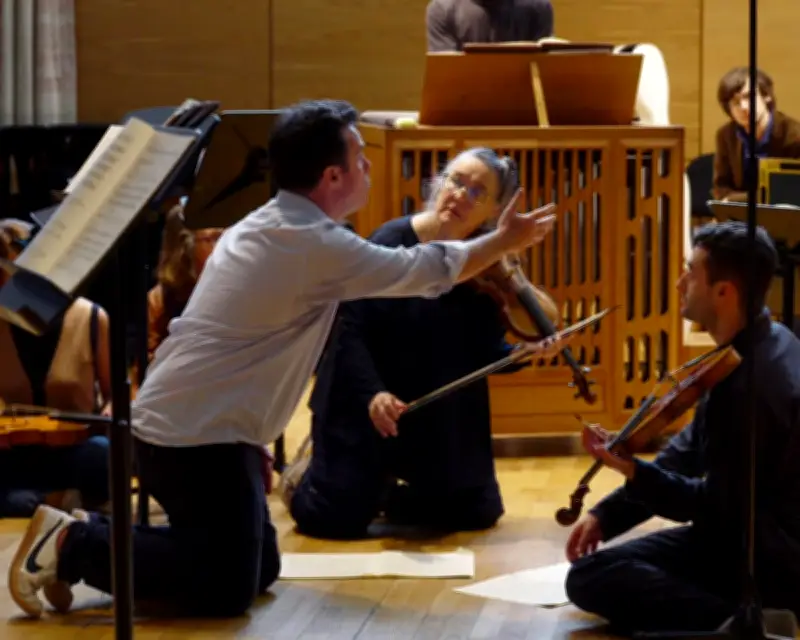
With musicians at the Royal Academy of Music, the violinist Margaret Faultless and tenor Nicholas Mulroy, Varwig put this theory into practice in a two-day workshop centred on Bach’s St John Passion. The idea wasn’t to prepare a performance or a recording, but to create a workshop in which the musicians were invited to let the music take them wherever they wanted it to. They weren’t told to dance, play kneeling on the floor, gesticulate or conga to Bach’s contrapuntal intricacies – but that’s what happened. Among the highlights are the way the pain of the tenor aria “Ach, mein Sinn” is amplified through what Faultless called the “cosmically messy” intensity of their performance, in which the emotional togetherness of the singer and the players was what mattered the most. And there’s the “unbearable”, as Faultless described it, confrontation with the music and meaning of another tenor aria, “Erwäge, wie sein blutgefärbter Rücken” (“Ponder how his bloodstained back”); the singer and the musicians kneel, entreating heaven with outstretched hands, listening to each other more intensely and intimately than a conventional concert performance usually allows.
Embodied listening through history
This kind of embodied listening didn’t go away in the 19th century: Hector Berlioz, who trained as a doctor, described listening to Beethoven’s Op 131 quartet with biological precision in 1829: “Bit by bit, a heavy weight seemed to press on my breast as in a horrible nightmare, I felt my hair tingling, my teeth chattering, all my muscles contracting.” The Promenade concerts, which began in 1895 in London’s Queen’s Hall, were so named because audiences were able to move about, but in general as the 19th century progressed, the silence and stillness of audiences became the culture of classical music, a trend that was identified by Stendhal, Rossini’s biographer, at the Paris opera in 1824: “What will result from this scrupulous silence and continuous attention? That fewer people will enjoy themselves.”

Transformative potential for performers and audiences
Many musical works simply lose much of their power without the engagement of our bodies, from our chattering teeth to our melancholic disorders to our contracting innards. For musicians, the project was transformative. “We found ourselves engaged in music we know so well in such different ways. We experienced the physicality of our own bodies and emotions,” says Faultless. “We were incredibly attuned to our fellow performers and listeners in the room. We were free to inhabit the intensity of Bach’s music, free to move, to breathe together and to respond to the power of the story through our shared humanity … [It felt] intensely immediate, connected and transformative.” Varwig adds: “I have utopian visions where this level of physical and emotional engagement among performers and audiences becomes the norm in the classical music world.” This is a bold and brilliant idea. There’s work to be done: let’s move!
Starmer’s musical legacy
Keir Starmer, the former flute-player, has decided to step away from the prime minister’s podium: the double-bar line awaits for the doomed pied piper of politics whose band of converts grew smaller with every passing month of his premiership. But there are some musical shoots that are worth hanging on to: Starmer is the only leader of a political party or prime minister to mention Shostakovich in a conference speech; the only PM since Edward Heath to profess a genuine love for Beethoven’s symphonies; and he’s a politician who communicated the value of music education, having experienced its benefits first-hand. Yet we never saw a transformative pitch to put music at the heart of the curriculum in Starmer’s two brief years, and there hasn’t been a massive boost to funding the music portfolio of Arts Council England – in fact the reverse. But the mood music matters, and the feeling that at least Starmer was enthusiastic and understood why music education was so important is something you’ve got to hope his successor picks up. Andy Burnham was culture secretary in Gordon Brown’s government, we know he’s a diehard Everton fan and he loves the Smiths and the Pogues. It’s great to have those passions, Andy, but maybe spread the love for musical culture as a whole, and who knows? Maybe a new era of restoration for music education is ahead of us. Sunny uplands, and all that jazz.