A new exhibition at Melbourne’s Potter Museum of Art celebrates the cultural and ecological significance of the eucalypt. Translating as ‘breathing for us’ in Woi Wurrung, the show Ngarn Wa’ngal brings together more than 160 works that capture this defining feature of the Australian landscape. Ngarn Wa’ngal: Art of the Gum Tree opens on 10 July; admission is free.
First European Scientific Description
The first European scientific description using the taxonomic name eucalyptus was published in 1788 by the wealthy French botanist Charles-Louis L’Héritier de Brutelle. His book included an engraving of messmate stringybark – the first print depicting a eucalypt – based upon specimens and seeds taken from Lutruwita/Tasmania in 1774, on Cook’s second voyage to the Pacific. Eucalyptus obliqua was one of the first gums to be grown in England and the first to be commercially available at nurseries.
19th Century Colonial Imagery
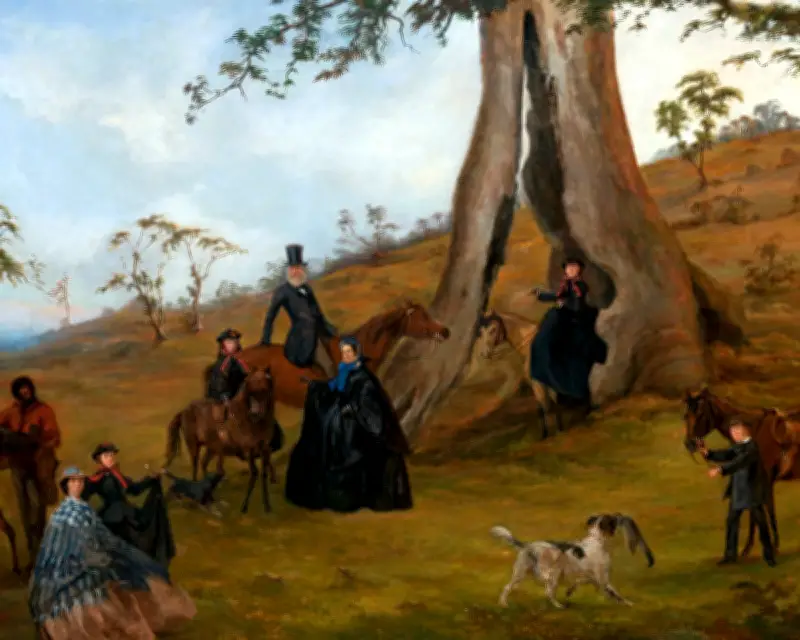
In 19th century Australian art, gigantic eucalypts with hollow bases were presented as objects of awe and backdrops for settler–colonist self-imaging. Barossa vine grower Joseph Gilbert commissioned Alexander Schramm to depict his family posed around this giant tree rather than in his gardens or orchards. The Aboriginal man, possibly Peramangk or Ngadjuri, shown tending the pony, and the dead possum carried triumphantly in the dog’s mouth, are depictions of colonial dominance. Gilbert’s estate Pewsey Vale continues as a winery today; the ancient tree was lost to fire.

Influence on Melbourne Artists
Louis Buvelot's painting 'Gisborne Hill from the slopes of Mount Macedon' (1875) was exhibited to much praise, with one reviewer writing: ‘Our rocks and mountains, our pastures and creeks, are always characteristic, but the eucalyptus is the most characteristic of all; and in depicting its weird aspects and contorted ramification, Mr Buvelot is always happy and successful.’ Buvelot’s ability to capture the untidy nature of gums and make them appealing was hugely influential on the next generation of Melbourne artists, including Frederick McCubbin and Arthur Streeton.
Gumnut Nouveau and Early Activism
Prussian-born woodcarver Robert Prenzel emigrated to Melbourne in 1888 and established his own cabinet-making business in the early 1900s. Encouraged to carve items that would appeal to a local audience, he merged the fluid curves of art nouveau design with Australian motifs in a style later dubbed ‘gumnut nouveau’. His panel 'Cockatoo' (1915) was produced during the first world war, when anti-German sentiment limited his once lucrative furniture commissions. Although it is not carved from eucalypt timbers, gum branches were the principal native plant he depicted.
After living abroad for more than 20 years, Arthur Streeton returned to Australia, acquiring land in the Dandenong Ranges. His atmospheric late-career landscapes inspired activism. In a newspaper article titled ‘Ruin in the Range. The penalty of Occupation’, Streeton decried the logging of old-growth forests: ‘With our settlement we have upset the natural order of things, and the result is fire, wind and desolation … [We] have no appreciation of the beauty and use of trees, no sense of our responsibility … in preserving the forests for future generations.’
Changing Public Sentiment
Hans Heysen first visited the Flinders Ranges, Adnyamathanha Country, in 1926 and returned multiple times, captivated by the striking geology, the intense light and the enormous river red gums. At a time when both inland tourism and colour photography were still uncommon, Heysen’s dramatic oil paintings and translucent watercolours were a revelation to city dwellers accustomed to the softer hues of south-eastern Australia. His paintings played a significant role in changing public sentiment towards central Australia.

Botanical Art and Modern Interpretations
Margaret Stones began her artistic and botanical career in Melbourne, attending botany lectures and participating in field trips. In 1951 she moved to London where her meticulous drawing skills led to her becoming a principal botanical artist for Kew Gardens and for Curtis’s Botanical Magazine. With its striking yellow flowers, the bell-fruited mallee (Eucalyptus preissiana) is now a popular tree for small gardens, although it is indigenous only to a small area in south-western Western Australia.
During the 1970s, Shay Docking created a series of drawings inspired by the sandstone formations of Ku-ring-gai Chase national park and its distinctive trees (Angophora costata): ‘With its smooth pink dimpled skin-like bark and gnarled branches, it swirls and spirals in an astonishing way – it looks extremely calligraphic … Salt sea winds and warm stone urge angophora into more and more fantastic shapes.’
Contemporary Voices
Hossein Valamanesh emigrated from Iran in his mid-20s. In his photograph 'Nesting' (2005) the artist is wholly present, physically and metaphorically embodying the challenge of trying to ‘nest’ in a new land, with its upside-down seasons, strange flora and fauna, and vastly different customs.
Hector Burton’s 'Puṉu-ngura (Tree country)' (2013) stems from a 2011 initiative of Burton and other Aṉangu artists to paint trees instead of Tjukurpa (Dreaming stories) and to protect the importance of their law. Burton has stated: ‘The trees are different for Aṉangu. They are the ancestors, they are our family. They are our history and our future.’
Political Statements and Cultural Preservation
In 'No More Give Away' (2024), Mervyn Rubuntja transforms a ‘Give way’ road sign into a direct and uncompromising political statement that speaks to the history of dispossession faced by Aboriginal Australians. Both protest and declaration, Rubuntja’s words assert a firm resistance to exploitation and loss of land, culture and authority – especially at the hands of mining conglomerates that operate on unceded Indigenous land across the country. The ghost gum stands alone, a witness to what has been taken and to what must be protected for future generations.
Wendy Hubert, a distinguished Yindjibarndi elder from the western Pilbara region, came to painting in 2017, surprising herself with a practice that became another form of recording and sharing knowledge. Her dynamic works are alive with the colours of the Pilbara – a continuous exchange between the artist and her Country.
Wanapati Yunupiŋu pioneered the practice of etching into stringybark with a rotary drill. His first etched stringybark 'Ŋäṉarr - Tongue of Flame' (2025) represents the flames that broke out of a men’s ceremonial ground at Biranybirany in the Waŋarr (time before morning), having been spread from Madarrpa Country by Bäru, the ancestral crocodile. A compelling feature is the darkened gnarl, which signifies the body of Bäru, who metamorphosed into fire.
Innovative Photography
Jane E Brown’s research into the photography of eucalypt-lover Russell Grimwade, in particular his glass-plate negatives and carbon prints made between 1920-1930, resulted in a series of photographs of gum blossom and gumnuts. Brown’s deep knowledge of the history, chemistry and alchemy of photography led to experimentation with developing techniques. Remarkably, she has found a way to print her photographs using eucalyptus oil as the developing agent. Her series title, 1,8-Cineole, is the chemical name for eucalyptol, the primary compound in eucalyptus oil.