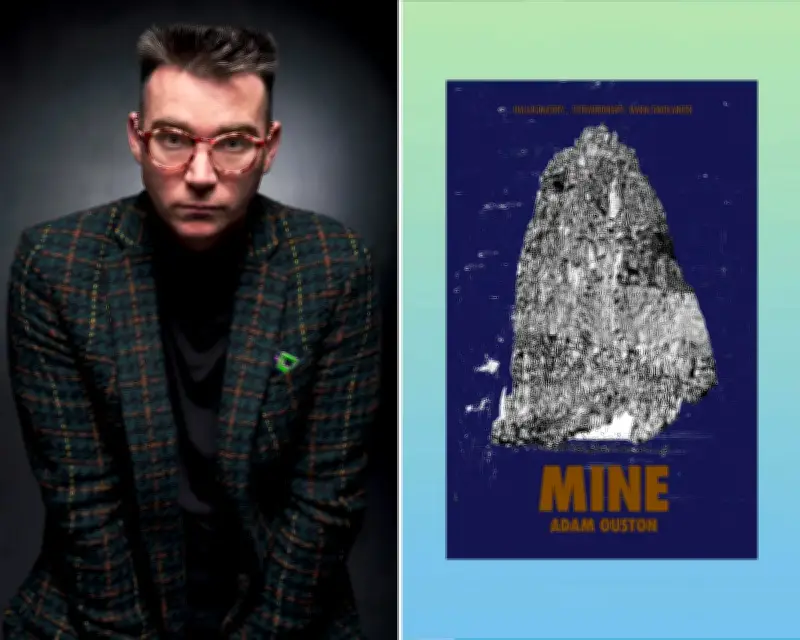
Adam Ouston's second novel, Mine, is a hallucinatory reading experience told in a single, unbroken sentence. The novel follows a poet, activist and teacher who has tumbled to the bottom of an abandoned mine shaft in western Tasmania, where he lies in the dark, concerned with running out of air.
A novel in one sentence
The novel consists of one long sentence, with thousands of clauses, digressions, conjunctions, modifications and clarifications, leaving no place for the reader to rest. Reading it aloud would leave one short of breath, parched, uncomfortable and delirious – in sync with the central character. The novel begins and ends with a howl, an urgent, pre-linguistic frequency that is “at once consoling and terrifying”.
The poet has fallen into the mine while researching ghost towns, the subject of his last great work, “a reckoning of place that had gathered slowly within him over seven decades and into an eighth, a lifetime of writing and thinking and erasing and starting over”. He thinks of this undertaking as a “hauntology”, a reckoning with the revenant.
Themes of history and exploitation
Both the poet and the novel are concerned with lost futures, particularly the aftermath of the rapacious exploitation of Tasmania's mineral wealth. The novel reaches for “the secret, invisible story beneath the story, history without history, transporting, dreamlike”. The title carries the colonial prerogative to declare ownership over land and resources: “speak name own, mine”.
Mine can be conceived as a hallucinatory work of both environmental and social history. The reader must hold the thread of narrative tightly as the novel winds through a maze of projections, identifications, repetitions and recursions. Narrative coordinates emerge: an elegy for a friend, an account of Mawson's expedition to Antarctica, a memoir of the poet's journey on an icebreaker, and a visit to the ghost town of Chester. The culmination is a bravura narration of the 1912 North Mount Lyell mine disaster, in which 42 men lost their lives.
Risky and exhilarating
This kind of writing is risky. Sections of Mine do buckle under conceptual overload and anxious multidirectional allusions. Yet the novel requires readers to cut their own track, rather than follow the signposted duckboards of the realist novel. It often recalls the “Age of Exploration Tracks”, when “cutting parties, armed with saws, axes, scrub-hooks, picks, and mattocks, carved and blazed access trails through the unrelenting rain and eucalypt forests, which itself was like boring through rock, a day's toil to clear five metres”. This is not a bad description of what it's like to read Mine, at once strenuous and exhilarating.
Ouston's debut Waypoints (2022) was longlisted for the 2023 Miles Franklin award. Mine is a more accomplished work, its formal radicalism matched by the feral political energy of the activist-poet at its heart. The vitality of this expression of contemporary Australian modernism is grounded by the jeremiad against the exploitation of labour and the environment in Tasmania. As the poet reflects, “it was staggering what some people did and allowed to be done to something so precious”. Mine by Adam Ouston is out now (Transit Lounge, $34.99).