'Portrait of a City' brings together more than 100 landmark works by some of the most influential photographers of the 20th century, showcasing how photography has shaped our collective understanding of the American city. The exhibition demonstrates how rapid urban expansion catalysed the camera's rise as a tool to document changing conditions, presenting a compelling visual account of a nation in motion.
Iconic images and their makers
Edward Steichen photographed the Empire State Building when it was the tallest structure in the world. He shot from the ground using a double exposure that exaggerated the building's height and compressed its mass into a single, dizzying image. His photograph transforms the skyscraper into spectacle – a feat of scale and modern ambition rendered through photographic artifice.
Curator Alexander Moore writes: 'Saul Leiter focused on everyday moments that most people would barely notice. His New York feels quiet and personal, despite being one of the busiest cities in the world. During his lifetime, his pioneering colour photographs remained largely unknown. Today, they are considered among the most accomplished images of New York ever made.'
Documenting America's postwar expansion
Robert Adams grew up in Colorado, where long walks, camping trips and close contact with the landscape shaped his way of seeing from an early age. His work attempts to confront the consequences of postwar American expansion and its effects upon the environment and society.
Peter Hujar was openly gay at a time when queer lives were routinely criminalised and marginalised. His photographs focused on artists, lovers and friends from New York's queer and bohemian communities. In the 1980s, the Aids crisis profoundly shaped Hujar's life and work. 'Richie' was made during this period of loss and heightened awareness. The photograph carries a sense of private encounter, reflecting a world increasingly lived behind closed doors. Hujar's work stands as a quiet record of community and endurance in the face of systemic neglect and personal grief.
Street photography and urban life
Garry Winogrand was a central figure in the redefinition of American street photography during the postwar decades. Winogrand worked at great speed, producing on average around 600 rolls of film per year, often resulting in tilted horizons and abrupt framing. In 1967 he was placed alongside Diane Arbus and Lee Friedlander in 'New Documents', a landmark exhibition at New York's Museum of Modern Art.
Alexander Moore: 'Growing up on the Lower East Side gave Rebecca Lepkoff an intimacy with its streets that few photographers possessed. In this image, the graffiti-covered wall, dramatic afternoon light and quietly self-assured figure create a portrait of postwar New York that feels both deeply human and strikingly modern.'
Helen Levitt was born and raised in New York and began photographing the city in her late teens. Largely self-taught, she developed her practice while moving through neighbourhoods she knew intimately, particularly Harlem and the Lower East Side. Levitt was interested in capturing people as they inhabit their own worlds within the shared space of the street.
Everyday moments and social documentary
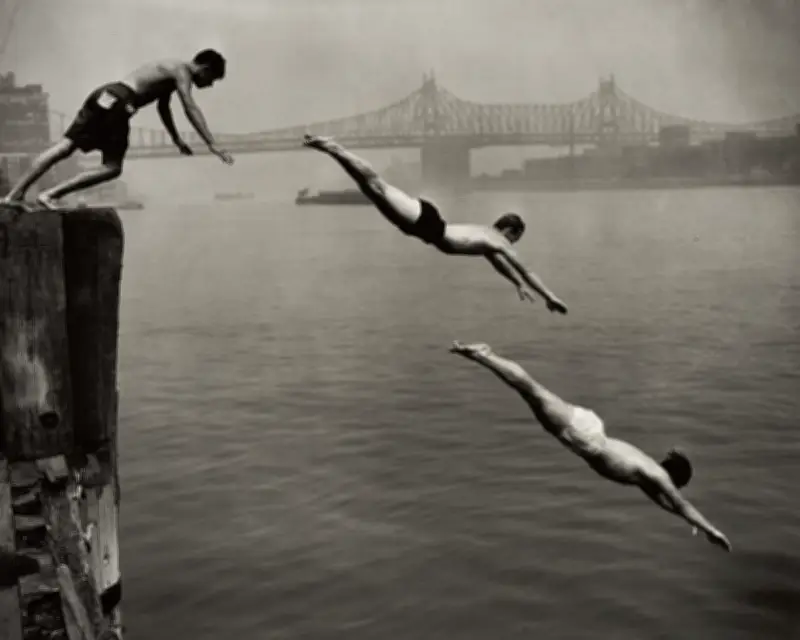
Arthur Leipzig was a Brooklyn-born photographer whose work focused on everyday life in the city during the 1930s–50s. He was a member of the influential Photo League. This image captures a moment of play set against the city's infrastructure, reflecting how young New Yorkers claimed the river's edge as a space of freedom within the modern city.
Mary Ellen Mark is celebrated for her work in photojournalism and long-form documentary projects and was widely published in magazines including Life, Rolling Stone and the New Yorker. This photograph was made as part of a series on homelessness in the United States. Mark's close framing emphasises the conditions of daily life without separating the subjects from their environment.
Historical perspectives
Walker Evans occupies a central place in American photography because he redefined how the modern city could be seen. Working during the Great Depression, Evans applied a detached approach to document urban and rural America. Evans's landmark book 'American Photographs' (1938), which featured this photograph, defined the photobook as a genre.
John Gutmann brought with him a visual sensibility shaped by Bauhaus-influenced ideas. This photograph depicts migrants from the Great Plains who travelled west from states such as Oklahoma, Texas and Missouri in search of work during the Great Depression. Gutmann also photographed leisure and street life, examining American culture from a different perspective.
'Portrait of a City: A Century of American Photography' is at Dulwich Picture Gallery until 4 October.