A self-made legend
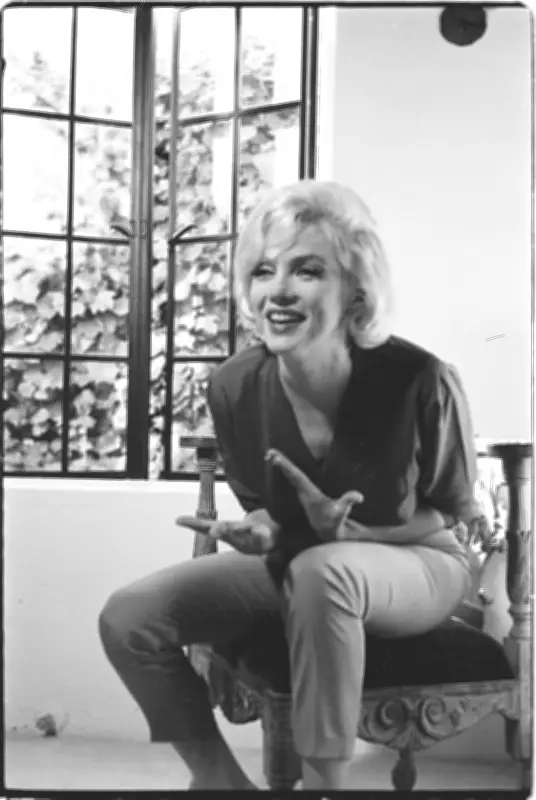
Timed to mark 100 years since Marilyn Monroe's birth, the National Portrait Gallery's exhibition "Marilyn Monroe: A Portrait" argues that her image was not a Hollywood invention but a self-created work of genius. The show presents her image as a vehicle for success that worked because she gave herself fully to the camera, so that audiences felt they saw the real woman beneath the fantasy and loved her.
J G Ballard imagined Monroe's body as a vast desert landscape in his fiction, a symbol of a pinnacle of plenty and a commercial/entertainment monument to American optimism and tragedy, comparable to one of her reported lovers, John F Kennedy. He called her death a "psychic cataclysm" for the post-war mass consumer audience, writing: "Here was the first and greatest of the new style film goddesses, whose images, unlike those of their predecessors, were fashioned from something close to the truth, not from utter fiction."
Monroe was born Norma Jeane Mortensen in the charity ward of Los Angeles General Hospital, an illegitimate child whose mother had serious mental health problems. During the Great Depression she was moved between foster homes and an orphanage while dreaming of becoming a star. The first image in the show is a photobooth picture of the teenage, brunette Norma Jeane in 1940, already giving it movie-star glamour; she appears as the dreamer of her own Dickensian story.
The gallery is staying open until 9pm (last entry 7:45pm-8pm) Thursday-Saturday because of popular demand for the exhibition.
Photographers and the making of Marilyn
The exhibition is structured around Monroe's working relationships with photographers. These relationships with older male photographers were often physical too, with Eve Arnold an important exception, but they seem to have been a means to an end in the Norma Jeane days, the male gaze pointing the way toward her own creation.
One room is largely given over to her early work with André de Dienes. A contact sheet showing her new blonde look in 1946 carries his handwritten note: "First photos of Marilyn Monroe — The legend has started." But she was not his creation. Her modelling agency had recommended she go blonde, and a beach shoot with de Dienes from the same year, before she was famous, showed her control. Wrapped in an army blanket by the ocean, she acts out different emotions with a moody, existential quality that resembles an Ingmar Bergman film. The shots were stunning, but she would not let them be released because this was not the image she was honing for Marilyn Monroe.
Three years later, another de Dienes beach shoot shows the fully formed Monroe: smiling, happy and carefree. It was a classic role that was also not a role — a clever construction using pin-up tropes but also a way to release a spirit that shines through in the images.
Cecil Beaton said: "Whatever press agentry or manufactured illusion may have lit the fuse, it is her own weird genius that has sustained her flight." Truman Capote described her presence: "It's like a hummingbird in flight: only a camera can freeze the poetry of it."
Hollywood stardom and The Seven Year Itch
The big screen was where she was headed. The first part of the show ends with excerpts from her films that make her star quality clear. The show also looks behind the scenes at the famous publicity shoot for 1955's "The Seven Year Itch", in which Monroe's skirts are raised by air from a subway grill and she delights in the sensation. It was first filmed on a New York street, with the press invited, but the resulting scrum was frightening, with New Yorkers screaming for her. The audio was unusable and the scene had to be reshot on a soundstage. The pressure of fame had truly begun.
Artistic interrogation
The show mostly avoids the scandals, the battles with husbands and studio heads, and the mistreatment and abuse Monroe suffered. Instead, it turns to how the icon was subjected to artistic interrogation, and this is where the exhibition begins to depress. Many works by artists from her era and later make up the second half, and most are weak. Willem de Kooning's ghastly portrait turns her into a mocking mannequin; her then-husband Arthur Miller was furious when he saw it, but Monroe said artists should be free to depict her how they wished. That democratic outlook, with one eye on the endless proliferation of her image, made her essentially Warhol before Warhol.
Warhol himself was obsessed with her, and his work is the best art here. "Nine Multicolored Marilyns (Reversal Series)" uses silk-screened negatives to unveil the darkness behind the image, with a haunting immediacy. Other works, such as Audrey Flack's memento mori, are sentimental, while others are ghoulish and trite. Marlene Dumas's "Dead Marilyn" is an oil work based on a paparazzi picture of her corpse; Peter Blake shows only the gurney her corpse is strapped to. Each purports to show fame's squalid end but only adds to the sensationalist death cult around her.
The tragedy behind the image
Monroe was aware of a dark, shadow lust directed at her that wanted tragedy. She kept a handwritten copy of a Beaton article accompanying his Harper's Bazaar shoot, in which he wrote: "It is an artless, impromptu, high-spirited, infectiously gay performance. It will probably end in tears."
Richard Avedon's later "sad Marilyn" image, caught in a moment of downtime between shots, was not taken surreptitiously. Avedon remembered approaching her carefully, and "she was not saying no". She clearly wanted the pain beneath the perfect image to be seen.
A work by Richard Hamilton replicates a contact sheet from one of her final shoots, showing that by then she would scour out shots she did not like. Hamilton saw it as self-harm: "An aggressively, suicidal, antagonistic tendency in the attacks on her own image."
A death the world wanted?
The exhibition raises the question of whether her death from an overdose at 36, alone in a hotel room, was a way of giving the world the tragedy it wanted, freezing her potent image for worship, mockery and debate. Joan Didion did not think so, calling it a miracle that she got so far: "That she withstood the incredible, unknowable pressures of her public legend as long as she did is evidence of the stamina of the human spirit."
The show is a must-visit, refreshing the discourse around Monroe while displaying photos that demonstrate her genius. As Didion put it: "She was a profoundly beautiful, profoundly moving young woman."
National Portrait Gallery, until September 6.