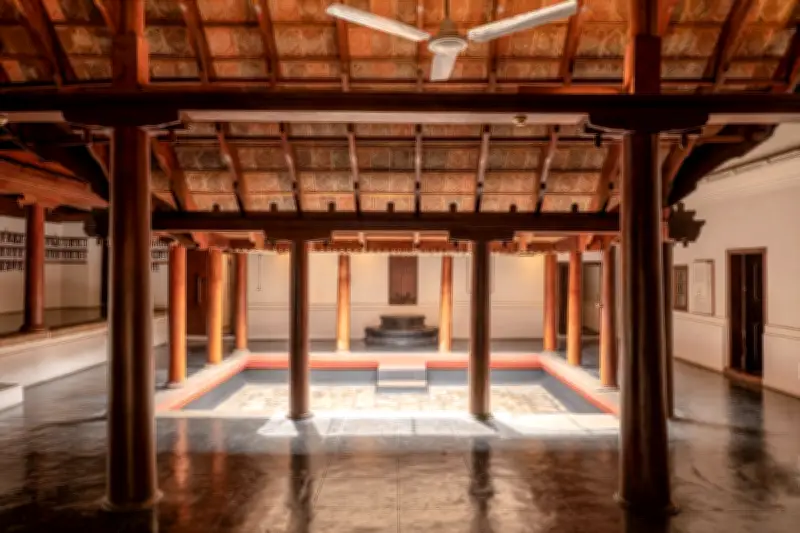
The tharavad, a traditional style of housing in Kerala, India, was designed for and run by women, with architecture that accommodated female bodies, cycles, and authority. Author Megha Mohan, researching for her book Herlands: Lessons from Societies Where Women Make the Rules, sought her own ancestral tharavad, Palayil, only to find it demolished. However, surviving examples reveal a built environment that prioritized women's needs.
Design for Women's Bodies
The tharavad, typically a nalukettu ("four corners") structure, featured a roofless central courtyard called a nadumuttam. Rooms were arranged for specific female experiences: a childbirth room, a menstruation room, and a corridor labeled "Corridor with rooms for menstruating women and pregnant ladies" in one conserved tharavad. Architect Benny Kuriakose, who restored several tharavads, noted that the kitchen was placed in the northeast to direct hot air away from women's bedrooms. Menstruating women were catered to by other women, excused from chores, and given a room of rest, contrasting with practices like chaupadi that treat menstruation as polluting.
Acoustic Privacy and Social Spaces
In the conserved Kandath tharavad, custodian Sudevan Bhagwaldas explained that raised platforms called purathalams were positioned diagonally across the courtyard so that "acoustically, no word spoken by the women can be heard by the men and vice versa – even if you should shout." This design protected women's conversations. The chuttu veranda, an outer corridor lit by brass lamps, served as a discreet route for conjugal visits under the sambadhanam system, a union that could be dissolved by either party.

Matrilineal Inheritance and Legacy
The tharavad was central to Nair matrilineal society, where property passed through women. Mohan's great-grandmother, Palayil Sreedevi, was the last woman in her line to live in Palayil. Her mother, Palayil Kalyani, held the keys and deeds, and her blessing was required for business deals, marriages, and naming. The birth of a girl was celebrated with bells, as gender academic Lekha NB explained: "The birth of a girl child was more prized than a male child because of the role a woman has in physically carrying the progeny."
Decline and Lessons
The matrilineal system was dismantled by laws in the early 20th century that ended female inheritance and made sambadhanam illegal. Mohan notes that tharavads were caste structures: Nair women enjoyed the architecture, while lower-caste women labored outside under semi-bonded conditions. Despite this, the architecture's lesson endures: "keep your shelter, keep your independence, keep the key." Mohan's book Herlands explores real communities where women built systems of care and mutual support.