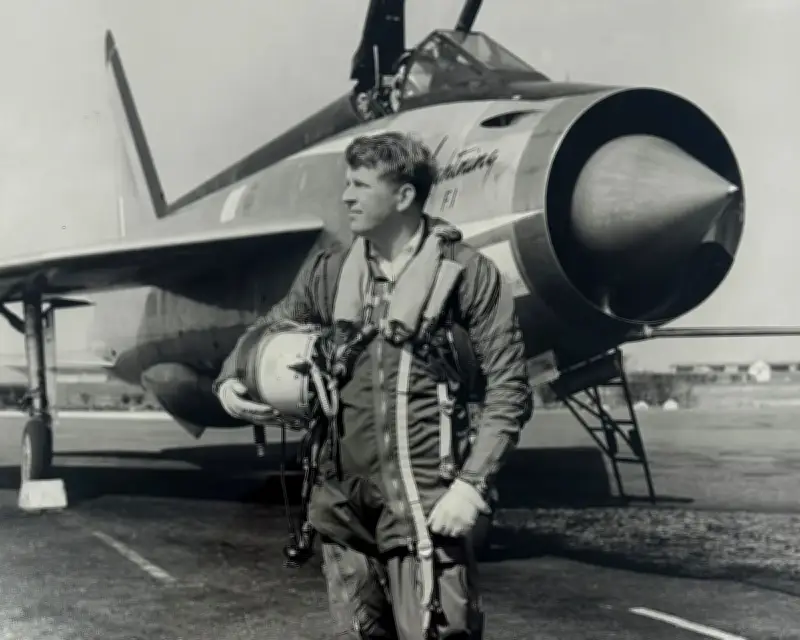
John Hall, a British test pilot who helped develop the English Electric Lightning, the first and last entirely British-built supersonic jet fighter, has died aged 98. He was a neighbour and friend of the writer on Guernsey.
Cold War testing
During the late 1950s, Hall was part of an intrepid team of test pilots who pushed the Lightning prototypes to their limits. The aircraft became the RAF's main interceptor, with a phenomenal rate of climb, and was nicknamed "the pocket rocket" by envious American fighter pilots.
On one occasion, Hall took a Lightning up to 36,000ft for a "cold soak" endurance test. He flew for 90 minutes with the plane completely frozen. His hands became almost useless, the controls stiffened, and he could only work them with jerky movements. Unable to lower the undercarriage normally, he just about managed a landing, after which the ground crew prised his 6ft 2in frame out of the aircraft and led him to safety, hardly able to walk.

Structural integrity test
He also survived a "structural integrity test" over the RAF's North Sea firing ranges. He tried to discover if it was possible to empty the magazines feeding its three 30mm Aden cannon simultaneously before the recoil shook the aircraft apart. Expecting the entire body to crack apart, he heard "a bloody great bang" and saw warning lights flashing, but the aircraft held together.
Early life and career
Hall was born in East Bridgford, Nottinghamshire, and attended Southwell Minster grammar school. He was 10 when the second world war broke out, and like many of his contemporaries longed to fly Spitfires. At 18, after the war, he trained at RAF Cranwell and joined a Spitfire squadron that saw active service in the Suez canal zone.
In 1952 he returned to the UK as an instructor on Meteor jet bombers. By the late 1950s he was part of the English Electric Lightning test pilot team. He left the RAF to work directly for English Electric (later BAE), but continued to test jets for the RAF part-time. He later moved to British Caledonian airlines, flying commercial transatlantic flights in Boeing 707s for 25 years until retirement.
Personal life
His first marriage, to Shelagh Stone, ended in divorce. He moved with his second wife, Tessa (nee Maxwell), to Guernsey, where he enjoyed local swimming. He is survived by Tessa, three sons from his first marriage, James, Patrick and Richard, and another son, Maxwell, from his second.