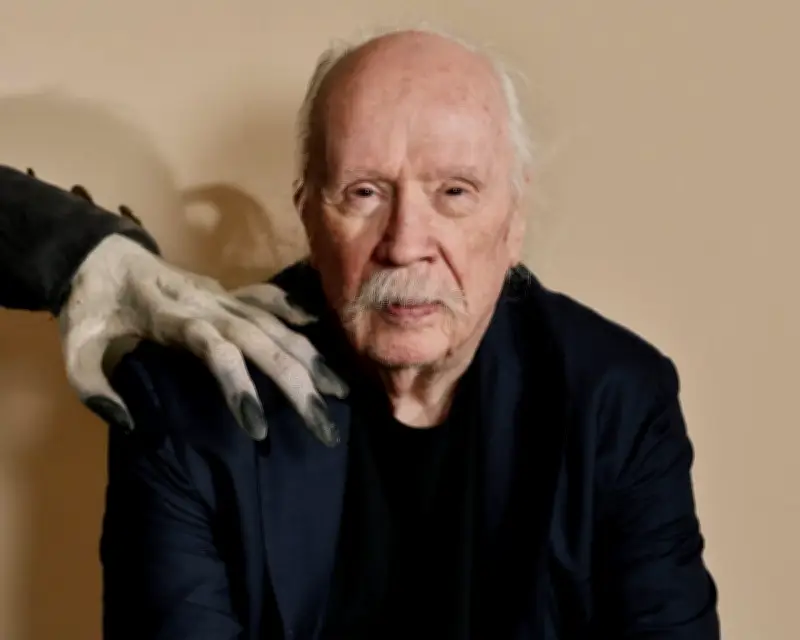
In 2024, legendary horror and sci-fi director John Carpenter had a dream that felt like one of his own movies: a portal to the underworld beneath a disused church, monstrous demons, and people turned inside out. He turned it into a graphic novel, Cathedral, with an accompanying soundtrack. 'I woke up and thought: wow! What an elaborate story,' he says. 'I rarely have cinematic dreams, but this was one of them.'
When asked if this was a nightmare, Carpenter replied, 'Nightmares, for me, are personal—something that happened to me. Usually my nightmares are, I'm directing a movie and no one will listen to me.' This reflects his career-long battle for creative control.
A Rebel Filmmaker's Journey
Carpenter's film career wound down after 25 years of making tense, terrifying movies his own way. He is the epitome of the stubbornly independent filmmaker. 'Don't tell me what to do is John Carpenter's credo!' he says. Few of his films were commercial hits initially, including his final two: Ghosts of Mars (2001) and The Ward (2010).

Does he miss making movies? 'Yes and no. Yes, because I've always loved cinema and the process. But no, working in the studio system in Hollywood is very difficult.' He adds, 'You have to fight to do that. That takes a little bit out of you as a person. There's a reason why directors come out looking as if they've been in a war.'
Influence and Legacy
Many of Carpenter's films are considered classics: Halloween, The Thing, Assault on Precinct 13, The Fog, Escape from New York. His style influences horror, sci-fi, and TV shows like Stranger Things. Musicians like Portishead, Daft Punk, and Hans Zimmer cite his synth-driven scores.
Carpenter seems unaware of his influence. When told about filmmakers citing him—Guillermo del Toro, Quentin Tarantino, James Cameron—he says, 'If you were gonna emulate a director, you'd emulate somebody whose movies aren't panned.' He admits he rebelled against mobile phones and computers.
Early Life and Rebellion
Carpenter's rebellious streak began in childhood. In 1953, his family moved to Bowling Green, Kentucky. 'It was the Jim Crow south in the 1950s. Everything I know about evil I learned in that small town,' he says. His father, a music teacher, encouraged him to learn violin, but he was bullied for it. 'These country boys decided I was great to beat up.'
He rebelled against authority, the Vietnam war, and the system. His father told him to 'just create something.' Seeing Forbidden Planet at age eight inspired him to become a movie director.
Halloween and Its Impact
Halloween (1978), made for $325,000, grossed over $70 million. It is often cited as the foundational slasher movie. Carpenter says, 'I put in what I thought was the summation of all the horror I had seen. I wanted to manipulate the audience like a carnival ride.' The film's opening—revealing a child with a knife in the suburbs—was key.
The studio wanted a sequel. Carpenter wrote but did not direct Halloween 2. 'They took it out of my hands, but they had to pay me every time they made a movie. I am a happy capitalist.'
Subversive Cinema
Carpenter's films often punctured certainties and ridiculed authority. Assault on Precinct 13 upended hierarchies. Escape from New York featured a snarling anti-hero rescuing a feeble president. Big Trouble in Little China made the leading man a klutzy sidekick.
The Thing (1982), now a horror masterpiece, was released two weeks after ET the Extra-Terrestrial. Carpenter recalls, 'I remember seeing the boys on their bicycles and ET wrapped up, and then they go up into the sky. That's when I threw up.' He prefers his version: 'If you want the truth about alien encounters, my movies are more realistic.'
Starman (1984) showed his capacity for emotional drama. 'I wanted to show I could do it,' he says.

They Live and Political Commentary
They Live (1988) targeted Reagan-era hyperconsumerism and inequality. The film's sunglasses reveal subliminal messages like 'Obey' and 'Marry and Reproduce.' Carpenter says, 'It's a documentary, and it didn't end. It's still going on now, even worse.' He adds, 'I'm a real sucker for American values. I keep believing we'll fight them off one day.'
Slavoj Žižek called it 'one of the forgotten masterpieces of the Hollywood left.' Carpenter had never heard of Žižek and asked for the clip.
Life After Filmmaking
Carpenter stopped making films after The Ward (2010). 'I was exhausted. I was addicted to moviemaking and needed rehab.' He now tours playing his film music with his son and godson, records new material, and has no regrets. 'I've had a fantastic time. Now I'm playing music. It doesn't get better than this.'
His days are leisurely: 'Basketball, the news, and video games. Then I go to have long, beautiful sleeps—and dream.'