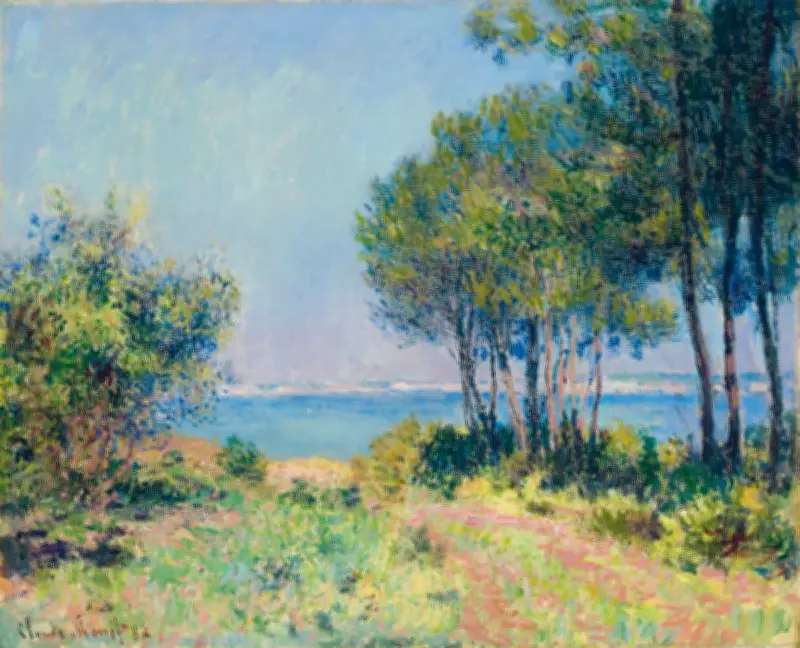
Claude Monet once said of Paul Durand-Ruel: 'We owe him everything.' Now, Monet's Fir Trees at Varengeville (1882) will be among the masterpieces displayed at the Geelong Gallery from 20 June, as part of the most ambitious exhibition in the gallery's 130-year history.
From Paris to Geelong: A Journey of Art and Vision
In March 1886, French art dealer Paul Durand-Ruel sailed to New York with over 300 paintings, including 43 by Monet and 35 by Renoir. At the time, the Parisian establishment mocked the Impressionists for their radical use of colour and bold brushstrokes. Durand-Ruel, on the brink of financial ruin, was one of their few champions. Their last hope was to find new collectors abroad. Against all odds, his gamble paid off. In the United States, the Impressionists found their first receptive audience, rescuing the artists from obscurity and poverty, and turning Impressionism into a global phenomenon that endures today.
In a fitting tribute to Durand-Ruel's global vision, more than 70 paintings that passed through his hands have now made another cross-continental journey—this time to a port city on Australia's southern coast. The exhibition, Discovering the Impressionists: Paul Durand-Ruel, Art Dealer Among Artists, is on show at the Geelong Gallery.
A Dealer's Legacy Lives On
It would have been 'no surprise' to Durand-Ruel that these paintings have travelled to regional Australia, says Claire Durand-Ruel, the dealer's great-great-granddaughter, who co-curated the exhibition with art historian Marianne Mathieu, a global authority on Impressionism. Claire studied archival records detailing the lengths her great-great-grandfather went to in the 19th century to ship paintings to America and Russia. 'He wanted to go as far as he could, to send the works as far as he could, all of his life,' she says. 'That was the policy of the Durand-Ruel Gallery. You cannot bring the people to your gallery, that's difficult, so the works have to move to the people.'
The exhibition features works by Monet, Renoir, Berthe Morisot, and Camille Pissarro. Almost all are on loan from private collections, mostly from Europe, so they are rarely seen publicly anywhere in the world.
Rediscovering Forgotten Artists
In dialogue with these giants of art history are pieces by a second wave of lesser-known Impressionists also championed by Durand-Ruel—Albert André, Georges d'Espagnat, Gustave Loiseau, Maxime Maufra, and Henry Moret. Mathieu believes these painters have been neglected by art historians because their careers lacked the dramatic rupture from the establishment that defined their forerunners. 'We want to put this generation at the level they deserve,' she says.
Claire believes visitors will instinctively understand why her ancestor backed these painters with the same conviction as the Impressionist pioneers. She gestures to a large oil-on-canvas by André depicting a nude woman flanked by peacocks, their iridescent feathers swirling around her. 'It is incredibly beautiful. That's what [Durand-Ruel] saw,' she says. 'These works deserve to be exhibited now because of both the quality of the art and the opportunity to educate people about other artists. He believed in them totally.'
A Homage to a Pioneering Dealer
The exhibition is also a homage to Durand-Ruel, who at times single-handedly kept artists employed by buying their paintings when no one else would, nearly bankrupting himself twice. Monet is recorded as saying: 'Without Durand, we would have died of hunger, all of us Impressionists. We owe him everything.' Monet had an especially great debt of gratitude: with a loan from the dealer, he bought his property at Giverny, where he lived for more than 40 years, painting water lilies and other scenes from his garden.
To artists, Durand-Ruel was 'a paterfamilias, a confidant, a friend, and a banker all rolled into one,' Claire writes in the exhibition catalogue. Looking back, she is amazed and touched by his faith in the paintings, especially through years of public condemnation. 'He had both vision and stubbornness,' she says, laughing. 'He was so optimistic. He's very impressive.'
Enduring Appeal of Impressionism
Today, the artists Durand-Ruel supported are some of the most famous in history. Their work sells for up to hundreds of millions of dollars, is collected by top museums, and has been exhibited globally. Australia alone held major French Impressionism shows in 2018, 2019, 2021, and 2025, some of which were cut short during pandemic lockdowns. These exhibitions sparked criticism for being formulaic crowd-pullers, but Mathieu believes there is still much to learn about the movement. 'I'm searching every day, all the time, and there are still things to bring into the light,' she says. 'There are still many things to discover.'
Beyond the intellectual, both curators hope the exhibition will spark emotions. 'I want visitors to have a sense of beauty,' Mathieu says. 'I want them to experience how wonderful these paintings are. These paintings of colour, of light, of happiness and hope.' 'It's pure joy,' adds Claire. In today's world, she says, 'it's what people need.'
Discovering the Impressionists: Paul Durand-Ruel, Art Dealer Among the Artists runs from 20 June to 11 October at Geelong Gallery.