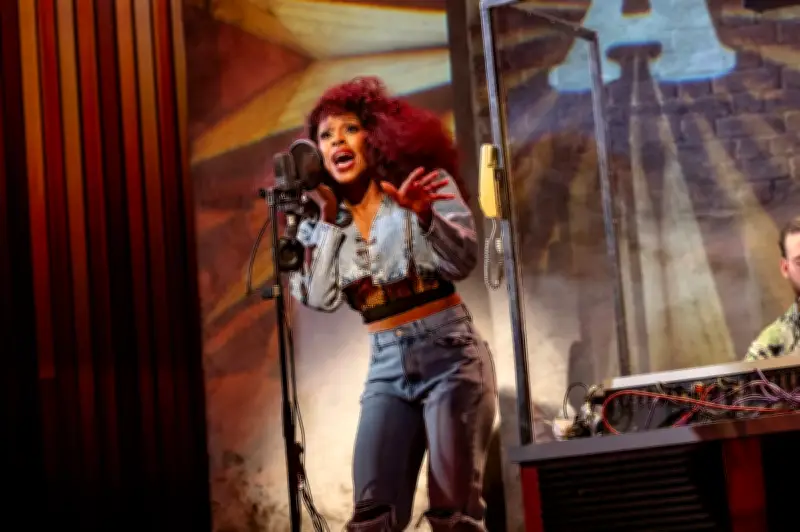
The new jukebox musical about Chaka Khan, I'm Every Woman, at the Troubadour Wembley Park Theatre, has been described as tedious and utterly un-funky. The show, which features the singer's hits from the 70s onwards, including Tell Me Something Good, I Feel For You, and Ain't Nobody, is augmented with songs by other artists. The production tells a by-the-numbers tale of triumph over adversity and addiction.
A Show Plagued by Poor Execution
The script, written by Khan's creative director Nia T. Hill, is bad. The projection-based designs are bad. The cartoonish cameo appearances by Stevie Wonder, Whitney Houston, Miles Davis, and others are traducingly awful. The singing voices of a cast led by an extravagantly bewigged Alexandra Burke are pretty much the only saving grace, though the garish costumes are fun in a Wembley-hen-night kind of way.
After the obligatory curtain raiser of the title song, the show opens (and eventually closes) with Khan and her mother, sisters, and daughter at a group therapy session. This sets the tone for the mopey, confessional, expository dialogue to come. Then whoosh, it's on with the whistle-stop life story.
Khan's Life Story Told in a Whistle-Stop
Khan is born Yvette Marie Stevens in Chicago, her childhood shaped by stern Catholicism and her departed father's heroin habit. She is renamed Chaka by a Yoruba priest, briefly marries Black Panther activist Hassan Khan at 17, and has a daughter, Milini, before being co-opted into rising funk ensemble Rufus. From the very start, people tell her that her voice is an instrument of "freedom" and "revolution." "I won't be a monument, I'll be a movement," she says. But after Black Panther leader Fred Hampton is gunned down by police, any sense of the wider world falls away. We're left watching Chaka navigate the peaks and troughs of the iniquitous music industry and her own poor life choices involving men and intoxicants.
A head-wagging Stevie Wonder and a twerpish Prince write songs for her – hooray! Her vocals are taken off Robert Palmer's Addicted to Love – boo! Managers and record labels champion and then betray her. Her second husband Richard (Miles Anthony Daley) proves as much a rotter as the first. The first act closes with pregnant Chaka, in a turban and slippers, blasting him out of the house with a pump-action shotgun.
Clumsy Devices and Awful Moments
Perhaps the clumsiest device in a show that's mired in obviousness is to have Chaka accompanied throughout by her alter ego "Marie Stevens." Amusingly but crassly played by Chrissie Bhima as a caterwauling, swivel-eyed Tasmanian Devil, this id-figure cajoles Chaka into using cocaine, heroin, and fentanyl to get through the late nights and long days.
Perhaps the most deliciously awful moment comes when a Muppet-croaking Miles Davis gives Chaka smack in a nightclub. Plumes of powder shoot up the sliding panels of Sara Perks' set while dancers caper with lampshades and antlers on their heads. Suddenly, Trainspotting isn't the only dreadful skag-influenced musical in town, and Sinatra isn't the only show dropping famous names like used Kleenex.
A Warts-and-All Hagiography
Khan is, unsurprisingly, a co-producer on I'm Every Woman and attended the opening night (35 minutes after it was due to start). To be fair to her, this is a warts-and-all hagiography, in which most of her demons and deficiencies are laboriously itemised. But the inclusion of songs by Joni Mitchell, Gil Scott Heron, and Aretha Franklin feel like an admission that her back catalogue isn't strong enough to sustain 160 minutes. Racky Plews' direction and Ebony Clarke's choreography are relentlessly pedestrian, particularly in the boggy, family-centred second act. I felt sorry for the cast, many of whom have fine voices, but are stuck with barely functional characters and leaden dialogue.
Burke does her best, belting out the songs and rocking a series of dramatic looks involving thigh boots, sheath dresses, ripped denim, and gold bustiers. Her wigs range from wet-look curls to a vast, purple thunderhead that will remind audiences of a certain age of the Crystal Tips cartoon. But she's stuck in a vehicle that's unroadworthy. Some artists' life stories can carry a musical but on this evidence, Chaka's can't. To 27 Sept, imeverywomanthemusical.com.