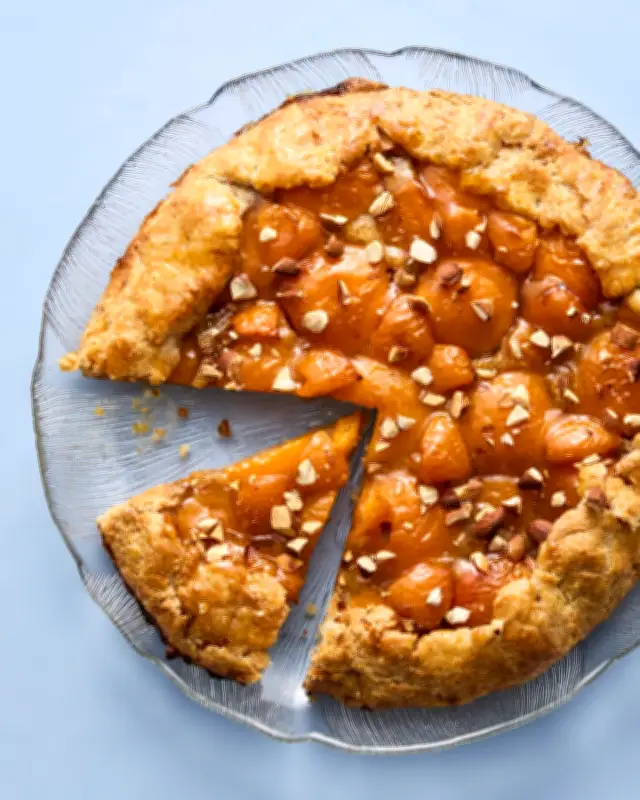
The galette takes its name from the pebble it's said to resemble – as Elizabeth David observes, it takes many forms, all of them round and flat. For me the word conjures the buckwheat pancakes of Brittany while French friends, in a quick straw poll, tend to think first of the frangipane-stuffed puff pastry galette de rois served at Epiphany, with one vote for a buttery Breton biscuit.
What is a galette?
Ask the English-language internet, however, and you'll be served what is more commonly known as a tart(e), more specifically a charmingly rustic, free-form version which doesn't require a tin. Though Anne Willan references prune and apple three-tier galette pies from the Pyrenees in her 1981 classic French Regional Cooking, and David includes a yeasted version that sounds more like a cobbler in French Provincial Cooking, most fruit galette recipes I find seem to be American. My hunch is that Alice Waters' tradition of a daily seasonal galette at Chez Panisse may have popularised the name across the pond, but the general idea never needed upselling. As a quick and easy way to turn a punnet of fruit into a dessert, it's hard to beat, whatever you call it.
The pastry
There are two popular options here: a rich shortcrust, or a rich rough puff. As Louis Thompson observes in his incredibly comprehensive exploration of the galette on Nicola Lamb's Kitchen Project Substack, “because you are eating such a small amount of pastry per portion in a galette, it can afford to be richer”. He, like Nicole Rucker, goes for a rough puff, as does Rose Levy Beranbaum, who writes in The Baking Bible that “in recent years, when I bake a pie, the pie crust I always turn to is this one”, which she describes as a “perfect flaky and tender cream-cheese pie crust”.
While Thompson keeps it simple with equal parts of butter and flour, Beranbaum swaps some of the butter for cream cheese and heavy cream. This makes for a softer and slightly more savoury crust next to Thompson's buttery, shatteringly crisp base, which puts me in mind of the end of a croissant. Rucker opts for a plainer formula of 60% of the flour weight in butter, allowing the filling to shine. Also in the cream cheese, butter and cream camp are Brian Levy, and Helen Goh and Yotam Ottolenghi, whose rich shortcrust recipe in 2017's Sweet actually contains more fat than flour, and, probably not coincidentally, proves a tester favourite. Brian Levy's softer, crumblier, more pie-dough like version, which contains less butter, is instead enriched with an egg yolk.
All stand up admirably to the task of containing the fruit's juices without springing a leak, or even a suspicion of sogginess, but as a galette, in my mind at least, should be something one can knock up relatively easily, I've decided to opt for a rich, flaky shortcrust rather than anything that requires folding and layering, however minimally. I've based mine on the Sweet formula, but because we all enjoyed the flavour of the wholemeal flour in Levy's pastry so much, I've swapped in some of that (Thompson advises going for no more than half of the total weight if using something like spelt or rye in particular, on the basis that “beyond this, I find the flavour overwhelming and begin to experience unwanted textural changes due to the reduced gluten-forming capabilities”. After two delicious but less than perfect-looking attempts with a 50:50 mixture, I realise that wholemeal flour does make the dough softer and harder to work with, so I reduced the quantities to a third. (Note: if you decide to go for an alternative grain, you may find it needs more liquid to bring it together, so always trust your eyes… though it should only just clump into a dough. If it's very dusty, scoop out the dough, and add a little more liquid just to the dry bits. I've also left out the vinegar, because as far as I can tell it's only really helpful to stop the pastry discolouring if you're storing it for long periods, and this is less important if you're using wholemeal flour in any case.
Probably the most important piece of advice: keep everything as cold as possible, particularly if you're making this, as I was, in the height of summer. As there's no tin to support the sides, it's well worth chilling the shell both before filling and before cooking, in warm weather. If your kitchen is nice and cool, you may wish to skip one of these steps.
The fruit
I try recipes using apples, peaches, rhubarb and blueberry – from pineapple to pear, there aren't many fruit that don't work in a galette, so I'll try to make this as general as possible while, perhaps controversially, opining that the drier the fruit, the prettier the galette, but the less satisfying the result.
Thompson and Rucker's apple galettes are beautiful, and undeniably delicious, but the low-profile nature of the galette – the real showstoppers tend to feature just one layer of thinly cut fruit – means that they lack the juicy generosity of the stone fruit versions. They're works of art, but I prefer my apples in a deeper pie – Goh and Ottolenghi's rhubarb and blueberry combination works well, though given the season you might prefer their alternative suggestion of fig and raspberry as a combination, but Beranbaum and Levy's peaches prove the crowd favourites. For my perfect recipe, I've chosen to use apricots, first because we grow such beautiful ones in south-east England at this time of year, and second because wherever they're from, apricots are a fruit that's almost always enhanced by cooking.
Whatever you use, however, you need to assert your authority over its juices. Goh and Ottolenghi toss the fruit with a little tapioca starch or cornflour to help thicken them, and cook it immediately, before the sugar starts to draw them out, and Levy does the same but with ground almonds. Beranbaum takes the opposite approach, macerating the fruit with sugar and lemon juice for up to 90 minutes before draining off the resulting juice, reducing it with butter to a rich syrup, and then returning it to the fruit along with some cornflour to further thicken it in the oven. Rucker employs a simpler version, spreading some of the sugared juices on top of the fruit before baking, and turning the remainder into a glaze for the top.
Thompson, after taking advice from Chez Panisse-trained pastry chef Sarah Johnson, author of Fruitful, does nothing at all: “A common mistake,” Johnson tells him, “is adding sugar to the fruit before baking. I like to put the galette in the oven without sugar, then gradually add it as it cooks. This helps preserve the fruit's shape and prevents excess liquid from escaping, which can lead to leaks”. As well as sprinkling a little on top (though Thompson cautions against adding too much, especially to tarter fruits like rhubarb or (red) plums “as these are particularly juicy fruits which will leach buckets of juice”), the main job of “managing the sweetness of the fruit instead comes from a flavourful glaze applied after baking”.
Given a shiny glaze is the easiest way in the world to give even the most rustic of tarts a professional looking finish, this approach, in which you prioritise keeping the fruit intact during baking, and then adjust the sweetness in a more controlled fashion once it's out of the oven, seems sensible.
Personally, I like the colour, and texture of roasted fruit skin, so I haven't peeled them, but if you'd like to, dunk them in boiling water for a minute, then run them under a cold tap; the skins should just peel off. How you cut the fruit also matters: “if you know the fruit you're using is particularly juicy,” Thompson explains, “it is helpful to place it less densely and in larger slices – for apricot and plum galettes, I only cut the fruit into quarters”. For something like an apple or a firm, unripe pear, however, you can get away with slices about 5mm thick.
The sponge
Rucker and Beranbaum, who have, of course, already macerated their fruit, throw caution to the wind and add it straight to the pastry without a mediator (which works fine with apples, but does mean Beranbaum's is better eaten soon after cooling, before the juices have had time to mingle too much with the base. That said, this is the best time to eat it in any case). Famously, however, the Chez Panisse galette, which may well be the patient-zero of this modern galette phenomenon, utilises something called “moon dust” to act as an absorbent layer between fruit and pastry, much as one might thickly butter a tomato sandwich to stop the bread going soggy.
Another alumnus, David Lebovitz, recalls that it was a mixture of “flour, almond meal, sugar and crushed amaretti cookies” and also that “because I can never leave anything alone, I nicknamed [it] ‘Lunar Lint’”. Goh and Ottolenghi also utilise amaretti, mixed with flour, sugar and cinnamon while Levy, whose book focuses on using fruit, rather than refined sugars, as a sweetener, cleverly whizzes up dried apricots and orange juice to make a chunky jam layer that works really well.
The most popular approach comes from Thompson, who makes the most delicious frangipane I've ever tasted simply by dint of roasting whole almonds in their skins and grinding them himself, before mixing with butter, sugar and egg. I also add a little flour, in deference to the juiciness of the fruit I'm using, and sprinkle some extra on top, as he recommends.
The glaze
Goh and Ottolenghi forgo a glaze, perhaps on the basis that such things would be gilding the lily for such a rustic bake. Beranbaum uses excess juices drained from her fruit and Levy and Rucker both suggest the standard smooth apricot jam. Though I've gone for the last approach, because it's easy and it works with the fruit I've chosen, I must give an honourable mention to Thompson's apple stock, made from the pectin-rich skins and cores of the fruit simmered with water, and then mixed with sugar and cornflour; it's very clever indeed, and certainly worth considering if you're working with apples or pears.
Levy finishes his tart with chopped pistachios rather than the usual crunchy sugar. Swapping these for almonds feels like the obvious move given how well they go with apricots, and the fact you'll be roasting some anyway for the frangipane.
Make ahead
This is best eaten on the day it's cooked, but you could make the individual elements (pastry shell, frangipane, cut fruit) ahead of time and assemble just before baking.
Perfect apricot galette
Prep 50 min Chill 1 hr 15 min Freeze 1 hr Cook 45 min Serves 8
For the pastry
125g cold butter, cut into 2cm cubes
120g plain flour, plus extra to dust
60g wholemeal plain flour
¼ tsp fine salt
⅛ tsp baking powder
80g full-fat cream cheese
For the filling (or use 50g crumbled amaretti mixed with the same amount of flour and sugar)
100g skin-on almonds
50g caster sugar
20g plain flour
30g butter, softened
A pinch of salt
1 egg, beaten
For the topping
650g apricots or other stone fruit
1 tbsp cornflour
2 tbsp caster sugar
2 tbsp smooth apricot or other jam
To make the pastry, freeze the butter for at least an hour, until solid. Measure the flours, salt and baking powder into a bowl and freeze them, too.
Put the flours in a food processor and add the cream cheese. Pulse to combine, then add the butter. Pulse until the mixture looks like coarse breadcrumbs with some larger chunks of butter remaining visible. Alternatively, do this in a bowl and use your fingertips to flatten the chunks. Cautiously add just enough iced water (probably two tablespoons) that when you squidge a piece between two fingers it becomes a dough. At this point tip out on to a clean work surface and use your hands to press it together – if any pieces still look a bit dusty, then add a little more water to them separately before adding to the rest, so as not to over hydrate it. Form into a ball, then flatten into a circle. Wrap and chill for at least 45 minutes.
Meanwhile, heat the oven to 200C (180C fan)/390F/gas 6. Put the whole almonds on a baking tray and roast for 12 minutes. Once cool (turn off the oven for now), roughly chop them. Set aside 10g and blitz the rest to a fine powder, then mix in the sugar, flour, butter, salt and just enough egg to make a paste, keeping the remainder for the egg wash.
Roll out the dough on a large, floured piece of baking paper to a rough circle about 32cm across. Carefully move to a baking sheet and chill while you prepare the fruit.
Cut the apricots in half and remove the stones (no need to peel unless you want to). If very large, cut into quarters.
Trim the pastry to neaten the edge, then use a plate or lid about 25cm wide to draw a circle in the middle, being careful not to cut all the way through. Spread the circle with the frangipane, then scatter with the cornflour and one tablespoon of the sugar. Finally, arrange the apricot halves across the tart, skin-side up, cutting the last pieces to fill any gaps.
Fold the rim of the pastry towards the centre all the way around, crimping slightly to make it look a bit prettier – there should be a wide circle of fruit still visible in the middle. Put back in the fridge for 30 minutes unless your kitchen is very cool. Heat the oven, and a baking sheet, back up to 200C/180C fan/gas 6.
Brush the pastry with beaten egg. Slide the paper and tart on to the hot baking sheet and bake for 15 minutes, then scatter the fruit with the remaining tablespoon of sugar. Put back in the oven for 30 more minutes or until the pastry is nicely browned, turning halfway if it's colouring unevenly. Take out of the oven and slide off the paper on to a wire rack to cool.
Heat the jam in a microwave or small saucepan until runny. Once the tart has cooled for about 15 minutes, paint the fruit and pastry with jam and scatter with the reserved chopped nuts. Whether you call it a galette or a tart, what are your top tips for success in the free-form, open-top pastry department? Puff, rough puff or shortcrust? Frangipane or moon dust? And is Alice Waters responsible for the galette label?