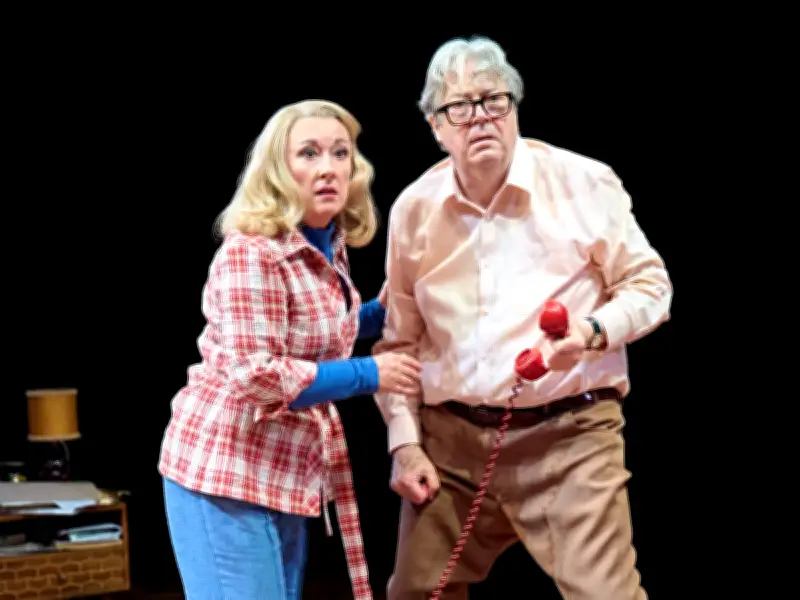
Alan Ayckbourn's 1969 farce 'How the Other Half Loves' has returned to the Old Vic in a revival that is meticulously plotted and executed, yet wildly implausible and dated. The production, directed by Philip Breen, is elegantly staged in the round as originally conceived and coasts on the comic timing of Dorothy Atkinson and Roger Allam, who remains silkily hilarious despite fluffing his lines several times on opening night.
A Sitcom-ish Couple and a Liaison
Frank and Fiona Foster (Allam and Atkinson) are a recognisably sitcom-ish couple. Frank is a blithe, bumbling managerial figure; Fiona is the irritated and overdressed 'her indoors', greeting his maundering anecdotes with a basilisk stare. She has conducted a liaison with his younger underling Bob Phillips (Rowan Polonski) on their wedding anniversary.
Bob is a jack-the-lad type with a new baby and his own aggravated wife Teresa (Ayesha Antoine). The socially stratified living and dining rooms of the two couples are enmeshed on Rob Howell's set, one defined by avocado starters and sherry, the other by beer and soup. Fiona and Bob make frantic attempts to phone each other while standing side by side, invariably getting the other's other half, until they finally connect and concoct a cover story: they will claim to have been out with Bob and Frank's colleague William Featherstone and his wife Mary, hearing how their marriage has been rocked by infidelity.
Implausible Premises and Dated Tropes
The improbabilities begin here. It makes sense, kind of, for the paternalistic Frank to try to mend the Featherstones' fictitious rupture over a dinner party. But there is no reason on earth that Teresa would invite them – two people she barely knows – the following night, except that the central conceit requires the Featherstones to simultaneously inhabit two buttock-clenchingly awkward suppers on consecutive evenings, swivelling between crossed dining tables like goalies in a game of table hockey.
Ayckbourn often defines his characters by a single trait for comic purposes: Frank's vagueness, Fiona's acid frustration. Adam Gillen's William is a ferociously uptight control freak who has turned his wife Mary (Laura Elsworthy) into a cringing jelly, for whom the simplest act – taking off her gloves, accepting a drink – provokes shrieking paroxysms of anxiety. The mechanics of the second half depend on her unbelievable decision to visit the Phillips's house the day after dinner has descended into marital warfare, and the abandoned, leering Bob's similarly nonsensical decision to bully her into drudgery.
The play presents itself as a subversion of late-60s patriarchal norms by serving up a relentless diet of sexist tropes and then delivering a half-hearted, you-go-girl redemption speech for Mary at the end. Frank's urbane, lordly manner is of a piece with Bob's cocky priapism and William's clenched and domineering manner, epitomised by the little scolding smacks he gives Mary's hand for perceived social faux pas. When Fiona asks him how he'd react if his wife cheated on him, he replies: 'Hit her, perhaps.' One can argue that Ayckbourn was reflecting attitudes of the time, but the gender politics leave a rancid taste.
Craftsmanship vs. Authenticity
While the linear dynamics of the Featherstone and Phillips marriages are steadily ramped up throughout, the Fosters exist in a state of queasy stasis, Frank endlessly distracted from finding out the truth. Allam and Atkinson excel at both the physical comic business of farce and the verbal gymnastics of misunderstanding and non-sequitur, while the other four are stuck in increasingly frantic gurning. The action doesn't spring from the personalities here: rather, character is retroactively dictated by the levers of the plot. There's a cruelty to the way these people are manipulated and put through the emotional wringer. One can admire the chilly precision of Ayckbourn's stagecraft, but the play lacks the ring of authenticity. Runs to 19 Sept at oldvictheatre.com.