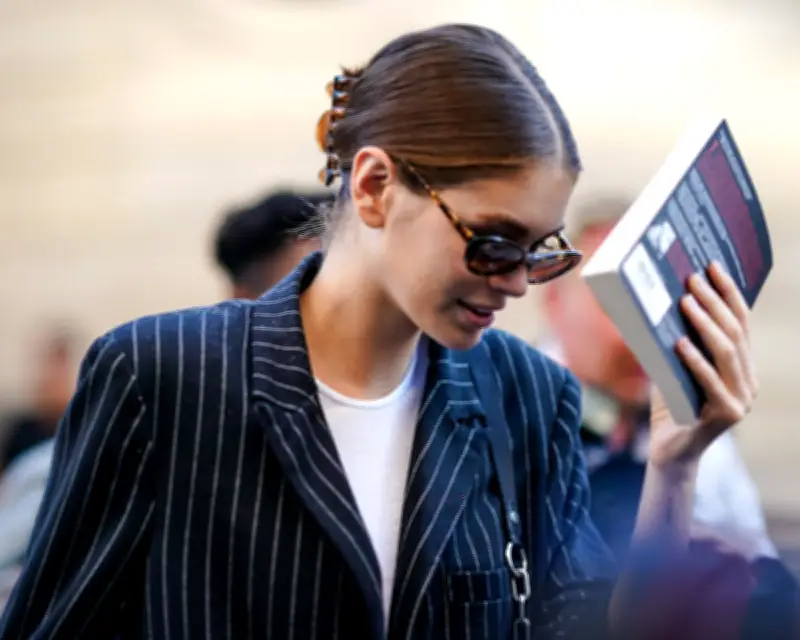
From celebrity book clubs to the revival of the edgy literary party, being a book lover is in. Dior has launched new versions of their Book Tote emblazoned with the covers of classics such as Ulysses and Dracula. Earlier this year, Coach collaborated with Penguin to produce miniature literary bag charms – fully readable micro-versions of books, from I Know Why the Caged Bird Sings to Sense and Sensibility. Miu Miu hosts a Literary Club; Chanel its Rendez-vous littéraire.
The rise of the 'hot literati'
Being bookish is now sexy, we’re told. i-D magazine recently ran a piece on the Whitney Review – a literary journal based in New York – proclaiming its team part of the “hot literati reshaping criticism”. The founder describes the Review as “sexy, surprising, stubborn”, and its contributors “curious and beautiful” (corroborated by an accompanying shoot in which the Whitney team look more like a bunch of models than anything else). But the piece raised eyebrows in the comments section of i-D’s Instagram page: “the definition of vacuous and vapid”, writes one user; “No room for ugly literati, only HOT”, says another.
Should we be sceptical?
Writer and content creator Sihaam Naik believes reading has become “hot” because of the economic pressures faced by young people today: “Gen Z is a generation that will probably never be able to own houses, and so we’re more aligned with investing in taste. So you buy books, art books and niche ephemera to set yourself apart from peers or signal your taste.”

Celebrity book clubs may also be driving the trend, says Naik: the likes of Dua Lipa, Kaia Gerber and Reese Witherspoon share books by “writers who need their platform … It works so well, but it’s just unfortunate as a sign of the times”, reinforcing the idea that “something is only worth sharing online if you are conventionally attractive.” Focusing on how someone looks when reading as opposed to how they engage critically with the text inadvertently creates a new, exclusionary barrier around literary culture – you must be hot to take part.
BookTok and Bookstagram influence
The trend no doubt has its origins in BookTok and Bookstagram, on which creators share aesthetically pleasing reading spaces, shelves full of beautiful books and special editions. Book creator Sol Noya (@booksconleche on Instagram) thinks that the trend is a good thing, “a welcome change from past stereotypes of readers being dull or odd, particularly given that there are still very significant percentages of the population that barely read for leisure at all.” According to YouGov polling conducted last January, 40% of Britons had not read or listened to a book in the prior year.
“Reading has a positive impact on critical thinking and empathy, which are two traits society needs desperately. So in that sense, reading being ‘in’ is something I’m in favour of,” she continues. However, she says the aestheticisation of reading focuses far too much on consumption; reading as a new form of “subtle wealth signalling”. “Having a huge book collection implies having the cash to spend on buying the books and space to store them.”
A positive side?
Yet, in an age in which younger people are trying to find ways to disengage from the internet and go analogue, there is a positive in having role models who encourage buying and reading books. Bookstagrammer Diana Clough (@literarydiana) tells the Guardian: “opting for analogue media over our phones is something we should wear with pride and feel sexy about – however genuine that might be.”
“Visibly engaging with the written word stakes our claim in the joy of reading, reclaiming the narrative of it being a reclusive act. And it can very much be hot, as the popularity of romantasy attests to. If reading is trendy, then it will only encourage more readers, which is never a bad thing.”
Naik, however, is a little more cynical: “I’m glad to see people treat bookworms and reading as worthy of being cool again, but is it a fleeting trend, and are we going to dunk on it next year? Who knows!”