Dulwich Picture Gallery in London is hosting the first exhibition in Britain of the complete Thirty-Six Views of Mount Fuji by Katsushika Hokusai. The show, which runs from 20 October to 17 January, presents the series as a single long meditation on the sacred mountain, with the iconic Great Wave reinterpreted as a symbol of ephemeral chaos against the enduring peak.
The Great Wave: A Monster of the Moment
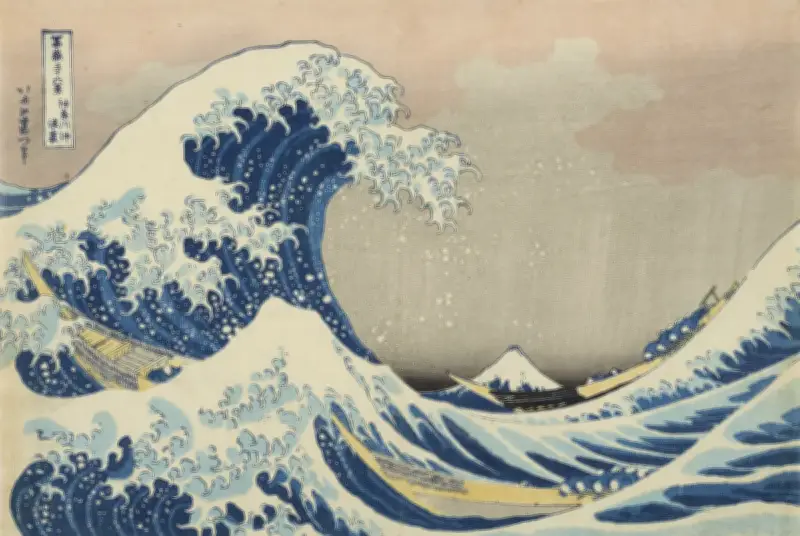
Three different impressions of Under the Wave off Kanagawa, widely known as the Great Wave, reveal the violence of the scene. The foaming summit of the wave towers over helpless rowers in long thin boats, its crackling claws appearing hungry to swallow human flesh. The wretched people are the emotional heart of the picture, their imminent risk of drowning its whole point.
Hokusai, a devout Buddhist, offers consolation: the wave looks vast as a mountain but soon will break and be gone, while Mount Fuji endures eternally. The mountain, not the wave, is the hero of the masterpiece. The wave is an illusion; Mount Fuji is the truth.
Perspectives on the Sacred Peak
Hokusai delights in epic shifts of perspective, often showing Fuji as a small, distant object while the foreground fills with distracting action. In Fuji from Kanaya on the Tōkaidō Highway, travellers are carried across the Ōi River by bearers, a crossing that was a key military point for Edo, so no bridges were allowed. No one in the scene looks at the mountain.
Other images show people actively seeking the view, like tourists and pilgrims who trek to a country teahouse in winter to see Mount Fuji in the snow, rewarded with an icy scene of devastating beauty. A ferryman rows across a river under a golden evening sky, some passengers looking at the peak, others not.
Global Influence and Modernist Echoes
Hokusai's miracle colour, Prussian blue, came from Europe, and his knowledge of perspective was also coloured by European art. But the traffic of influence went both ways. The series, created in the early 1830s, reinvented landscape art as a conceptual and symbolic meditation, becoming the first global masterpiece.
Van Gogh, Whistler and other European avant-garde artists collected and emulated Japanese woodblock prints. The review notes that Cézanne's repeated efforts to paint Mont Sainte-Victoire, fragmenting its rocky mass into shards of perception, echo Hokusai's journey around Mount Fuji. Monet's obsessive paintings of Rouen Cathedral, a haystack and his waterlily garden also reflect Hokusai's influence. Hokusai taught these Frenchmen to see landscape as metaphysical.
Timeless Inspirations
Individual images from the series have become icons, such as Ejiri Station, Province of Suruga, depicting people holding their hats as the sky fills with blown paper. Jeff Wall famously restaged it in his photograph A Sudden Gust of Wind (After Hokusai).
The review concludes that focusing on separate images distorts Hokusai's meaning; they must be seen as part of one long meditation on Mount Fuji, the godlike summit that shows there is serenity beyond the chaos.