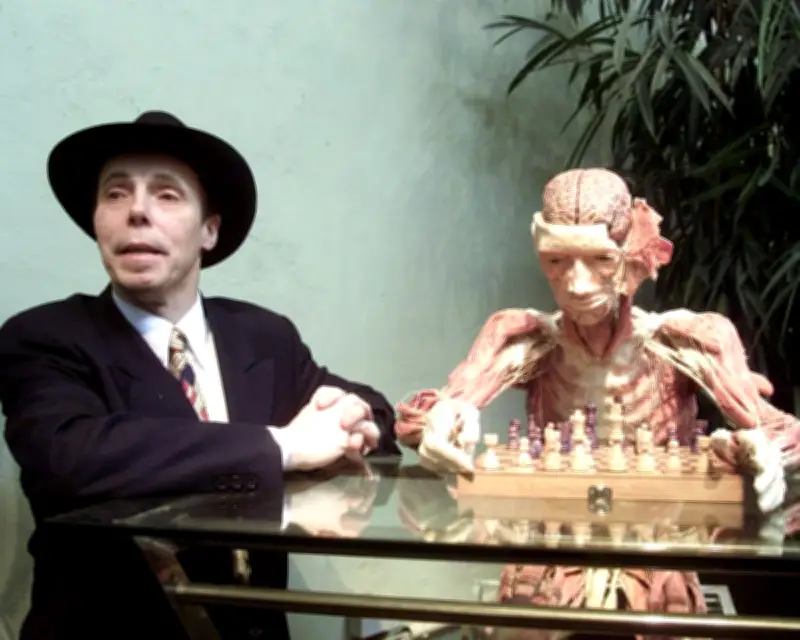
Gunther von Hagens, the inventor of plastination, will be remembered as the man who killed off 1990s shock art. He certainly plastinated any reputation Damien Hirst had as a disturbing artist of mortality.
When this German scientist turned showman made a popular bloodsplash around the world in the latter half of the 90s, Hirst was still pickling sheep, sharks and pigs and displaying them as philosophical specimens. Other artists also played with carnality and horror, from endoscopy videos to model landscapes filled with Nazi atrocities. But it was just art. Then along came Von Hagens with his Body Worlds exhibitions, using plastination to perfectly preserve dissected bodies. He did what Hirst and co never dared: he displayed actual human corpses as a kind of grisly but purportedly educational art object.
The Race to the Bottom
Edmund Burke, the 18th-century politician and aesthetician, pointed out that if you told a theatre audience watching a tragic drama there was a public hanging outside, everyone would flock to the hanging. To put it another way, the art of horror is a race to the bottom. When Von Hagens offered the public real dead people to gawp at, opened up and preserved in the blood-red flesh, he drew global crowds in the millions, leaving the Hirst generation looking like an elite sideshow. He even staged a live, televised autopsy in London in 2002, reviving the kind of gory spectacle William Hogarth satirised in his print The Reward of Cruelty, which depicts the dissection of a hanged criminal.

The difference is that Hogarth sees something monstrous in the cold eyes of the anatomists as they cut up a judicially killed man and even let a dog eat his entrails. That’s the difference between art and plastination. Von Hagens didn’t invite thoughts about mortality. He instead treated human flesh as cheap and meaningless material to be arranged in poses out of old anatomy books. The author stated: "In all honesty I found Body Worlds repellent."
Historical Precedents
Von Hagens, however, had an impeccable pedigree for what he did: he was a professor with a long association with Germany’s prestigious Heidelberg University. And of course the frontier of art and science he exploited has a long and gruesome history. Leonardo da Vinci and Michelangelo both carried out their own dissections of human bodies. Michelangelo wanted to understand muscles in order to portray nude bodies better: surviving records of his anatomies are quite literally sketchy. Leonardo, however, had true scientific ambition and was years ahead of university doctors in his stunning drawings and notes that dig into every part of the human machine from the brain to the genitals, the foetus to the eye. His infinitely subtle observations make the body’s goriest secrets beautiful.
A closer model for Von Hagens is Andrea Vesalius, the first "modern" anatomist whose 1543 book the Fabrica is illustrated with prints thought to have been made by a pupil of Titian. Its combination of sculptural poses and flayed horror has a lot in common with Body Worlds: in the frontispiece an avid (male) audience watch as Vesalius calmly cuts open a (female) corpse.
The Wax and Bone Traditions
After that, the art of anatomy got increasingly "real" and disturbing. In the 18th and 19th centuries Italian art skills produced uncanny replicas of anatomised human bodies in wax, meticulously copying colours and textures, supposedly in the service of science. La Specola, the natural history museum of Florence, lets you visit its vast collection of these hyperreal eviscerated bodies to look at and learn from until you feel sick.
Gunther von Hagens brought this tradition into our time but also made it seem too natural, as if death could be rationalised away. At La Specola, the weirdness is explicit – you know this is odd, macabre stuff to be looking at. Body Worlds has a false acceptance that treats death as nothing to get emotional about.

This acceptance of mortality also has its artistic precedents, not least in the use of bones to create spectacular ossuaries in many parts of Europe. In the crypt of the church of Santa Maria della Concezione in Rome you can see the bones of thousands of Capuchin friars arranged in an artistic manner that might have made Ed Gein blush – there’s a grotto of skulls, a chamber of thigh bones. The Marquis de Sade was stunned. You leave with a sense of disgust and confusion, wondering why they did it, and why you went.
Art vs. Plastination
At the opposite pole there is Rembrandt’s Anatomy Lesson of Dr Nicolaes Tulp, in which the body being dissected is seen as an infinite mystery, the pale ghost of us all. Artists, from Leonardo and Rembrandt to the young Hirst, have glimpsed the enigma of life in the relics of death. But Gunther von Hagens was no artist.