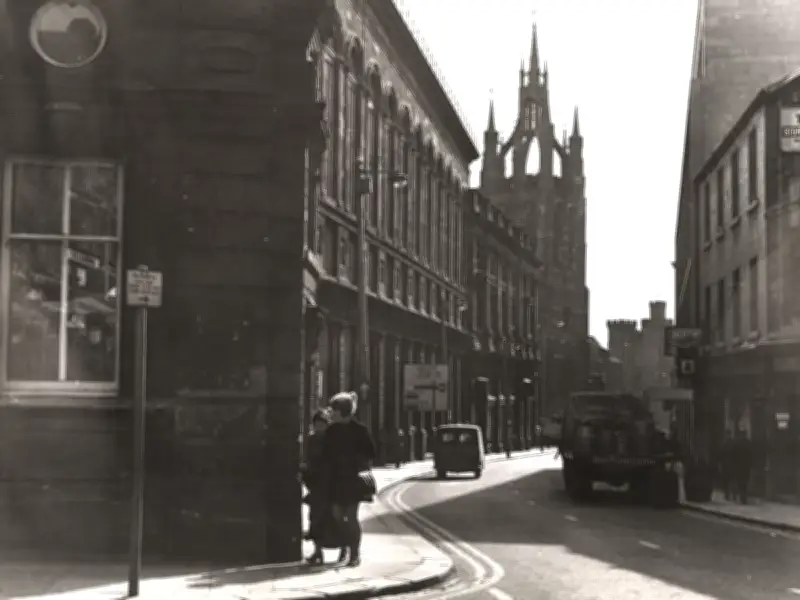
A photograph by Laszlo Torday looks down Newcastle’s Groat Market in the mid-to-late 1960s, six decades before the same city-centre view was captured in 2026.
Landmarks and lost buildings
In the distance stand three buildings that form the historic essence of the city: St Nicholas’ Cathedral (now Newcastle Cathedral), the Black Gate and the Castle Keep (now Newcastle Castle). On the left is part of the old Town Hall, long gone; on the right, a Bass Charrington lorry is unloading barrels of beer at a pub. Behind it rises Thomson House, recently opened as the headquarters of Newcastle Chronicle and Journal.
The Groat Market took its name from the crushed oats once sold at the location, trading alongside the nearby Bigg and Cloth Markets and a cluster of other medieval markets that lined this stretch of the old Great North Road.
The rise and fall of the Town Hall
The Town Hall was built in 1858 and served as Newcastle’s seat of local government from the mid-19th century until the opening of the new Civic Centre in the late 1960s. Its ground floor was devoted to shops, banking offices and a hotel; another floor became a music hall capable of accommodating up to 2,400 people. The council chamber was on the first floor, facing St Nicholas’.
The building would soon become one of Newcastle’s most unloved. Dr Collingwood Bruce dismissed it as “a huge pile of buildings of modern erection which greatly impedes the traffic of the street and almost totally obscures the view of St Nicholas’.”
A 1965 report noted: “Newcastle’s old Town Hall is a monstrosity to begin with, but now derelict, dilapidated and filthy, it’s a nightmare.” The building was finally demolished in 1973 and replaced by One Cathedral Square, a period-style office, shop and leisure complex.
Thomson House and the newspaper era
Thomson House was officially opened by Prime Minister Harold Wilson in May 1965, after the Evening Chronicle and its sister titles vacated their former Victorian-built home, just around the corner on Westgate Road. The new complex was hailed as one of the most sophisticated newspaper offices in the world.
A brochure produced at the time said: “The news of the North and of the whole world pours in night and day. By telephones from our reporter ‘out on a story’ at Consett or Carlisle, Benton or Berwick. By radio from the correspondent in Cairo or Connecticut, Berlin or Bangkok. The pictures, too, flow in. It is all channelled here. The excitement, the urgency never let up.”
At its peak, between 900 and 1,000 people were employed there. In a much-changed media landscape, the company moved out of the Groat Market building after 53 years in 2018 and transferred to premises in Eldon Square more suited to its 21st-century digital operation.
What comes next
In 2024, it was reported that the former Thomson House had been sold to the Scotsman Group, a hotel and leisure operator. The next chapter in the long evolution of Newcastle’s historic Groat Market is still to be written.